

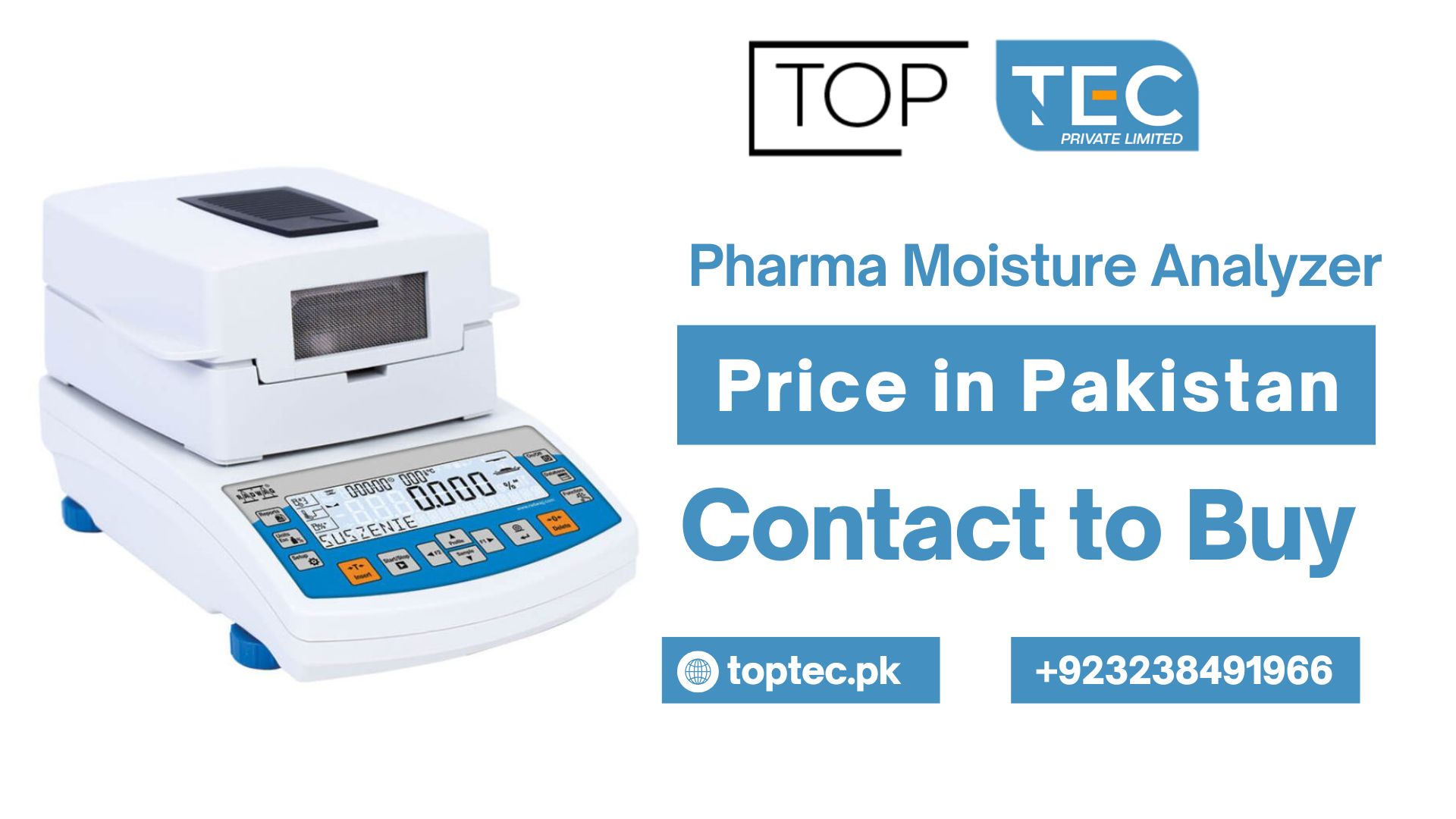
Discover precision pharma moisture analyzers designed for fast, accurate QC testing of powders, APIs, and excipients. Compare halogen, infrared, and Karl Fischer models from top manufacturers to ensure GMP and USP compliance
Moisture content is one of those pharmaceutical quality parameters that sits quietly in the background of almost every manufacturing decision — and then becomes the center of attention when something goes wrong.
A tablet batch that doesn’t compress properly because the granulation moisture is slightly off. An antibiotic powder that degrades faster than expected because the water activity is higher than the specification allows. A capsule fill that clumps during production because the excipient moisture content wasn’t verified before blending. A stability study that produces unexpected results because moisture control during manufacturing wasn’t as tight as assumed.
Every one of these scenarios has cost pharmaceutical manufacturers real money, real batch losses, and real regulatory problems. And in almost every case, the right moisture measurement equipment — properly selected, properly operated, and properly integrated into the manufacturing process — would have caught the problem before it became a failure.
This is why the decision to buy Pharma Moisture Analyzer equipment deserves more serious attention than it often gets in pharmaceutical facility planning conversations. It’s not a peripheral analytical tool. It’s a critical quality parameter measurement system that touches raw material testing, in-process monitoring, finished product release, and stability assessment.
This guide covers the complete picture — measurement technologies, equipment selection criteria, top model categories, moisture analyzer price in Pakistan realities, and how to build the complete analytical environment that makes your moisture measurement reliable and compliant.
Why Moisture Matters So Much in Pharmaceutical Manufacturing
Before diving into analyzer technology, it’s worth being specific about why moisture control is so consequential in pharmaceutical manufacturing. Different products and processes have different moisture sensitivities, and understanding the specific risks in your operation clarifies what measurement capability you actually need.
Chemical Stability
Water participates in hydrolysis reactions that degrade many pharmaceutical active ingredients. Beta-lactam antibiotics — penicillins, cephalosporins — are particularly moisture-sensitive, with hydrolysis of the beta-lactam ring directly reducing potency. Aspirin hydrolyzes to acetic acid and salicylic acid in the presence of moisture. Many other APIs show accelerated degradation at elevated moisture content.
The relationship between moisture content and chemical stability is the primary reason pharmaceutical products have moisture specifications — and why moisture analyzer for pharma applications needs to be accurate enough to detect meaningful variations in moisture content, not just gross differences.
Physical Properties
Moisture affects the physical properties of pharmaceutical materials in ways that directly impact manufacturing process performance:
Granulation: Moisture content of wet granulations determines compressibility in tablet compression. Too wet and the granulation sticks to punches; too dry and tablets are friable.
Powder flow: Moisture affects interparticle forces in powder blends, with significant effects on flow behavior and blend uniformity. Excessive moisture causes powder bridging and clumping.
Capsule fill weight: Hygroscopic excipients absorb moisture between batches, changing their bulk density and affecting capsule fill weight consistency.
Tablet hardness and disintegration: Moisture content of compressed tablets affects hardness development during curing and disintegration time in dissolution testing.
Microbiological Risk
Water activity — the availability of free water in a pharmaceutical product — determines the ability of microorganisms to grow. Products with water activity above approximately 0.6 can support mold growth; above 0.85, bacterial growth becomes possible. Pharmaceutical products must maintain water activity below thresholds that prevent microbiological contamination during shelf life.
Regulatory Requirements
ICH Q6A guidelines specify moisture as a universal test for solid oral dosage forms. Pharmacopeial methods — particularly USP <921> Water Determination and USP <731> Loss on Drying — define acceptable measurement approaches. DRAP product registrations specify moisture limits for pharmaceutical products that must be verified during batch release.
The Main Measurement Technologies — Understanding What You’re Evaluating
When you start researching to buy Pharma Moisture Analyzer equipment, you’ll encounter several different measurement technologies. Understanding what each actually measures and how helps you evaluate which is appropriate for your specific applications.
Loss on Drying (LOD) — Thermogravimetric Analysis
The most common pharmaceutical moisture analyzer approach in routine laboratory use. The sample is weighed, heated to drive off volatile content (primarily moisture), and reweighed. The weight loss expressed as percentage of original weight is the “loss on drying.”
LOD analyzers come in two main forms:
Oven-Based LOD: Traditional approach using a drying oven and analytical balance. Sample is dried in an oven at specified temperature for a defined time, then weighed after cooling in a desiccator. Accurate and widely accepted pharmacopeially, but slow — often several hours per determination — and requires manual operations that introduce variability.
Halogen Moisture Analyzers: Combine an analytical balance with a halogen heating unit in a single instrument. Sample is placed on the balance pan, the halogen lamp heats the sample, and the instrument continuously monitors weight loss, displaying moisture percentage in real time and indicating when the endpoint is reached. Results in minutes rather than hours.
Halogen moisture analyzers have largely replaced oven-based methods for routine QC applications because they’re faster, more convenient, and highly reproducible. The moisture analyzer price in Pakistan for quality halogen instruments is accessible for most pharmaceutical QC budgets, making them the standard choice for routine moisture analyzer for pharma applications.
Limitations of LOD methods: LOD measures everything that’s volatile at the drying temperature — not just water. If your pharmaceutical formulation contains volatile excipients (certain flavoring agents, volatile solvents) that evaporate during drying, LOD will overestimate true water content. For most pharmaceutical formulations this isn’t a significant issue, but for some specialized products it requires consideration.
Karl Fischer Titration — Specific Water Measurement
Karl Fischer titration is the pharmacopeial gold standard for pharmaceutical water determination — USP <921> is specifically the Karl Fischer method. Unlike LOD, Karl Fischer titration specifically measures water — not other volatile components.
The Karl Fischer reaction uses iodine to oxidize water in a stoichiometric reaction. By measuring the iodine consumed (in coulometric KF) or the volume of standardized iodine reagent required (in volumetric KF), the water content is calculated with high precision.
Volumetric Karl Fischer: Uses a standardized iodine solution as the titrant. Appropriate for samples with moderate to high water content — typically 0.1% and above. Most versatile KF approach for pharmaceutical applications.
Coulometric Karl Fischer: Generates iodine electrochemically at the anode during the titration. Extremely sensitive — capable of measuring water content at ppm levels (below 0.1%). Appropriate for very dry samples or when very low moisture levels must be measured with precision.
For pharmaceutical applications where absolute water content is required — API raw material testing, finished product release, stability studies — Karl Fischer titration is often the required or preferred method. Many product specifications specifically reference the Karl Fischer method.
The moisture analyzer price in Pakistan for Karl Fischer titrators spans from accessible entry-level instruments to sophisticated automated systems with multiple measurement modes. The right level of investment depends on your sample throughput, moisture range requirements, and whether automation is justified by your testing volume.
Near-Infrared (NIR) Spectroscopy
NIR spectroscopy uses the absorption of near-infrared light by molecular bonds — particularly O-H bonds in water — to quantify moisture content. The technique is non-destructive, rapid (results in seconds), and can be applied to intact tablets, powder blends, or other pharmaceutical materials without sample preparation.
NIR moisture measurement requires calibration against reference samples with known moisture content. Once calibrated, it provides rapid measurement appropriate for:
- At-line or online process monitoring during tablet compression or granulation
- Rapid non-destructive testing of finished products
- High-throughput raw material screening
NIR instruments represent the highest moisture analyzer price in Pakistan in the analytical category — the technology is sophisticated and the instruments are complex. But for pharmaceutical manufacturers with high-volume moisture testing or process analytical technology (PAT) requirements, NIR provides capability that thermogravimetric or titrimetric methods cannot match.
Microwave Resonance Technology
Microwave-based moisture analyzers measure the dielectric properties of materials — water has distinctly different dielectric properties from dry pharmaceutical excipients. These instruments can measure moisture in seconds and are suitable for at-line or online applications.
Less common in Pakistani pharmaceutical laboratories than LOD or Karl Fischer methods, but increasingly relevant as pharmaceutical manufacturers implement process analytical technology strategies.
Selecting the Right Technology for Your Application
This is where generic moisture analyzer guides often fall short — recommending one technology for all applications rather than helping you match technology to your specific situation. Here’s an honest framework:
Routine QC Release Testing of Solid Dosage Forms
For testing tablets, capsules, granulations, and powders as part of batch release QC, halogen LOD moisture analyzers are the practical choice for most applications. They’re fast, reproducible, and don’t require chemical reagents. If your product specification was established using LOD methodology, halogen LOD instruments give you direct comparability.
When you buy Pharma Moisture Analyzer equipment for general pharmaceutical QC use, a quality halogen instrument with good temperature uniformity, adequate balance precision (0.1mg or better), and appropriate maximum sample weight (typically 5-50g for pharmaceutical applications) covers most routine requirements.
API Raw Material Testing
Many API specifications require Karl Fischer titration specifically — the method is referenced in the specification and pharmacopeial monograph. For API testing, Karl Fischer titration isn’t optional. A volumetric KF titrator handles most API water content ranges. If you test APIs with very low water content — below 0.1% — coulometric KF capability may also be needed.
Hygroscopic Products and Formulations
Products that absorb moisture rapidly during testing present challenges for any LOD method — the sample is gaining moisture from the environment faster than the instrument can measure. For highly hygroscopic materials, Karl Fischer titration in a controlled-humidity environment, or a closed-vessel sample introduction system, provides more reliable results than open-pan LOD measurement.
Process Monitoring Applications
If your goal is at-line or online moisture monitoring during manufacturing — during granulation, coating, or blending — NIR or microwave technology is the appropriate approach. Traditional LOD or KF methods are too slow and too sample-intensive for real-time process monitoring.
Stability Studies
Stability samples require moisture measurement that accurately reflects changes in water content over the storage period. For stability studies, Karl Fischer titration provides the specificity and precision that stability data reliability requires. Some stability protocols specify Karl Fischer methodology explicitly.
Key Specifications to Evaluate for Pharma Applications
When comparing pharmaceutical moisture analyzer instruments from different suppliers and evaluating moisture analyzer price in Pakistan across options, these specifications actually matter for pharmaceutical applications:
Measurement Range and Resolution
What moisture percentage range does the instrument measure? At what resolution? Pharmaceutical applications typically need measurement in the 0.01-30% range depending on the product type, with resolution of 0.01% or better for most QC applications.
Balance Precision (for Halogen LOD)
The moisture calculation depends on accurately measuring the weight loss. Balance precision of 0.1mg (0.0001g) is standard for pharmaceutical-grade halogen moisture analyzers. Lower precision balances produce less reliable results for small samples or small moisture changes.
Temperature Accuracy and Uniformity (for Halogen LOD)
The heating element temperature must accurately reach and maintain the set temperature, and that temperature must be uniform across the sample pan. Temperature non-uniformity causes incomplete drying in some areas while potentially overheating others. Look for instruments with temperature accuracy within ±2°C and documented temperature uniformity across the sample pan.
Drying Programs and Temperature Range
Different pharmaceutical materials require different drying temperatures and programs. Some materials require step-wise temperature programs — gentle heating first to avoid surface sealing (case hardening) before bulk moisture is driven off. Temperature range of 50-230°C with programmable profiles covers most pharmaceutical applications.
Sample Capacity
Maximum sample weight determines how large a sample you can test. Larger samples improve representativeness for heterogeneous materials. Minimum sample weight relates to balance sensitivity and measurement precision at low moisture levels.
Data Output and Documentation
GMP documentation requirements mean your pharmaceutical moisture analyzer must provide printable or transferable result records. Built-in printers, RS232/USB data output for LIMS connection, electronic result storage — these features support 21 CFR Part 11 compliance and GMP batch record documentation.
GMP/21 CFR Part 11 Compliance Features
User access control, audit trail, electronic signatures, method storage and protection — these features are increasingly expected in regulated pharmaceutical laboratory instruments. For facilities working toward DRAP GMP compliance or FDA-regulated manufacture, these compliance features are necessary rather than optional.
Calibration Support
What internal calibration standards are available? Is external calibration possible? What calibration documentation does the instrument provide? These questions are important for analytical instrument qualification in pharmaceutical QC laboratories.
Top Model Categories for Pharmaceutical Applications
Rather than specific model recommendations that go out of date rapidly, here’s a framework for understanding the model categories relevant to different pharmaceutical applications:
Entry-Level Pharmaceutical Halogen Moisture Analyzers
Appropriate for small pharmaceutical QC laboratories, contract testing facilities with moderate throughput, and facilities where moisture testing is important but not the primary analytical workload. These instruments provide adequate accuracy for most routine pharmaceutical moisture testing with the basic documentation features needed for GMP compliance.
The moisture analyzer price in Pakistan for entry-level pharmaceutical-grade instruments is accessible for most QC laboratory budgets while providing genuine pharmaceutical-grade performance.
Mid-Range Pharmaceutical Halogen Analyzers
More sophisticated temperature control, better balance precision, more extensive data management and GMP compliance features, and often expanded connectivity for LIMS integration. Appropriate for pharmaceutical manufacturers with moderate to high moisture testing throughput and formal GMP qualification requirements.
This is the category most Pakistani pharmaceutical manufacturers end up in when they buy Pharma Moisture Analyzer equipment for primary QC use.
High-End Pharmaceutical Halogen/Infrared Analyzers
Sophisticated instruments with advanced temperature uniformity, multiple measurement modes, comprehensive 21 CFR Part 11 compliance, sophisticated data management, and often research-grade balance precision. Appropriate for pharmaceutical companies with demanding specifications, complex materials, or regulatory requirements that necessitate the highest measurement performance.
Entry-Level Karl Fischer Titrators
Volumetric KF instruments for API testing and other applications where specific water measurement is required. Basic functionality — manual titration operation, simple result display, basic documentation. Appropriate for laboratories with modest KF testing volumes.
Automated Karl Fischer Titrators
Motorized burettes, automated endpoint detection, sophisticated result calculation, GMP compliance features, and often automated sample introduction. For pharmaceutical QC laboratories with significant KF testing volume, automation significantly improves throughput and reduces operator variability.
Research-Grade Karl Fischer Systems
Combination volumetric/coulometric systems, oven sample introduction for solid samples without dissolution, sophisticated software with advanced compliance features. Appropriate for pharmaceutical development, stability testing facilities, and high-specification QC operations.
Moisture Analyzer Price in Pakistan — Honest Assessment
The moisture analyzer price in Pakistan ranges significantly across instrument types and specification levels. Here’s an honest framework:
Halogen Moisture Analyzers
The most accessible moisture analyzer price in Pakistan in the pharmaceutical category. Entry-level pharmaceutical-grade instruments are within reach for most QC laboratory budgets. Mid-range instruments with better GMP compliance features represent meaningful but justified investment for established pharmaceutical manufacturers. High-end instruments reflect the engineering sophistication they provide.
Karl Fischer Titrators
Generally more expensive than comparable-specification halogen instruments due to the chemical measurement system complexity. Basic volumetric KF instruments are accessible; automated systems with full GMP compliance features represent substantial laboratory investment. The specific moisture analyzer price in Pakistan depends heavily on automation level and compliance features.
NIR Moisture Analyzers
The highest moisture analyzer price in Pakistan in the moisture measurement category. These are sophisticated spectroscopic instruments that require significant initial investment plus calibration development time and expertise. Appropriate for large pharmaceutical manufacturers with specific PAT or high-throughput requirements.
What drives price differences between instruments:
Balance precision and stability. Temperature accuracy and uniformity. Software sophistication and GMP compliance features. Data management and connectivity. Automation level for KF instruments. Build quality and expected operational lifespan.
Import considerations:
Most pharmaceutical moisture analyzers available in Pakistan are imported. Import duties, shipping, and currency exchange exposure all affect the effective moisture analyzer price in Pakistan. Established laboratory equipment suppliers with proper import channels typically offer better effective pricing than individual import procurement.
TOPTEC Scientific — Building the Analytical Environment Your Moisture Analyzer Needs
Here’s something that comes up consistently in pharmaceutical laboratory setups: the quality of the analytical environment around your instruments affects the quality of your analytical results as directly as the instrument specifications.
A moisture analyzer sitting on an unstable, vibrating workbench produces less reliable results than the same instrument on a stable, anti-vibration analytical bench. An instrument positioned in a high-humidity corner of the laboratory will produce systematically different results from one in a properly humidity-controlled environment. A laboratory with poor organization and inadequate storage creates workflow problems that compromise both efficiency and result reliability.
This is where TOPTEC Scientific becomes directly relevant to your moisture analyzer for pharma investment.
TOPTEC Scientific is a Pakistan-based manufacturing company producing high-specification laboratory furniture and equipment for pharmaceutical QC laboratories, analytical research facilities, and industrial testing operations throughout Pakistan. Everything they manufacture is produced locally — with all the practical advantages this brings for Pakistani customers: faster delivery, direct technical communication, no import complications, local installation support, and pricing that makes sense for Pakistani laboratory budgets.
For pharmaceutical laboratories investing in moisture measurement capability, TOPTEC Scientific manufactures the complete analytical environment infrastructure:
Anti-Vibration Analytical Balances Benches
Moisture analyzers incorporating precision balances — particularly halogen LOD instruments — require stable, vibration-free bench surfaces for accurate measurements. TOPTEC Scientific manufactures dedicated analytical balance benches with anti-vibration features, appropriate weight capacity, and smooth surfaces that support accurate weighing operations.
Positioning your pharmaceutical moisture analyzer on a properly specified analytical bench rather than a standard laboratory workbench improves measurement reproducibility — particularly for small samples where small weight differences translate to significant moisture percentage variations.
Laboratory Workbenches with Chemical Resistance
For Karl Fischer titrator setups — where reagent handling involves iodine solutions, methanol, and other KF reagents — chemical-resistant bench surfaces protect the furniture and maintain the clean, uncontaminated bench surface that accurate titration requires. TOPTEC Scientific manufactures laboratory workbenches with epoxy resin, phenolic resin, or stainless steel tops appropriate for different chemical environments.
Humidity-Controlled Enclosure Support
Highly hygroscopic samples require moisture testing in controlled-humidity environments — either a humidity-controlled room or a local enclosure with humidity control. TOPTEC Scientific manufactures enclosure and cabinet furniture that supports these controlled environment requirements.
Desiccator Storage Cabinets
Pharmaceutical samples awaiting moisture testing — particularly hygroscopic materials — should be stored in desiccated conditions to prevent moisture pickup between sampling and analysis. TOPTEC Scientific manufactures desiccator storage cabinets and organized storage solutions for analytical sample management.
Fume Hoods for Karl Fischer Reagent Handling
Karl Fischer reagents — particularly the iodine-containing titrant solutions — require fume hood handling for operator safety. TOPTEC Scientific manufactures ducted fume hoods with appropriate airflow performance and chemical-resistant interior surfaces for analytical chemistry laboratory environments.
Conducting Karl Fischer titrations in a properly specified fume hood protects operators from reagent vapor exposure and provides consistent local environmental conditions that improve titration reliability.
QC Laboratory Benching Systems
Complete QC laboratory benching — integrated workbench systems with appropriate storage, overhead shelving, service connections for electrical supply, and organized instrument positioning — supports efficient analytical workflow and maintains the organized laboratory environment that GMP compliance requires.
TOPTEC Scientific designs and manufactures complete laboratory benching systems that integrate multiple analytical instruments — moisture analyzer, analytical balance, dissolution tester, pH meter — in logical, ergonomically designed analytical workstations.
Sample Storage and Management Systems
Pharmaceutical QC laboratories manage large numbers of raw material, in-process, and finished product samples alongside reference standards and retention samples. Properly specified sample storage — organized, labeled, under appropriate environmental conditions — is a GMP requirement that TOPTEC Scientific‘s storage furniture solutions support.
Pass-Through Systems
For pharmaceutical facilities where samples move between production environments and QC laboratories under controlled conditions, TOPTEC Scientific manufactures pass-through boxes appropriate for different environmental zone boundaries.
Documentation and Computer Workstations
Modern pharmaceutical QC laboratories increasingly use computerized systems for analytical data management. Dedicated computer workstations adjacent to analytical instruments — properly specified for the laboratory environment, with appropriate cable management and ergonomic design — support efficient data entry and result management workflows.
The comprehensive local manufacturing capability of TOPTEC Scientific means you can source your complete QC laboratory infrastructure from a single local supplier who understands pharmaceutical laboratory requirements, delivers without import delays, and provides local support when furniture modifications or additions are needed.
Qualifying Your Moisture Analyzer for GMP Use
For pharmaceutical manufacturers, simply purchasing and installing a pharmaceutical moisture analyzer isn’t the end of the process — it’s the beginning. Before the instrument can be used for GMP-critical testing, it must be qualified.
Installation Qualification (IQ)
Documents that the instrument was installed correctly in the intended location with appropriate utilities, environmental conditions, and supporting infrastructure. Covers instrument identification, location, utility connections, and confirmation of receipt of documentation.
Operational Qualification (OQ)
Verifies that the instrument performs correctly across its operating range. For a halogen moisture analyzer, this includes verifying temperature accuracy across the operating range, balance linearity and repeatability, and correct operation of all instrument functions. Calibration with certified weights and temperature standards is part of OQ.
Performance Qualification (PQ)
Demonstrates that the instrument consistently produces results within acceptable limits under actual use conditions. Typically involves testing reference standards or certified moisture reference materials and demonstrating that results meet defined acceptance criteria.
Method Validation
For pharmaceutical testing, the analytical method used with your moisture analyzer for pharma must be validated according to ICH Q2(R1) guidelines — demonstrating accuracy, precision, specificity, linearity, range, and robustness appropriate for the intended use.
Reputable pharmaceutical moisture analyzer suppliers provide IQ/OQ documentation support and certified calibration standards. When you buy Pharma Moisture Analyzer equipment for pharmaceutical QC use, confirming qualification documentation support is as important as confirming instrument specifications.
Common Mistakes When Buying Pharmaceutical Moisture Analyzers
These patterns come up regularly when pharmaceutical manufacturers make moisture analyzer purchasing decisions they later regret:
Selecting LOD when Karl Fischer is required
Some pharmaceutical product specifications — particularly for APIs — specifically require Karl Fischer methodology. Using an LOD method to test a KF-specified parameter isn’t just less accurate — it’s non-compliant. Always confirm which method your product specifications require before selecting instrument type.
Underestimating throughput requirements
A moisture analyzer that takes 10-15 minutes per determination creates a testing bottleneck if your QC laboratory tests moisture on 20+ samples per day. Calculate your daily testing volume and match instrument throughput capability accordingly.
Ignoring GMP documentation features
Buying a technically accurate instrument without the GMP compliance features — user access control, audit trail, method protection, electronic result records — creates compliance problems in pharmaceutical QC applications. These features need to be confirmed before purchase, not after.
Positioning instruments in inappropriate environments
High-humidity locations, vibration-prone areas, temperature-unstable positions — all of these degrade moisture analyzer performance. Instrument positioning and the surrounding analytical environment matter for result quality.
Skipping qualification activities
Using an unqualified instrument for GMP-critical testing is a DRAP inspection finding. Equipment qualification activities need to be planned and executed before the instrument enters routine use.
Not planning for the surrounding analytical environment
Investing in a quality pharmaceutical moisture analyzer and positioning it on an inadequate workbench in a poorly organized laboratory undermines the investment. Plan the complete analytical environment — including furniture from TOPTEC Scientific — alongside the instrument itself.
Closing Thoughts
The decision to buy Pharma Moisture Analyzer equipment for your pharmaceutical manufacturing or QC operation is an investment in product quality that shows up across your entire manufacturing process — in better-controlled granulations, more consistent tablet compression, more reliable product stability, and cleaner regulatory compliance.
The moisture analyzer price in Pakistan that represents genuine value accounts for measurement technology appropriate to your specific applications, specification levels that meet your accuracy and GMP documentation requirements, qualification documentation support, and supplier capability that extends beyond the initial sale into ongoing calibration support and technical assistance.
And the analytical environment around your pharmaceutical moisture analyzer — the benches, fume hoods, storage systems, and complete QC laboratory infrastructure — needs to match the standard of your instrument investment. TOPTEC Scientific manufactures this complete infrastructure locally in Pakistan, with direct technical support and comprehensive capability to properly equip pharmaceutical QC laboratories.
Moisture measurement done right protects your products, your patients, and your regulatory compliance. Invest in it accordingly.
For analytical balance benches, chemical-resistant laboratory workbenches, fume hoods, QC laboratory benching systems, sample storage solutions, and complete pharmaceutical laboratory furniture manufactured locally in Pakistan, contact TOPTEC Scientific — equipping Pakistan’s pharmaceutical laboratories with properly specified, locally manufactured analytical infrastructure.
