

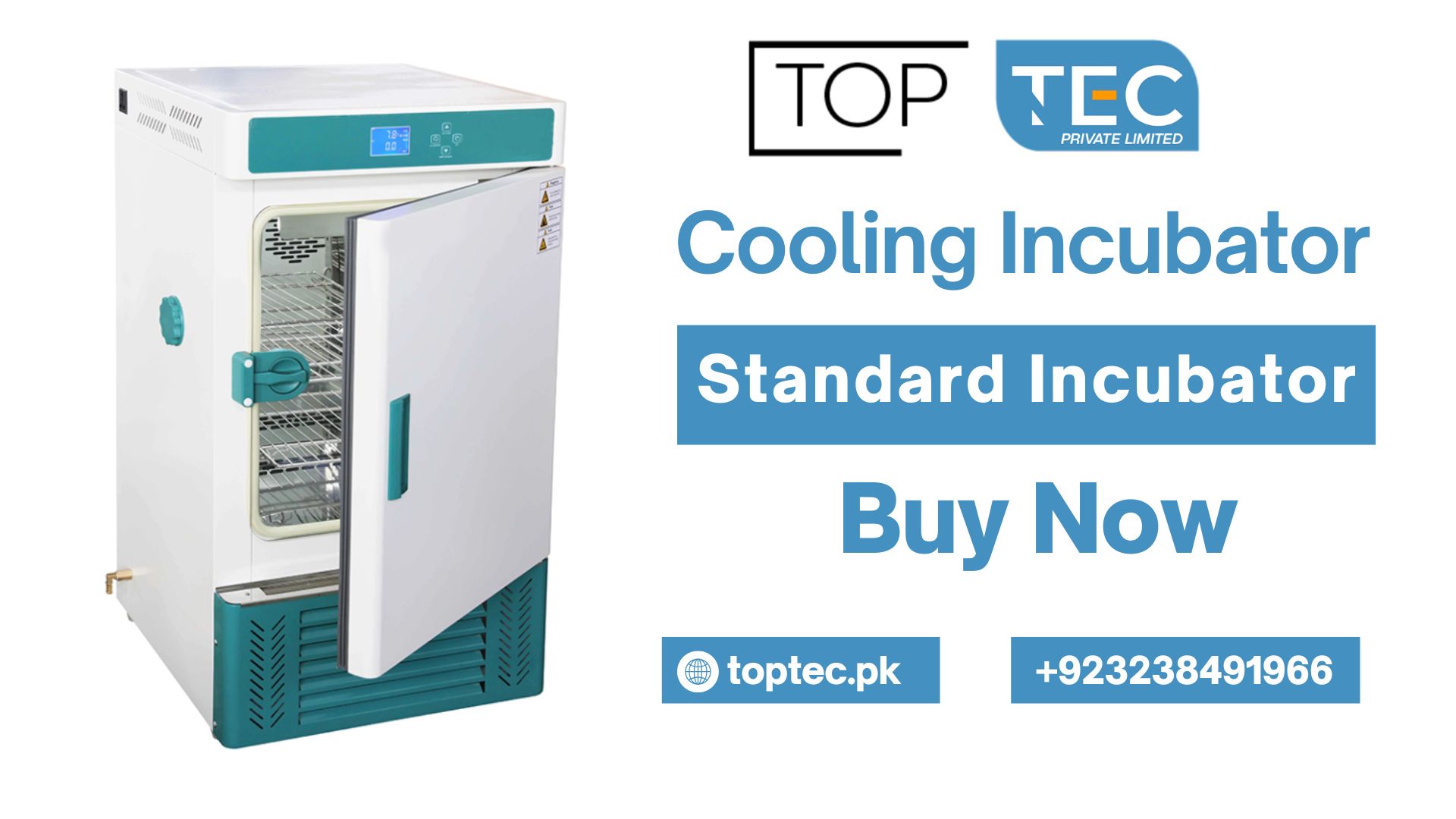
What is the main difference of Cooling Incubator vs. Standard Incubator? At first glance, a standard laboratory incubator and a refrigerated model seem to perform the same job. Both create a controlled chamber where samples can be held at a selected temperature. The important difference appears when the required temperature is close to—or below—the temperature of the room.
A standard incubator mainly heats. A refrigerated unit can heat and actively cool. That distinction matters in laboratories where room conditions change with the season, power usage or HVAC performance.
Before you buy cooling incubator equipment, identify the lowest temperature your method requires and compare it with the highest expected room temperature. The cooling incubator Price in Pakistan will usually be higher than that of a heating-only unit because refrigeration adds a compressor or thermoelectric system, insulation, sensors and additional controls.
The Short Answer
Choose a standard incubator when all approved methods operate safely above room temperature. Typical examples include routine bacterial cultures at 35–37°C and microbiological work at 30°C.
Choose a refrigerated model when the chamber must operate:
- Below room temperature
- Very close to room temperature
- At a stable 20–25°C during hot weather
- Across programmed heating and cooling stages
- For BOD, yeast, fungal or environmental work
- With temperature-sensitive samples
If you plan to buy cooling incubator equipment only because it appears more advanced, stop and examine the methods first. Extra capability adds purchase cost, maintenance and energy use. At the same time, the cooling incubator Price in Pakistan may be justified when failure to maintain a low set point could invalidate test results.
What Is a Standard Laboratory Incubator?
A standard incubator is an insulated chamber with an electrical heater, temperature sensor and controller. It may use natural convection or a fan to distribute heat.
Most heating-only models operate from a few degrees above ambient temperature to approximately 60–80°C, depending on the design. The phrase “above ambient” is critical. If a room reaches 30°C, a heating-only chamber cannot reliably maintain 25°C because it has no active way to remove heat.
Standard incubators are commonly used for:
- Bacterial cultures
- Microbial plate incubation
- Pharmaceutical microbiology
- Clinical laboratory cultures
- Food testing
- Culture-media studies
- Enzyme reactions
- General temperature-controlled storage
They are mechanically simple and usually cost less to operate. There is no refrigeration compressor, so servicing is generally easier and noise levels are lower.
What Is a Refrigerated Incubator?
A refrigerated incubator combines heating with active cooling. Depending on the design, cooling is provided by a vapour-compression system or thermoelectric Peltier modules.
Laboratories often buy cooling incubator models when they need stable conditions below ambient temperature or when room temperatures vary enough to affect a heating-only system.
The equipment may be used for:
- Biochemical oxygen demand testing
- Yeast and fungal cultivation
- Environmental microbiology
- Plant and seed research
- Insect studies
- Enzyme stability work
- Shelf-life experiments
- Temperature-sensitive culture storage
- Sample conditioning
- Controlled research at 15–25°C
The cooling incubator Price in Pakistan depends partly on how low the chamber can operate under actual ambient conditions. A model that reaches 10°C below room temperature is not equivalent to one that maintains 4°C independently of normal seasonal temperature changes.
Cooling Incubator vs. Standard Incubator: Comparison Table
| Feature | Standard incubator | Refrigerated incubator |
|---|---|---|
| Main function | Heating | Heating and active cooling |
| Typical lower limit | Several degrees above ambient | Below or near ambient |
| Typical upper limit | Around 60–80°C | Often around 50–60°C |
| Cooling mechanism | None | Compressor or Peltier |
| Energy use | Lower | Higher |
| Noise | Usually low | Compressor or fan noise may occur |
| Maintenance | Relatively simple | Refrigeration servicing may be needed |
| Purchase cost | Lower | Higher |
| Typical applications | Bacteria, routine microbiology | BOD, fungi, yeast and environmental work |
| Room-temperature sensitivity | High at low set points | Better control near ambient |
The comparison should be based on the complete operating range, not only the maximum temperature. When you buy cooling incubator equipment, ask for performance data at the intended room temperature. This is also important when comparing the cooling incubator Price in Pakistan, since cheaper units may offer a more limited cooling range.
Why Room Temperature Matters So Much
Suppose a laboratory needs to incubate samples at 25°C. During winter, the room remains at 20°C, and a standard incubator heats comfortably to the set point. During summer, the same room rises to 30°C. The chamber can no longer remain at 25°C because its heater can stop adding heat, but it cannot remove the heat already entering from the room.
This problem is common in laboratories where HVAC is not operated continuously or where room conditions change during power interruptions.
A refrigerated system removes excess heat and continues controlling the chamber near the required set point. That makes it the safer choice for methods where temperature excursions would alter growth, metabolism or test validity.
When a Standard Incubator Is the Better Choice
A standard unit remains the practical choice for many laboratories. There is no reason to pay for refrigeration if it does not support the intended method.
Choose a heating-only incubator when:
- Every method operates comfortably above ambient temperature
- The laboratory mainly cultivates bacteria at 30–37°C
- Room temperature remains well below the lowest set point
- Energy efficiency is a priority
- Quiet operation is important
- Maintenance resources are limited
- The unit will be used for routine microbiological work
A standard incubator is generally easier to qualify because the system contains fewer components. It is also less likely to produce internal condensation during low-temperature operation.
When Active Cooling Is Necessary
The decision to buy cooling incubator equipment is usually justified when a method operates below 25°C or close to the highest anticipated room temperature.
Typical situations include:
BOD Testing
Biochemical oxygen demand analysis commonly uses incubation at 20°C. In many Pakistani laboratories, room temperatures exceed 20°C for much of the year, making active cooling necessary.
Yeast and Fungal Cultivation
Many yeast and fungal methods use temperatures between 20°C and 30°C. Refrigeration helps maintain these conditions consistently during warm weather.
Environmental Studies
Soil organisms, aquatic microorganisms, insects and plant materials may require temperature conditions below normal room temperature.
Stability and Shelf-Life Work
Some research protocols involve holding samples at several temperatures or using programmed changes. A heating-only unit cannot perform a downward temperature stage without help from the surrounding room.
Temperature-Sensitive Reactions
Enzyme and biochemical studies may require precise control near ambient temperature, where an ordinary heated chamber becomes vulnerable to room fluctuations.
When planning these applications, review the cooling incubator Price in Pakistan against the cost of repeated studies, failed controls and unreliable seasonal results.
Compressor Cooling vs. Peltier Cooling
Not every refrigerated model uses the same technology. The cooling system affects performance, noise, energy use and servicing.
Compressor-Based Refrigeration
A compressor system works much like a laboratory refrigerator. Refrigerant circulates through the compressor, condenser, expansion device and evaporator to remove heat from the chamber.
Advantages include:
- Strong cooling capacity
- Better performance at low temperatures
- Suitability for larger chamber volumes
- Faster recovery after door opening
- Reliable operation under heavier thermal loads
Possible disadvantages include:
- Compressor noise
- Higher energy use
- More mechanical parts
- Refrigerant servicing
- Heat release into the laboratory
Before you buy cooling incubator equipment with compressor refrigeration, confirm that trained local technicians and compatible refrigerant are available. Compressor design is one factor that can noticeably change the cooling incubator Price in Pakistan.
Peltier Cooling
Peltier systems use solid-state thermoelectric modules. Applying an electrical current creates a temperature difference across the module, allowing heat to be moved away from the chamber.
Advantages include:
- No refrigerant
- Low mechanical noise
- Fewer moving parts
- Fine temperature control
- Lower vibration
Limitations may include:
- Lower cooling capacity
- Slower recovery
- Reduced efficiency in large chambers
- Strong dependence on room temperature
- Higher cost for powerful multi-module systems
Peltier models often suit smaller chambers and applications that need moderate cooling rather than very low temperatures.
Natural Convection vs. Forced Air Circulation
Standard and refrigerated incubators may use either natural convection or forced-air circulation.
Natural Convection
Warm air rises naturally, creating circulation without a fan.
Benefits include:
- Quiet operation
- Less air movement across samples
- Reduced risk of drying exposed materials
- Fewer mechanical components
The trade-off is slower temperature recovery and potentially greater variation across the chamber.
Forced-Air Circulation
A fan moves conditioned air throughout the chamber.
Benefits include:
- Faster recovery after door opening
- Better temperature uniformity
- More consistent performance with a full load
- Quicker heating and cooling
Strong airflow may increase evaporation from uncovered samples. Shelves and containers should also be arranged so that air passages are not blocked.
Temperature Accuracy, Uniformity and Stability
A digital display showing 20.0°C does not prove that every point inside the chamber is actually at 20.0°C.
Three specifications need to be understood:
Accuracy
Accuracy is the difference between the displayed temperature and a traceable reference measurement.
Uniformity
Uniformity describes temperature variation between different positions inside the chamber. Corners, shelves and areas near the door may behave differently.
Stability
Stability describes how much temperature fluctuates at one position over time.
A laboratory preparing to buy cooling incubator equipment should request data for all three parameters. The cooling incubator Price in Pakistan may be higher for models with better insulation, multiple sensors and a well-designed air-distribution system.
Performance should also be assessed under load. An empty-chamber test does not show how the unit behaves when shelves are filled with bottles, plates or sample containers.
Capacity and Chamber Layout
Do not choose the equipment by total litres alone. Internal width, height, shelf spacing and door clearance affect how much useful material the unit can actually hold.
Before you buy cooling incubator equipment, record:
- Number of samples per batch
- Container dimensions
- Required shelf spacing
- Airflow clearance
- Maximum loaded weight
- Future workload growth
- Frequency of door opening
Overloading the chamber restricts airflow and creates hot or cold spots. Samples should not touch internal walls or block supply and return vents.
A larger chamber may increase the cooling incubator Price in Pakistan, but buying an undersized unit can lead to overcrowding, repeated batches and unnecessary door openings.
Condensation and Humidity
Cooling air below its dew point causes moisture to condense. Water may appear on chamber walls, shelves or the inner door, especially when warm, humid room air enters during door opening.
Condensation can lead to:
- Microbial growth
- Corrosion
- Wet labels
- Sample contamination
- Slippery internal surfaces
- Unstable humidity conditions
Good operating practice includes:
- Limiting door openings
- Wiping up condensation promptly
- Checking the drain system
- Avoiding warm, uncovered liquids
- Inspecting door gaskets
- Following the cleaning schedule
- Allowing the chamber to recover before repeated access
A standard heating-only incubator generally has fewer condensation problems because it normally operates above room temperature.
Shaking and Lighting Options
Some refrigerated models include orbital shaking. Others offer programmable lighting for algae, plant or insect research.
If shaking is required, check:
- Orbit diameter
- Speed range
- Speed accuracy
- Platform dimensions
- Maximum load
- Flask clamps
- Imbalance protection
- Heat generated by the drive mechanism
If lighting is required, review:
- Light intensity
- Day/night programming
- Heat contribution
- Spectrum
- Shelf-level uniformity
The decision to buy cooling incubator equipment with shaking or lighting should be driven by actual protocols. These options can add significantly to the cooling incubator Price in Pakistan and may reduce usable chamber space.
Controls, Alarms and Data Logging
Useful control features include:
- High- and low-temperature alarms
- Door-open alarm
- Power-failure alarm
- Independent over-temperature protection
- Automatic restart settings
- Password-protected set points
- Programmable temperature stages
- USB or Ethernet data export
- Internal event history
- Remote alarm contact
For overnight or weekend studies, remote alarms can prevent an unnoticed refrigeration failure from ruining an entire experiment.
Before you buy cooling incubator systems for regulated work, review how records are stored and whether settings can be changed without authorisation. More advanced controls may increase the cooling incubator Price in Pakistan, but they can simplify investigations and support data integrity.
Qualification and Calibration
In pharmaceutical, clinical and controlled research environments, both equipment types should be included in the calibration and qualification program.
Installation Qualification
IQ may verify:
- Make, model and serial number
- Installation location
- Electrical supply
- Shelves and accessories
- Ventilation clearance
- Refrigerant details
- Manuals and certificates
Operational Qualification
OQ may include:
- Temperature accuracy
- Temperature uniformity
- Controller operation
- Timer accuracy
- Alarm tests
- Door-switch function
- Over-temperature protection
- Cooling and heating performance
- Power-failure response
Performance Qualification
PQ should demonstrate acceptable performance with a representative load. Temperature mapping is often performed with calibrated sensors placed throughout the chamber.
When you buy cooling incubator equipment for GMP use, request IQ/OQ support and calibration information before issuing the purchase order.
Maintenance and Operating Costs
A standard incubator usually requires cleaning, temperature calibration, gasket inspection and occasional heater or fan servicing.
A refrigerated model may additionally require:
- Condenser cleaning
- Compressor inspection
- Refrigerant checks
- Evaporator maintenance
- Drain cleaning
- Defrost inspection
- Condenser-filter replacement
- Cooling-performance verification
The cooling incubator Price in Pakistan is only the initial cost. Energy consumption, replacement parts, calibration, servicing and possible compressor repairs should be included in the total ownership calculation.
For reliable operation:
- Keep condenser vents clear
- Maintain the required wall clearance
- Do not place the unit near ovens or direct sunlight
- Inspect door seals regularly
- Clean spills immediately
- Avoid unnecessary door openings
- Record abnormal noise or long recovery times
Cooling Incubator Price in Pakistan
The cooling incubator Price in Pakistan varies according to chamber volume, cooling technology, temperature range, brand and control features. Since most systems are imported, exchange rates and taxes also affect quotations.
The following figures are broad estimates:
| Equipment type | Typical configuration | Indicative price range |
|---|---|---|
| Standard heated incubator | Basic digital control | PKR 180,000–800,000 |
| Compact refrigerated model | Small chamber, basic cooling | PKR 600,000–1,800,000 |
| Mid-size refrigerated model | Forced air and programmable control | PKR 1,500,000–4,000,000 |
| Large floor-standing model | High capacity and data logging | PKR 3,500,000–8,000,000 |
| Refrigerated shaking model | Orbital platform included | PKR 2,000,000–10,000,000+ |
| Premium specialised model | Lighting, CO₂ or advanced controls | PKR 6,000,000–20,000,000+ |
These values are indicative and should not be treated as current supplier quotations.
When you buy cooling incubator equipment, ask whether the price includes delivery, shelves, stabiliser, installation, calibration and qualification documents.
The final cooling incubator Price in Pakistan should be compared using complete working packages rather than the base instrument alone.
Questions to Ask the Supplier
Before approving a purchase, ask:
- What is the guaranteed temperature range at the stated room temperature?
- Is cooling compressor-based or thermoelectric?
- What are the accuracy, stability and uniformity values?
- Were these values measured with an empty or loaded chamber?
- How quickly does the chamber recover after door opening?
- What is the usable internal volume?
- How many shelves are included?
- What alarms and data outputs are available?
- Is installation included?
- Is temperature mapping available?
- What is covered by the warranty?
- Are compressor and control-board parts available locally?
- Is IQ/OQ documentation included?
- What is the expected delivery time?
Laboratories that buy cooling incubator equipment should obtain these answers in writing. A proper comparison of the cooling incubator Price in Pakistan must also account for service availability and spare parts.
Laboratory Furniture from TOPTEC PVT. LTD
A benchtop refrigerated unit requires a rigid, level and properly sized work surface. Floor-standing models need clear access, nearby sample-preparation space and adequate ventilation around the condenser.
TOPTEC PVT. LTD manufactures laboratory furniture in Pakistan for pharmaceutical companies, hospitals, universities and research laboratories.
Before you buy cooling incubator equipment, TOPTEC can help plan:
- Reinforced instrument benches
- Chemical-resistant workbenches
- Sample-preparation tables
- Stainless-steel worktables
- Storage cabinets
- Laboratory sinks
- Mobile trolleys
- Reagent shelving
- Cleanroom furniture
The cooling incubator Price in Pakistan usually does not include supporting furniture, so the workstation should be included in the project budget.
TOPTEC can customise bench dimensions, load capacity, storage and cable routing around the selected instrument. Refrigerated units should not share a bench with analytical balances, microscopes or other vibration-sensitive equipment.
Frequently Asked Questions
Can a standard incubator maintain 20°C?
Only if the room remains sufficiently below 20°C. A heating-only unit cannot reliably maintain a set point below the surrounding temperature.
Does a refrigerated model also heat?
Most models can both heat and cool within their stated operating range. Verify the exact specification before purchase.
Which option is better for bacterial culture?
For routine bacteria grown at 30–37°C, a standard incubator is usually adequate. Refrigeration is useful if the protocol includes lower temperatures.
Which option is better for BOD testing?
A refrigerated model is generally required because BOD testing commonly uses 20°C, which may be below room temperature.
Is Peltier cooling better than compressor cooling?
Neither is universally better. Peltier systems are quiet and refrigerant-free, while compressor systems generally provide stronger cooling for larger chambers.
Does refrigeration control humidity?
Not necessarily. Cooling may reduce moisture in the air and cause condensation, but humidity is not controlled unless the equipment includes a dedicated humidity system.
Is a voltage stabiliser recommended in Pakistan?
It may be advisable where the electrical supply is unstable. Confirm the manufacturer’s voltage tolerance and supplier recommendation.
Final Thoughts
The difference between a standard incubator and a refrigerated model comes down to heat removal. A standard unit can raise the chamber above room temperature. A refrigerated unit can actively remove heat and maintain conditions below or close to ambient temperature.
Choose a standard incubator for routine work at temperatures comfortably above the laboratory environment. Choose active cooling for BOD testing, fungi, yeast, environmental studies and any method that must remain stable during warm seasonal conditions.
When you buy cooling incubator equipment, verify the working range at actual room temperature, chamber uniformity, recovery time, alarms and local service support. Compare the complete cooling incubator Price in Pakistan, including shelves, installation, calibration, qualification and maintenance.
For reinforced instrument benches, sample-preparation workstations and complete laboratory furniture manufactured locally in Pakistan, contact TOPTEC PVT. LTD.
