

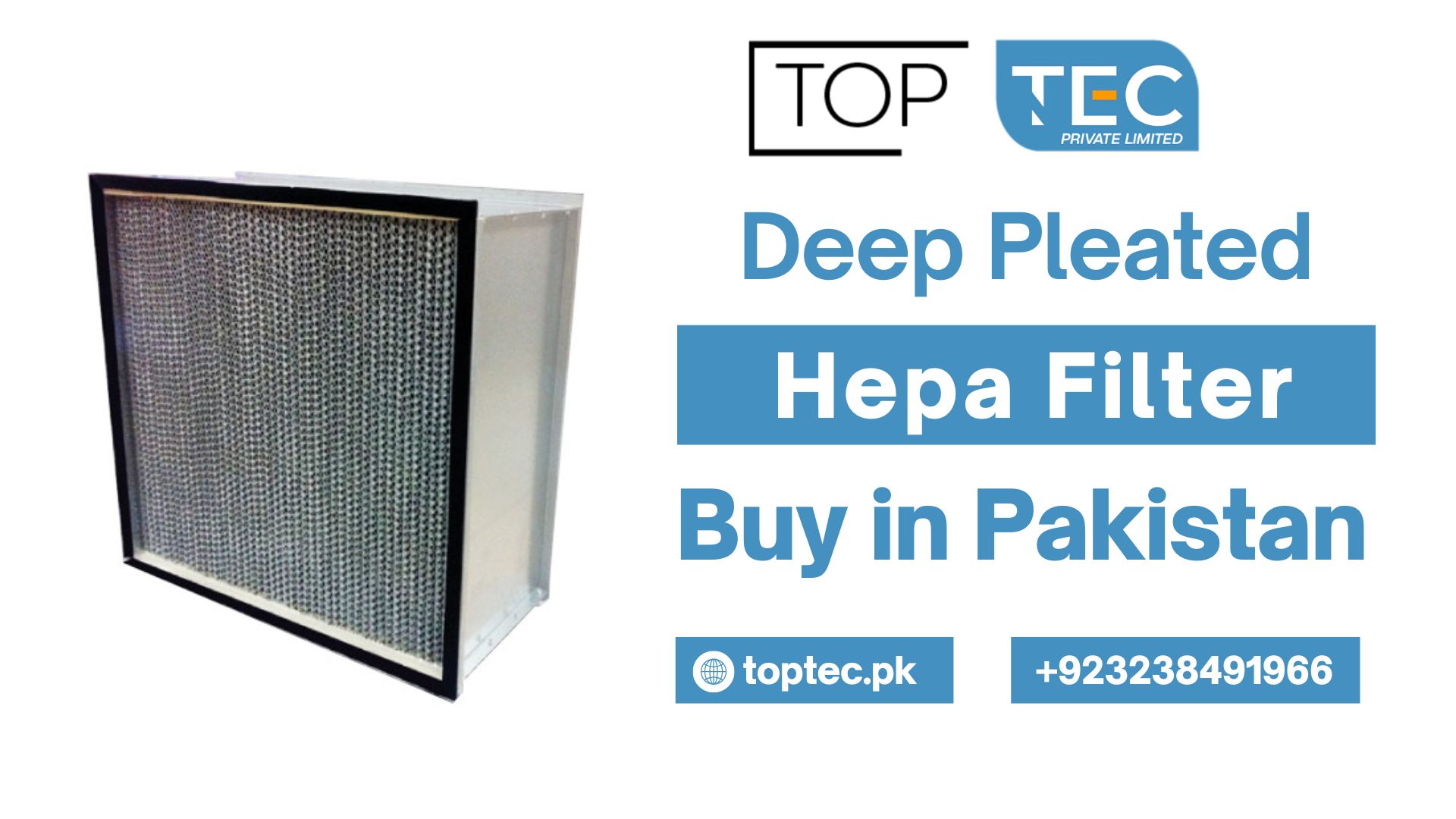
Walk into any pharmaceutical cleanroom, hospital isolation ward, or high-end electronics lab, and you’ll see stainless steel cabinets, fancy touchscreens, and people in bunny suits. But the most critical piece of equipment in that room is usually hidden inside a metal frame, doing a job nobody notices until it fails.
I’m talking about the HEPA filter.
And not just any HEPA filter. I’m talking about the Deep Pleated HEPA Filter.
Most people think a filter is a filter. It’s a sieve. You pour air in, it catches the dust, clean air comes out. If you believe that, you’re going to make some very expensive mistakes. I’ve seen cleanroom projects get derailed because someone bought the cheapest flat-panel filter they could find on Alibaba, slapped it in a cabinet, and wondered why their particle counts were through the roof.
A filter isn’t just a sieve. It’s a carefully engineered piece of fluid dynamics. And if you’re serious about contamination control, you need to understand why the deep pleated design is the only one that matters for critical applications.
When you Buy Deep Pleated Hepa Filter units, you’re not just buying a mesh. You’re buying surface area, low resistance, and most importantly, reliability.
What Actually Makes It “Deep Pleated”?
Let’s kill the confusion right now. What’s the difference between a standard pleat and a deep pleat?
It’s all about geometry.
A standard pleated filter might have 30 pleats per foot. The pleats are shallow. It looks like a slight ripple. A deep pleated filter — often called a “mini-pleat” in the industry, though that term is a bit misleading — can have 60, 90, or even more pleats per foot. The pleats are tall and tightly packed.
Why does this matter? Surface area.
Imagine trying to breathe through a single straw. Hard, right? Now imagine breathing through a bundle of 50 straws. Easy.
Air is the same. If you force air through a small filter area, it has to move fast. Fast air means turbulence. Turbulence means particles bounce off the filter media instead of sticking to it. It also means the filter clogs up instantly because all the dirt is hitting one tiny spot.
A deep pleated filter folds a massive amount of filter media into a small frame. A standard 24×24 inch filter might have 40 square feet of media. A deep pleated version of the same size? It can have 80, 100, or even 120 square feet.
Double the media. Half the velocity. Twice the efficiency.
This is Rule #1. When you Buy Deep Pleated Hepa Filter units, you’re paying for that extra media. And you need it.
The Separator Debate: Aluminum vs. Paper vs. None
If you start shopping for filters, you’ll hit a wall of acronyms: AS, PS, HS. What the heck do they mean?
This refers to the separator — the material that keeps the pleats from touching each other.
Aluminum Separator (AS)
This is the old-school standard. Thin strips of aluminum foil are glued between the pleats.
- Pros: Strong, holds shape well, cheap.
- Cons: The glue can outgas (bad for sensitive electronics), the foil can corrode over time, and it’s heavy.
Paper Separator (PS)
Thin, treated paper strips.
- Pros: Lighter than aluminum, no corrosion issues.
- Cons: Can absorb moisture (swelling and deforming the pleats), not as strong.
Hot Melt Separator (HS) / No Separator
This is the modern, high-end approach. The pleats are glued together directly with a hot melt adhesive, or held by a synthetic mesh. No foil, no paper.
- Pros: Lightest weight, no outgassing, 100% incinerable (eco-friendly), very rigid.
- Cons: More expensive to manufacture.
My take? If you’re building a cabinet for pharmaceuticals or semiconductors, spend the extra money and get the Hot Melt (HS) type. When you Buy Deep Pleated Hepa Filter units for critical work, the last thing you want is aluminum foil outgassing near your wafers or drug product.
The “0.3 Micron” Myth — You Need to Understand MPPS
Everyone knows HEPA stands for “High Efficiency Particulate Air.” Everyone knows the standard is 99.97% efficiency at 0.3 microns.
But nobody knows why 0.3 microns is the standard.
Here’s the secret: 0.3 microns is the hardest size to catch.
- Big particles (>1 micron): Easy to catch. They’re heavy. They hit the fiber and stick (inertial impaction).
- Tiny particles (<0.1 micron): Easy to catch. They’re so small they bounce around like crazy (Brownian motion) and smack into fibers by accident.
- The “Most Penetrating Particle Size” (MPPS): Right in the middle, around 0.1 to 0.3 microns. They’re too small to hit hard, but too big to bounce around much. They slip right through.
This is why deep pleats win again.
Because they have so much surface area, the air velocity through the media is incredibly low. This gives those sneaky 0.3-micron particles more time to wander and get caught. A flat filter might hit 99.97% at 0.3 microns. A good deep pleated filter will hit 99.99% or better at the MPPS.
When you Buy Deep Pleated Hepa Filter units, look for the MPPS efficiency on the spec sheet, not just the 0.3-micron number. H13 is 99.95% MPPS. H14 is 99.995% MPPS. For pharmaceutical work, you want H14. No exceptions.
The One Test That Matters (And 90% of People Skip It)
You can have the best filter media in the world. You can have perfect pleats. But if the frame leaks, you have a $500 paperweight.
I can’t tell you how many labs I’ve walked into where the main filter was bypassing 20% of the air through gaps around the frame. The filter itself was 99.99% efficient. The system was 80% efficient.
This is why you Buy Deep Pleated Hepa Filter units that come with an individual scan test certificate.
Every single deep pleated filter should be scanned with a photometer or particle counter before it leaves the factory. They spray a challenge aerosol (like PAO or DOP) over the face and probe the edges with a sensor. If they find a leak, they seal it. If they can’t seal it, they scrap it.
If a supplier tells you “we do batch testing” or “we test randomly,” run away. You need a scan certificate for your filter. Not the batch. Yours.
Where Do You Actually Use These Things?
You don’t need a deep pleated filter for your home AC. That’s overkill. You need them where life or product quality is on the line.
1. Pharmaceutical Aseptic Filling
This is the big one. When you’re filling vials with injectable drugs, there is no margin for error. A single bacterium-carrying particle ruins a batch worth millions. The low velocity of deep pleated filters ensures that the air sweeping over your open vials is as close to particle-free as physics allows.
2. Hospital Operating Theaters (OTs)
The air coming out of the ceiling in an OT isn’t just for cooling. It’s a piston pushing contaminants away from the open wound. You need high volume, low turbulence air. Deep pleated filters deliver that.
3. Semiconductor Fabrication
A speck of dust on a silicon wafer destroys a microchip. We’re talking about particles smaller than the eye can see. The electronics industry practically invented the deep pleated filter because their tolerances are insane.
4. Biosafety Cabinets (BSCs)
Class II BSCs protect the product and the operator. The airflow patterns are complex. You need filters that can handle the resistance of the air curtain and the downflow simultaneously without collapsing. Deep pleated filters are the only choice.
Why TOPTEC PVT. LTD is Your Best Bet in Pakistan
Let’s talk logistics. You need to Buy Deep Pleated Hepa Filter units for your new lab in Lahore or Karachi. You have two options:
Option 1: Import it.
You find a supplier in China or Germany. You pay for the filter. You pay for shipping. You pay 20-30% customs duty. You pay for a freight forwarder. You wait 6-8 weeks. And when it arrives, if it’s broken, good luck getting a replacement.
Option 2: Buy from TOPTEC PVT. LTD.
TOPTEC is a Pakistani manufacturer. They don’t just import and resell; they manufacture laboratory furniture and controlled environment equipment here.
When you source from TOPTEC:
- No Customs Duty: It’s local manufacturing. The price you see is the price you pay.
- Speed: They aren’t waiting for a container ship from Shanghai.
- Support: If you have a question about gasket sealing or filter sizing, you call a local number and talk to an engineer, not a sales rep in a different time zone.
- Customization: Need a non-standard size? TOPTEC can build the cabinet around the filter you need.
I’ve seen too many projects stall because of import delays. If you’re building a lab in Pakistan, supporting a local manufacturer like TOPTEC isn’t just patriotic — it’s smart project management.
Their range includes everything you need to build a complete cleanroom:
- Laminar Flow Cabinets (Vertical and Horizontal)
- Biological Safety Cabinets (Class II)
- Pass Boxes (Static and Dynamic)
- Cleanroom Workbenches and Sinks
- And yes, the Deep Pleated HEPA Filters to go inside them.
Installation Nightmares (And How to Avoid Them)
You just spent $800 on a H14 deep pleated filter. You hand it to the contractor. He installs it. Two months later, you fail your certification.
What happened?
1. The Gasket Problem
Deep pleated filters are fragile. The pleats can be crushed easily. If you overtighten the filter clamp, you crush the pleats against the frame. You’ve just reduced your filter’s efficiency by 30%. Use a torque screwdriver. Follow the manual.
2. The “Dirty” Install
I’ve seen guys install filters in a room that’s still being drywalled. The filter is full of drywall dust before it’s even turned on. Install the filter last. After cleaning. After painting. When the room is ready.
3. Bypass Leaks
This is the silent killer. The filter is perfect. But the seal between the filter frame and the cabinet wall is garbage. Use a high-quality polyurethane gasket. Not cheap foam tape.
Maintenance: When Do You Replace It?
Here’s the million-dollar question. How often do you change it?
The old rule was “every 3 years.” That rule is dead.
You replace a deep pleated HEPA filter based on pressure drop and integrity testing.
- Pressure Gauge: Your cabinet should have a magnehelic gauge. When the pressure drop across the filter doubles (e.g., from 0.5″ w.g. to 1.0″ w.g.), it’s clogged. Change it.
- Annual Leak Test: Every year, you must do a PAO/DOP leak test. If the filter fails the leak test (a hole appears), you change it. You can’t patch a HEPA filter.
- Smell Test: If the air coming out smells like wet dog or chemicals, the carbon layer (if it has one) is saturated. Change it.
Don’t wait 3 years. In a busy pharma plant, a filter might last 18 months. In a clean electronics lab, it might last 5 years. Let the data decide.
Final Verdict: Is It Worth the Money?
A deep pleated HEPA filter costs 3x to 5x more than a standard flat filter. Is it worth it?
If you’re making sterile drugs? Yes.
If you’re doing open-heart surgery? Yes.
If you’re making microchips? Yes.
If you’re filtering air for a general office HVAC system? No. Save your money.
The deep pleated design isn’t a luxury. It’s a necessity for high-stakes work. It gives you the surface area you need to drop the velocity, the efficiency you need to hit ISO Class 5, and the rigidity you need to survive installation.
So when the time comes to spec out your project, don’t look at the price tag first. Look at the specs. Check for the MPPS efficiency. Demand the individual scan test certificate. And for the love of all that is clean, make sure you Buy Deep Pleated Hepa Filter units from a supplier who actually understands what they’re selling you.
Your product — and your patients — depend on it.
