

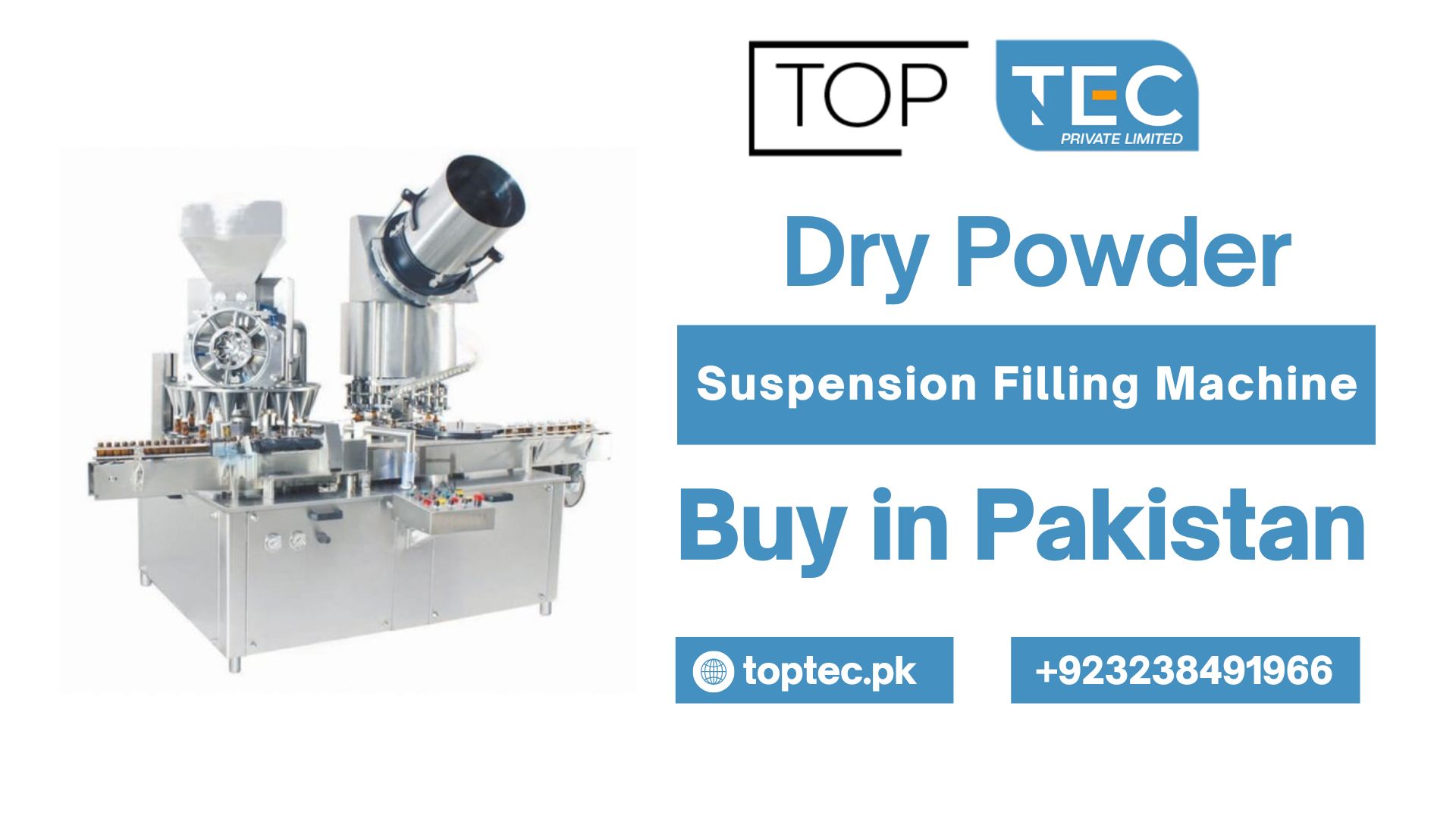
Where to buy Dry Powder Suspension Filling Machine in Pakistan? A significant proportion of them involve dry syrup formulations — antibiotic powders, antifungal suspensions, oral rehydration preparations — that get reconstituted with water just before dispensing to patients. These products exist because the active ingredients they contain are unstable in liquid form over the shelf life required for commercial pharmaceutical products. Keep them dry, and they’re stable for two to three years. Mix them with water at the point of use, and they deliver effective therapy.
The manufacturing process for these products involves filling precise quantities of dry powder into glass or plastic bottles, sealing them, and labeling them for distribution. Simple enough in concept. Genuinely demanding in execution — particularly when you’re operating at 60 bottles per minute, maintaining fill weight accuracy within tight pharmaceutical tolerances, and doing all of this in a GMP-compliant environment under DRAP oversight.
This is the world of dry powder suspension filling machine equipment. And if you’re a pharmaceutical manufacturer in Pakistan currently evaluating this investment — whether you’re setting up a new dry syrup line, replacing aging equipment, or scaling up existing production capacity — this guide is written specifically for you.
What Makes Dry Syrup Filling Technically Demanding?
Before getting into equipment specifics and Dry Powder Suspension Filling Machine price in Pakistan, it’s worth spending a moment on why this filling application is genuinely more challenging than it might initially appear.
Dry pharmaceutical powders are not cooperative materials. Unlike liquids, which flow predictably through calibrated orifices and can be measured volumetrically with high precision, dry powders have complex flow behavior that varies with:
Particle Size Distribution: Fine powders flow differently from coarse granules. Most dry syrup formulations contain multiple components with different particle sizes — APIs, excipients, flavoring agents, sweeteners — that can segregate during handling and affect fill weight consistency.
Bulk Density Variation: Powder bulk density changes with compaction, humidity, temperature, and handling history. A dry syrup powder filling machine that achieves excellent fill weight accuracy with freshly manufactured powder may perform differently with powder that’s been stored or transported. Good equipment design accommodates this variability.
Hygroscopicity: Many antibiotic powders — amoxicillin, ampicillin, cephalosporins — are hygroscopic. They absorb moisture from the air, and moisture absorption changes their flow properties and, in some cases, initiates chemical degradation. High-speed dry syrup filling operations must be conducted in controlled humidity environments, and the equipment must minimize exposure time between powder contact and bottle sealing.
Aeration and Settling: Powder handling equipment — conveyors, hoppers, transfer systems — aerates powder, increasing its volume temporarily. Settled powder in a hopper has different bulk density from freshly transferred powder. Suspension filling equipment designs must account for this aeration effect to maintain consistent fill volumes.
Dustiness: Fine pharmaceutical powders generate dust during handling. This dust is a containment problem — potentially exposing operators to pharmaceutical compounds, creating cross-contamination risks between products, and creating housekeeping challenges in the filling area. Pharmaceutical-grade dry powder suspension filling machine systems must manage dust generation as a primary design requirement.
Understanding these characteristics explains why pharmaceutical dry syrup filling requires dedicated, purpose-designed suspension filling equipment rather than generic powder filling machinery adapted from other industries.
The 60 BPM Target — What High-Speed Filling Actually Involves
Sixty bottles per minute is a meaningful production rate benchmark. At 60 BPM operating over a standard production shift with realistic efficiency, you’re producing somewhere between 20,000 and 25,000 bottles per shift — depending on your bottle size, changeover time, and routine stops for weight checks and adjustments.
For a pharmaceutical company producing dry syrup products in any significant commercial volume, this kind of throughput is the operational reality that determines whether your production economics work.
But achieving 60 BPM with pharmaceutical-grade fill weight accuracy requires engineering that goes well beyond simply speeding up the mechanical cycle:
Auger Dosing Precision at Speed
The most common dosing mechanism in dry syrup powder filling machine equipment is the auger — a precisely machined screw that rotates a controlled number of turns to deliver a defined volume of powder into each bottle. At 60 BPM, the auger completes a full filling cycle — start, rotate, stop, stabilize — in one second. Achieving consistent fill weights at this cycle speed requires precisely controlled servo drives, fast-response torque monitoring, and auger geometry matched to your specific powder characteristics.
Vibration Management
High-speed mechanical operation generates vibration. Vibration affects powder settling in hoppers, auger performance consistency, and bottle positioning accuracy during filling. Good 60 BPM dry powder suspension filling machine designs incorporate vibration isolation and damping throughout the mechanical structure rather than treating it as an afterthought.
Bottle Handling Reliability
At 60 BPM, a bottle positioning error doesn’t just affect one bottle — it can cascade through the filling station, creating multiple rejected bottles before the system detects and corrects the problem. Reliable bottle handling — infeed, positioning under the filling nozzle, and discharge — is as important as the filling mechanism itself for achieving consistent 60 BPM production.
Real-Time Weight Monitoring
Modern pharmaceutical suspension filling equipment incorporates checkweighing systems that monitor fill weights continuously during production — not just during periodic operator checks. Statistical process control algorithms detect fill weight drift before it results in out-of-specification product, triggering automatic adjustment rather than waiting for operator intervention.
Powder Replenishment Without Production Interruption
At 60 BPM, the powder hopper depletes faster than at lower speeds. Production-interrupting hopper replenishment stops hurt overall equipment efficiency significantly. High-speed dry syrup filling systems should incorporate continuous or semi-continuous powder feeding — either a large-capacity main hopper with level monitoring and alert systems, or an integrated powder transfer system that replenishes the working hopper without stopping the filling line.
Core Filling Mechanisms — Understanding What You’re Buying
The filling mechanism is the heart of any dry powder suspension filling machine, and understanding the main options helps you ask better questions when evaluating suppliers.
Auger Fill Systems
The dominant technology for pharmaceutical dry syrup filling. A vertical auger — essentially a precision-machined screw — sits in a cone-shaped hopper. The auger rotates a precisely controlled number of turns, delivering a consistent volume of powder through the filling tube into the bottle below.
Auger fill systems work well across a wide range of powder types and are particularly suited to the blended multi-component powders typical in dry syrup formulations. Fill weight accuracy depends on auger geometry (pitch, diameter, flight depth), rotation control precision, powder consistency, and the mechanical design of the powder cone and stirrer that maintain consistent powder presentation to the auger.
Pharmaceutical-grade auger filling systems use servo motors with closed-loop position control — the auger rotation is precisely commanded and verified rather than simply timed. This servo control is what enables the fill weight consistency pharmaceutical applications require.
Volumetric Cup Fill Systems
A rotating disc with precision-machined cups of defined volume. Each cup picks up a charge of powder as it passes under the hopper outlet, then delivers it into the bottle as the disc rotates. Fill weight accuracy depends on consistent powder density and complete cup filling on each cycle.
Cup fill systems are mechanically simpler than auger systems and work well with free-flowing powders. For the more cohesive, variable-density powders typical in pharmaceutical dry syrup applications, auger systems generally provide better fill weight accuracy.
Combination Systems
Some dry syrup powder filling machine designs combine volumetric pre-dosing with auger-controlled final dosing — using coarse volumetric dosing for the bulk of the fill and fine auger control for the remainder. This approach can improve throughput while maintaining fill weight accuracy for specific powder types.
The Complete Filling Line — What Comes Before and After the Filler
A dry powder suspension filling machine doesn’t operate in isolation. It’s one station in a complete filling line, and the performance of the complete line determines your actual production output and product quality.
Bottle Washing and Sterilization
Glass or HDPE bottles need to be clean and, depending on your product specification, may require ionized air cleaning to remove particulates before filling. Some dry syrup filling lines include bottle washing stations; others rely on bottles supplied from validated clean packaging suppliers.
Bottle Infeed and Orientation
An unscrambler or bottle orientation system feeds bottles in correct upright orientation to the filling line conveyor. At 60 BPM, reliable bottle orientation is essential — a tipped or inverted bottle at the filling station creates an immediate production problem.
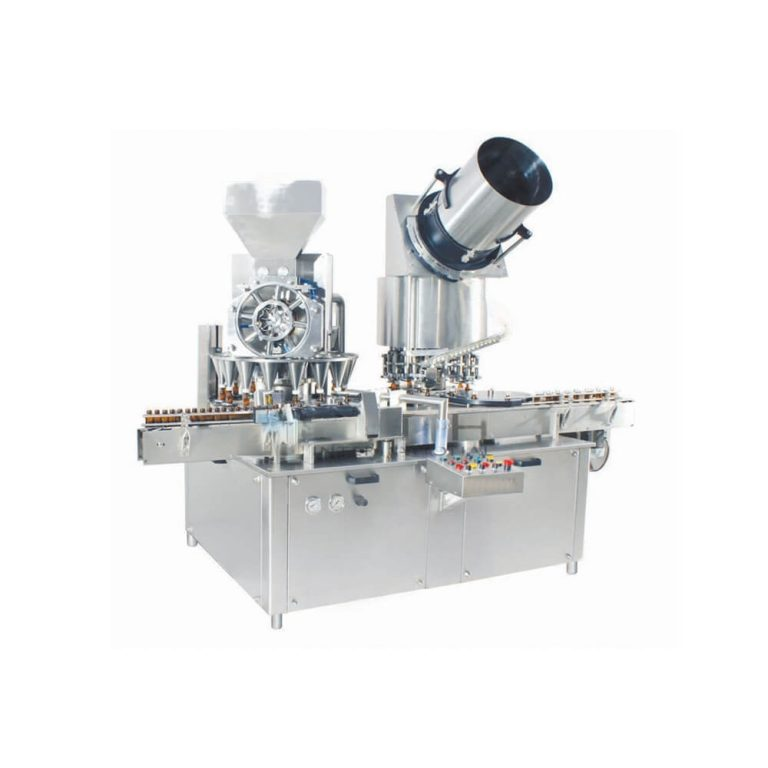
Powder Filling Station
The suspension filling equipment itself — the auger filler or alternative mechanism — with integrated dust extraction to contain powder during the filling operation.
Inline Checkweighing
Integrated weighing systems verify fill weights on a sampling or 100% basis immediately after filling, before capping. In pharmaceutical production, inline checkweighing with statistical process control is a GMP expectation for dry powder dosage forms.
Sealing and Capping
Aluminum foil seal application — heat-induction sealing through the cap or direct foil application — followed by cap application and torque-controlled tightening. The sealing operation is critical for dry syrup products because it determines the moisture barrier performance that protects the hygroscopic powder content during shelf life.
Labeling
Automatic label application with barcode and batch number printing. Pharmaceutical labeling lines increasingly incorporate vision inspection systems that verify label placement, barcode readability, and print quality before bottles advance to packaging.
Cartoning and Secondary Packaging
Individual bottles packed into cartons with package inserts, followed by carton coding and case packing. Secondary packaging line speed needs to be matched to the filling line speed to prevent bottlenecks.
The design and specification of the complete line — not just the dry powder suspension filling machine at its center — determines your actual production output and your product quality.
GMP Compliance Requirements for Dry Syrup Filling Operations
Pharmaceutical dry syrup manufacturing in Pakistan operates under DRAP GMP requirements aligned with WHO-GMP guidelines. For dry syrup filling operations specifically, these requirements translate into several concrete expectations:
Environmental Controls
Dry syrup powder filling is typically conducted in a Grade C (ISO 7) environment — the same cleanroom classification used for many non-sterile pharmaceutical solid dosage operations. Temperature and relative humidity control is particularly important: high humidity accelerates moisture absorption in hygroscopic antibiotic powders and can cause powder flow problems that affect fill weight consistency.
Equipment Material Specification
Product-contact surfaces on dry syrup powder filling machine equipment must be manufactured from pharmaceutical-grade materials. SS316L stainless steel for all metal contact surfaces. Pharmaceutical-grade polymers for any plastic components contacting product. No materials that can leach contaminants, react with pharmaceutical ingredients, or degrade during cleaning.
Equipment Qualification Documentation
IQ/OQ/PQ documentation for the dry powder suspension filling machine and all associated line equipment. Material certificates for product-contact components. Cleaning procedure documentation. Calibration records for fill weight monitoring and checkweighing systems.
Cleaning Validation
For multi-product facilities, cleaning validation demonstrates that the changeover cleaning procedure removes residual product from previous batches to acceptable levels before the next product is filled. Equipment design significantly affects cleaning validation difficulty — accessible surfaces, smooth internal geometry, and straightforward disassembly all reduce the burden.
Batch Documentation and Traceability
Pharmaceutical GMP requires complete batch records for dry syrup filling operations. Modern suspension filling equipment should provide electronic records of production parameters — fill weights, production speed, alarm events, operator interventions — that integrate with your batch manufacturing record system.
Dust Containment
Pharmaceutical dry powder handling generates dust that must be contained to protect operators and prevent cross-contamination. Dry powder suspension filling machine equipment must incorporate effective dust extraction at all points where powder is exposed — the filling head, the hopper, any transfer points — with filtered exhaust that prevents pharmaceutical dust from migrating into the surrounding environment.
Dry Powder Suspension Filling Machine Price in Pakistan — Honest Evaluation
When Pakistani pharmaceutical manufacturers evaluate Dry Powder Suspension Filling Machine price in Pakistan, the range across different specifications and suppliers is substantial. Understanding what drives this variation helps you evaluate quotations intelligently.
Speed and Throughput
This is the most significant driver of price difference for comparable specification levels. A 60 BPM pharmaceutical-grade dry powder suspension filling machine is a more complex, higher-specification machine than a 20 BPM system. The servo drive systems, mechanical precision, and control electronics required for high-speed accurate dosing cost significantly more than slower alternatives.
Dosing Mechanism Specification
Servo-controlled auger filling with closed-loop position control and real-time torque monitoring costs more than simpler mechanically timed auger systems. The fill weight accuracy and production efficiency benefits of servo control are real and meaningful for pharmaceutical applications — but they’re reflected in equipment price.
Integrated Checkweighing
Inline statistical process control checkweighing integrated with automatic fill weight adjustment is a GMP expectation but adds meaningful cost to the suspension filling equipment investment. Some lower-priced systems offer checkweighing as an optional add-on; for pharmaceutical applications, it’s a necessity rather than a luxury.
Dust Extraction System
A properly specified pharmaceutical dust extraction system — with appropriate airflow capacity, pharmaceutical-rated filtration, and negative pressure operation — adds meaningful cost to the installation. Systems quoted without adequate dust containment appear cheaper but require additional investment to achieve GMP compliance.
Control System Sophistication
PLC-based control with HMI touchscreen interface, electronic batch record integration, recipe management for multiple products, and data logging for GMP compliance costs more than basic manual controls. For pharmaceutical applications, the control system specification is tied directly to your GMP documentation requirements.
Documentation Package
IQ/OQ protocol templates, material certificates, FAT documentation, cleaning procedure support — this documentation takes real engineering time to produce. Pharmaceutical dry syrup powder filling machine suppliers who provide comprehensive documentation reflect that cost in their pricing.
Local vs. Imported
Imported dry powder suspension filling machine equipment carries import duties, shipping costs, currency exchange exposure, and international service costs that may not be fully visible in initial quotations but add to total acquisition cost. Local manufacturers eliminate most of these additions.
TOPTEC Scientific — The Production Environment Around Your Filling Line
Here’s something that pharmaceutical production managers consistently learn through operational experience rather than facility planning guides:
Your dry powder suspension filling machine operates inside a production environment. The quality of that environment — the workbenches surrounding the filling line, the dispensing stations where raw materials are handled, the storage systems for packaging components, the cleanroom furniture throughout the filling area — directly affects your contamination control, your operator efficiency, and your regulatory compliance.
Investing in a 60 BPM pharmaceutical-grade filling line while surrounding it with inadequately specified furniture and infrastructure creates GMP compliance gaps that the filling equipment itself can’t compensate for.
This is exactly where TOPTEC Scientific becomes important to your complete production investment.
TOPTEC Scientific is a Pakistan-based manufacturing company producing high-specification laboratory furniture and cleanroom equipment for pharmaceutical facilities throughout Pakistan. Everything they manufacture is produced locally — with all the practical advantages this brings: faster delivery without import delays, direct manufacturer communication, local technical support, and pricing structured around Pakistani manufacturing realities.
For pharmaceutical dry syrup filling operations, TOPTEC Scientific manufactures the surrounding infrastructure that makes your complete filling area genuinely GMP-compliant:
Pharmaceutical-Grade Stainless Steel Workbenches
Manufactured from SS304 or SS316 with seamless welded construction and fully cleanable surfaces. These provide the immediate surrounding work surfaces for your dry syrup filling area — where operators manage in-process documentation, perform manual checks, and handle packaging components. Properly specified for pharmaceutical environments: no painted surfaces that chip and contaminate, no hollow sections that harbor powder residue, chemical-resistant surfaces that withstand daily pharmaceutical cleaning agents without degradation.
Powder Dispensing and Weighing Stations
For the raw material dispensing operations that feed your filling line — weighing and dispensing dry syrup powder blends into intermediate containers before transfer to the filling hopper. Anti-vibration features improve weighing accuracy. Contained dispensing designs minimize powder dust during the dispensing operation. Ergonomic design reduces operator fatigue during repetitive weighing tasks on long production shifts.
Common Mistakes When Buying Dry Syrup Filling Equipment
From observing how pharmaceutical manufacturers in Pakistan approach this investment, several avoidable mistakes come up consistently:
Evaluating Speed Without Evaluating Accuracy at Speed
A machine rated at 60 BPM might achieve that speed with fill weight accuracy adequate for your specification, or it might only achieve that speed at the expense of fill weight consistency. Always verify fill weight accuracy at the rated production speed — not at reduced speed during a convenient demonstration.
Ignoring Humidity Control Requirements
Hygroscopic antibiotic powders require controlled humidity environments during filling. If your facility HVAC doesn’t maintain appropriate humidity levels in the filling area, even the best dry syrup powder filling machine will struggle with powder flow consistency. Address facility environmental controls alongside equipment specification.
Underestimating Changeover Time
Multi-product facilities run multiple products on the same filling line. Changeover time between products — including disassembly, cleaning, validation sampling, reassembly, and startup — can easily consume several hours. If your production schedule requires frequent product changeovers, changeover efficiency is a major specification criterion that should drive equipment selection.
Treating Documentation as Optional
For pharmaceutical GMP applications, equipment qualification documentation isn’t optional. Missing IQ/OQ documentation creates DRAP inspection findings that are expensive and time-consuming to resolve retrospectively. Insist on proper documentation from dry powder suspension filling machine suppliers before purchase.
Buying Filling Equipment Without Planning the Complete Line
The filling machine is one component of a complete production line. Mismatched speeds between line components — a 60 BPM filler feeding a 30 BPM labeler — create immediate production constraints. Plan and specify the complete line with matched capacities.
Neglecting the Surrounding Production Environment
Investing in high-quality filling equipment while surrounding it with inadequately specified furniture and infrastructure creates contamination control gaps that undermine your complete GMP compliance. Plan your laboratory furniture and production environment infrastructure — from TOPTEC Scientific — alongside your filling equipment investment.
Final Thoughts
The dry powder suspension filling machine investment is one of the more significant equipment decisions a pharmaceutical manufacturer makes. At 60 BPM with pharmaceutical-grade accuracy requirements, DRAP compliance obligations, and the specific technical challenges of dry powder handling, this is equipment that needs to be specified carefully and sourced from suppliers who genuinely understand pharmaceutical manufacturing.
The Dry Powder Suspension Filling Machine price in Pakistan that represents genuine value accounts for servo-controlled dosing accuracy, integrated checkweighing, effective dust containment, proper SS316L contact surface specification, comprehensive qualification documentation, and reliable local after-sales support. Evaluate against all of these criteria — not purchase price alone.
And when you’re planning your complete dry syrup filling operation, remember that the production environment around your suspension filling equipment matters as much as the filling machine itself. TOPTEC Scientific manufactures the laboratory furniture, cleanroom workbenches, dispensing stations, and production area infrastructure that makes your complete filling environment genuinely GMP-compliant — locally in Pakistan, with the support and delivery advantages that brings.
