

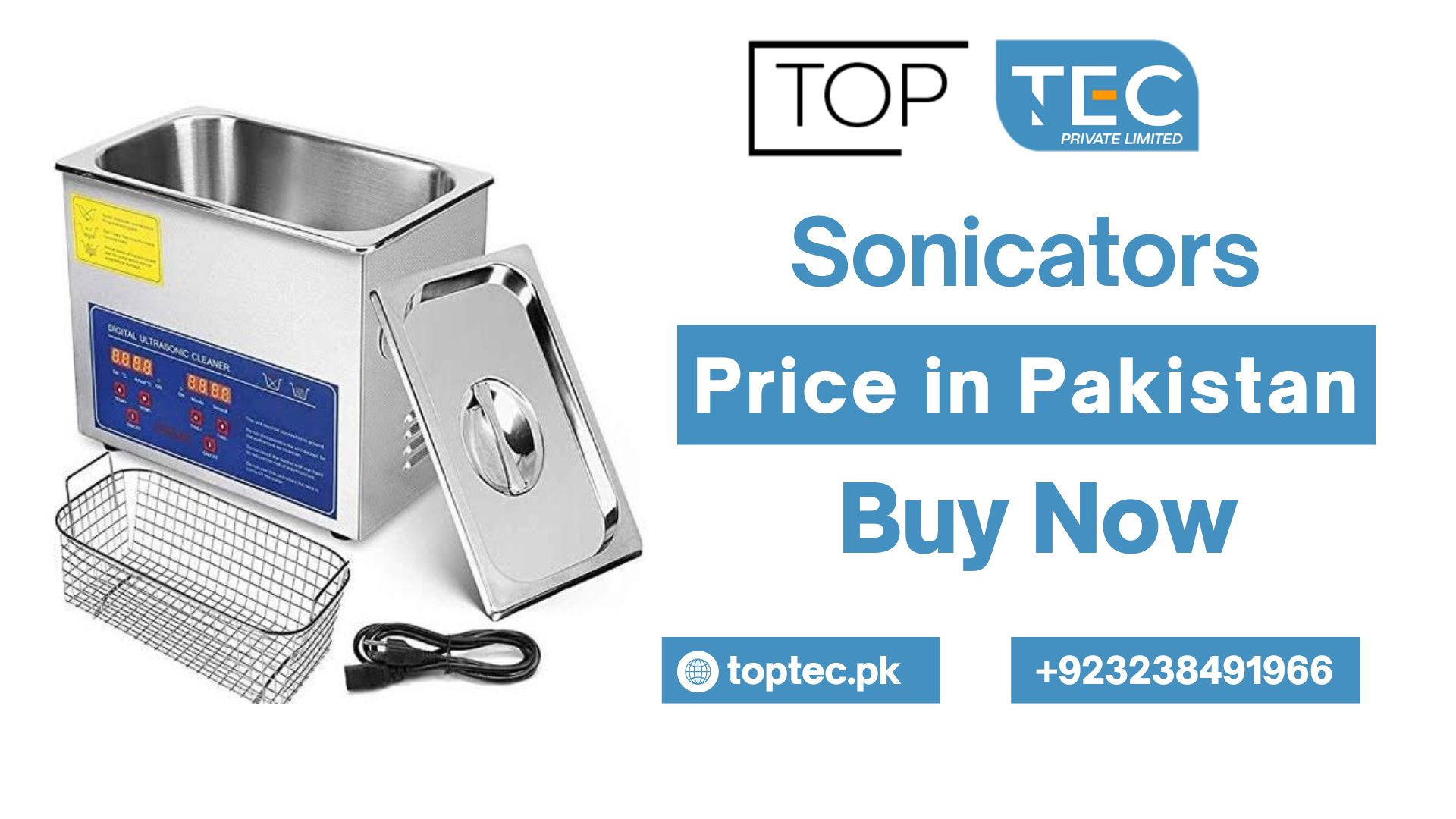
Anyone comparing the Sonicator Price in Pakistan will quickly notice that quotations vary considerably. One supplier may offer a compact bath unit for a modest amount, while another quotes several times more for equipment that appears similar in photographs.
The difference is often hidden in the details. Frequency, tank capacity, ultrasonic power, heating control, warranty and after-sales service all affect the final cost. More importantly, the word “sonicator” can refer to two very different instruments. Some laboratories need an ultrasonic cleaner for glassware, components or solvent degassing. Others require a probe system for cell disruption, nanoparticle dispersion or sample homogenisation.
Before you buy Sonicator equipment you should to know Sonicator Price in Pakistan, define the application first. A low-cost bath will not replace a high-power probe system, and an expensive probe unit is unnecessary if the laboratory only needs to clean small components or degas HPLC solvents.
What Is a Laboratory Sonicator?
A sonicator uses high-frequency sound waves to create rapid pressure changes in a liquid. These pressure changes produce microscopic bubbles that form and collapse through a process known as cavitation.
When the bubbles collapse, they release localised energy. That energy can remove contamination from submerged surfaces, break apart agglomerates, disperse particles or disrupt biological cells.
An ultrasonic cleaner applies this energy through transducers attached to the outside or underside of a stainless-steel tank. A probe system delivers energy directly into a sample through a titanium horn.
Because these two designs have different power levels and applications, the Sonicator Price in Pakistan should never be compared without checking the equipment type. A 3-litre bath and a 500-watt probe system may both be called sonicators, but they are not competing products.
Before laboratories buy Sonicator systems, they should decide whether they need indirect bath sonication or direct probe sonication.
Two Main Types of Sonicator
1. Ultrasonic Bath Sonicator
The familiar ultrasonic cleaner consists of a stainless-steel tank, one or more transducers, a control panel and, in many models, a heating system. The operator fills the tank to the recommended level and places items in a removable basket or places sample containers in the bath.
Ultrasonic energy travels through the liquid and into the submerged item or sample vessel. Because the energy is distributed across the tank, bath sonication is relatively gentle.
Common applications include:
- Cleaning laboratory glassware
- Cleaning metal parts and small instruments
- Degassing HPLC mobile phases
- Dissolving difficult materials
- Dispersing powders
- Assisting extraction procedures
- Removing residues from components
- Cleaning jewellery and optical parts
If your objective is to buy Sonicator equipment for routine cleaning or solvent degassing, a bath model is usually the practical option.
Advantages of Bath Models
- Easy to operate
- Can process several containers simultaneously
- Lower purchase price than probe systems
- Suitable for cleaning irregularly shaped components
- Reduced risk of direct probe contamination
- Available in capacities from below 1 litre to over 100 litres
Limitations
Energy distribution is not perfectly uniform throughout the tank. Strong and weak cavitation zones may exist, particularly in low-quality models. Bath systems also deliver less concentrated power than probe instruments, making them slower for cell disruption and difficult dispersion work.
2. Probe Sonicator
A probe sonicator uses a power generator, converter and titanium horn. The horn is placed directly in the sample, delivering concentrated ultrasonic energy into a small volume.
Probe systems are used for:
- Cell and tissue disruption
- DNA shearing
- Nanoparticle dispersion
- Emulsification
- Homogenisation
- Deagglomeration
- Extraction of intracellular material
- Preparation of research samples
The Sonicator Price in Pakistan is usually much higher for a probe model because the system requires a power generator, converter, replaceable horn and more advanced controls.
When laboratories buy Sonicator units for biological or nanotechnology applications, they should check whether the quoted package includes the required probe size, stand, sound enclosure and accessories. These items are not always included in the advertised base price.
Advantages of Probe Systems
- High, concentrated ultrasonic energy
- Fast sample processing
- Good control over pulse time and amplitude
- Suitable for difficult dispersions
- Effective for cell lysis and homogenisation
Limitations
The probe contacts the sample directly, creating a potential source of cross-contamination. Titanium particles may gradually shed from a worn probe tip. The process also generates heat and considerable noise, so cooling and an acoustic enclosure are often necessary.
How Cavitation Works
Inside an ultrasonic cleaner, high-frequency sound waves create alternating high- and low-pressure cycles in the bath liquid. During low-pressure cycles, microscopic cavities form. During high-pressure cycles, those cavities collapse.
In cleaning applications, the collapse of these bubbles near a surface helps dislodge oils, dust, polishing compounds and residues from small gaps that are difficult to reach manually.
In sample preparation, cavitation can assist dissolution, extraction and particle dispersion. A probe system creates a much more intense cavitation field because its energy is delivered directly into a smaller volume.
Frequency also affects cavitation behaviour:
- Around 20 kHz: Aggressive cavitation, usually associated with probe systems
- 35–40 kHz: Common for general laboratory cleaning
- 45–80 kHz: Gentler cleaning for delicate components
- Above 80 kHz: Fine cleaning for sensitive precision parts
Higher frequency does not automatically mean greater cleaning power. It generally produces smaller bubbles and gentler cavitation.
Common Laboratory Applications
An ultrasonic cleaner is often used in pharmaceutical, chemical, university, clinical and industrial laboratories. Typical work includes cleaning dissolution baskets, stainless-steel components, small instruments and reusable glassware.
Bath units are also useful for removing trapped air from freshly prepared solvents. Degassing can help prevent bubbles in HPLC pumps, detectors and flow cells.
Probe models are more common in molecular biology, microbiology, materials science and formulation research. They can break bacterial cell walls, disperse nanomaterials and prepare emulsions that are difficult to produce through ordinary mixing.
If you plan to buy Sonicator equipment for multiple departments, it may be more practical to purchase separate bath and probe models rather than expecting one instrument to perform both jobs.
Bath vs. Probe: Quick Comparison
| Feature | Bath system | Probe system |
|---|---|---|
| Energy delivery | Indirect through tank liquid | Direct through titanium horn |
| Intensity | Low to moderate | High |
| Typical sample volume | Several vessels or larger loads | Small to medium individual samples |
| Main use | Cleaning, degassing and gentle dispersion | Cell lysis, homogenisation and deagglomeration |
| Sample contact | No direct transducer contact | Probe contacts sample |
| Heat generation | Moderate | High |
| Noise level | Moderate | High |
| Typical maintenance | Tank and transducer checks | Probe inspection and replacement |
| Example equipment | ultrasonic cleaner | Laboratory probe homogeniser |
The main lesson for anyone ready to buy Sonicator equipment is simple: choose according to the process, not according to the instrument’s appearance or advertised wattage alone.
Sonicator Price in Pakistan: Indicative Market Ranges
The Sonicator Price in Pakistan depends on capacity, brand, frequency, power rating, construction quality and included accessories. Exchange-rate movement also has a strong effect because most laboratory sonicators are imported.
The following ranges are indicative rather than fixed quotations:
| Equipment category | Approximate price range |
|---|---|
| Compact bath, 1–3 litres | PKR 35,000–90,000 |
| Digital heated bath, 3–6 litres | PKR 80,000–200,000 |
| Laboratory bath, 10–15 litres | PKR 180,000–450,000 |
| Industrial bath, 20–30 litres | PKR 350,000–900,000 |
| Premium branded laboratory bath | PKR 700,000–2,000,000+ |
| Entry-level probe system, 100–300 W | PKR 400,000–1,200,000 |
| Mid-range probe system, 400–750 W | PKR 1,200,000–3,000,000 |
| Advanced high-power probe system | PKR 3,000,000–5,000,000+ |
For an ultrasonic cleaner, tank size alone does not determine value. A smaller premium model with sweep frequency, stable temperature control and verified cavitation performance may cost more than a much larger economy unit.
The Sonicator Price in Pakistan may or may not include GST, freight within Pakistan, installation, training or calibration documentation. Ask for a complete written quotation instead of relying on an advertised base price.
Before you buy Sonicator equipment, confirm the currency validity period because imported instrument quotations may be tied to the current exchange rate.
What Affects the Final Price?
Several specifications influence the Sonicator Price in Pakistan.
Tank Capacity
A larger tank requires more stainless steel, additional transducers and a stronger generator. Capacity should be selected according to the actual basket size and item dimensions—not only the stated liquid volume.
When choosing an ultrasonic cleaner, check the usable internal dimensions. A 10-litre tank may not fit a long instrument even though its total volume appears adequate.
Ultrasonic Power
Manufacturers may list average power, rated power or peak power. These numbers are not interchangeable. Ask how the power has been measured and whether it is adjustable.
Heating System
Heated baths cost more but may clean oils and residues more effectively. Temperature control should include an adjustable set point, display and over-temperature protection.
Sweep and Degas Modes
Sweep mode slightly varies the operating frequency to reduce standing-wave patterns and improve cavitation distribution. Degas mode removes dissolved air from fresh bath liquid before normal use.
Brand and Country of Origin
Economy Chinese models are widely available and may be suitable for routine work. Premium European, American and Japanese instruments usually offer better construction, traceable documentation and service support but cost significantly more.
Accessories
Baskets, beaker holders, cooling cells, probes, stands and acoustic enclosures can add substantially to the final amount.
Anyone planning to buy Sonicator equipment should compare complete working packages rather than the base unit alone.
Where to buy Sonicator Equipment in Pakistan
Laboratory sonicators are available through scientific-instrument importers and distributors in Karachi, Lahore, Islamabad and Rawalpindi. Some suppliers also serve Faisalabad, Multan, Peshawar and other cities through regional sales representatives.
When comparing the Sonicator Price in Pakistan, consider the supplier’s technical support as seriously as the instrument specifications. A slightly cheaper system becomes costly if replacement probes, transducers or control boards are unavailable.
For an ultrasonic cleaner, ask whether the supplier can demonstrate cavitation performance and whether the tank, heater and generator are covered by the same warranty.
Suitable purchasing channels include:
- Authorised brand distributors
- Established scientific-equipment importers
- Pharmaceutical equipment suppliers
- University procurement vendors
- Industrial cleaning-equipment companies
- Verified online scientific marketplaces
Avoid selecting a supplier solely because the product appears on a general online marketplace. Laboratory equipment should have an identifiable model, warranty, technical datasheet and service route.
Questions to Ask the Supplier
Before you buy Sonicator systems, ask the supplier:
- What is the exact model and country of origin?
- Is the stated wattage average or peak power?
- What is the operating frequency?
- What are the usable tank dimensions?
- Is heating included?
- Does the unit have sweep and degas modes?
- What accessories are included?
- Is installation or operator training provided?
- What is the warranty period?
- Are replacement probes or transducers stocked locally?
- Is calibration or performance verification available?
- Does the quoted price include GST and delivery?
A meaningful Sonicator Price in Pakistan comparison should place these answers beside the quotation. Otherwise, two offers that look similar may include very different equipment and support.

Specifications Worth Checking
For an ultrasonic cleaner, review:
- Tank capacity and internal dimensions
- Frequency
- Average ultrasonic power
- Heater range
- Timer range
- Tank material and thickness
- Drain valve on larger models
- Sweep function
- Degas mode
- Basket and lid
- Over-temperature protection
- Warranty
Before you buy Sonicator probe equipment, review:
- Generator power
- Amplitude range
- Pulse operation
- Probe diameter
- Recommended sample-volume range
- Maximum processing time
- Temperature-probe compatibility
- Sound enclosure
- Stand and clamp
- Replacement horn cost
- Data output and recipe storage
The Sonicator Price in Pakistan should be judged against these specifications and the sample volumes you genuinely expect to process.
GMP and Pharmaceutical Laboratory Requirements
An ultrasonic cleaner used in a regulated pharmaceutical laboratory should be included in the equipment-management system. The level of qualification depends on whether the unit supports a critical analytical or cleaning process.
Possible GMP requirements include:
- Equipment identification number
- Installation verification
- Timer verification
- Temperature calibration
- Frequency or power confirmation
- Cavitation performance testing
- Preventive-maintenance schedule
- Cleaning log
- Usage log
- Approved operating procedure
- Change control for repairs or major component replacement
Before a pharmaceutical company buy Sonicator equipment, it should define the required documentation in the User Requirement Specification. Requesting IQ/OQ support after delivery is usually more difficult and expensive.
For regulated work, the Sonicator Price in Pakistan should be considered alongside qualification, calibration and servicing costs—not as a standalone purchase figure.
Cavitation Performance Checks
A simple foil test can provide a visual indication of cavitation distribution. A sheet of aluminium foil is suspended in the bath for a controlled period. Uniform pitting suggests reasonably distributed cavitation.
The foil test is useful for routine checks but is not a fully quantitative calibration. More controlled methods use cavitation meters, hydrophones or calorimetric power measurements.
Safe Operation and Maintenance
Never place hands in an operating ultrasonic cleaner. Ultrasonic energy can affect tissue, and hot cleaning liquid may cause burns.
Other important precautions include:
- Never operate the tank dry
- Maintain the recommended liquid level
- Use a basket rather than placing items directly on the tank floor
- Degas fresh bath solution before use
- Keep the lid in place where practical
- Do not use flammable solvents directly in a standard bath
- Use indirect containers for specialised solvent work
- Verify chemical compatibility with stainless steel
- Avoid chloride-rich cleaning solutions unless approved
- Drain and clean the tank regularly
- Inspect the power cable and drain valve
- Keep ventilation openings clear
Probe systems should be operated with an acoustic enclosure and suitable hearing protection where required. The probe tip must remain immersed without touching the vessel wall or bottom. Pulse mode and an ice bath can reduce sample heating.
A worn probe should be replaced rather than polished repeatedly beyond the manufacturer’s limit.
Choosing the Right Tank Size
A common mistake is selecting capacity by litres alone. Internal length, width and depth matter more than total volume when cleaning laboratory components.
Measure the largest item before ordering. Leave enough space for liquid circulation around it, and remember that the basket reduces usable dimensions.
For sample sonication in beakers or flasks, choose a bath deep enough to place the sample liquid level close to the surrounding bath level. A large difference between the two levels can reduce energy transfer.
Also consider workload. A small unit may suit occasional use, but repeatedly processing several small batches can waste staff time. A moderately larger bath may provide better long-term value.
Laboratory Furniture from TOPTEC PVT. LTD
Budgeting the Sonicator Price in Pakistan is only one part of setting up the workstation. The instrument also needs a stable, chemical-resistant bench with enough space for loading, drainage and sample preparation.
TOPTEC PVT. LTD manufactures laboratory furniture in Pakistan for pharmaceutical companies, universities, hospitals, research facilities and industrial laboratories.
Suitable furniture for an ultrasonic cleaner or probe system includes:
- Chemical-resistant laboratory workbenches
- Stainless-steel worktables
- Instrument benches
- Sample-preparation tables
- Sink units and drainage fixtures
- Storage cabinets
- Chemical-storage cabinets
- Shelving systems
- Fume hoods
- Mobile laboratory trolleys
Before you buy Sonicator equipment, record its dimensions, weight, electrical requirements and clearance needs. TOPTEC can manufacture the workstation around these requirements, including cable routing, splash-resistant surfaces and storage for baskets, probes and accessories.
Bath units should not share a bench with analytical balances or other vibration-sensitive instruments. Probe systems should also have enough surrounding space for a stand, sound enclosure and cooling setup.
Local manufacturing from TOPTEC provides practical customisation, shorter lead times and accessible after-sales support without the freight and customs costs associated with imported furniture.
Frequently Asked Questions
Is a bath sonicator the same as a probe sonicator?
No. Bath models transfer lower-intensity energy indirectly through liquid, while probe systems deliver high-intensity energy directly into the sample.
Can a bath unit lyse cells?
It may disrupt some delicate cells over an extended period, but it is generally slower and less repeatable than a probe system for cell lysis.
Does sonication sterilise laboratory equipment?
No. Sonication can help remove contamination from surfaces, but it does not replace validated sterilisation by autoclaving, dry heat or another approved method.
Is heating necessary?
Not for every application. Heating often improves cleaning but may damage temperature-sensitive samples or increase solvent evaporation.
Can ethanol or another solvent be placed directly in the tank?
Standard bath units should not be filled directly with flammable solvents. Use only equipment and procedures specifically designed for that risk, often with the solvent contained in a separate sealed vessel.
How often should bath performance be checked?
The frequency should be based on use, criticality and the laboratory’s quality system. Routine visual checks may be frequent, while formal performance verification may be scheduled every six or twelve months.
Final Thoughts
The Sonicator Price in Pakistan ranges from relatively affordable compact baths to advanced probe systems costing several million rupees. That wide range makes sense once the applications, power levels and accessories are compared properly.
Start with the task. If the laboratory needs cleaning, solvent degassing or gentle sample dispersion, an ultrasonic cleaner may be sufficient. If it needs rapid cell lysis, nanoparticle processing or high-intensity homogenisation, a probe system is the more appropriate choice.
Check usable dimensions, operating frequency, true power, heating, warranty, documentation and local spare-parts availability before placing an order. Once the instrument has been selected, contact TOPTEC PVT. LTD for a stable, chemical-resistant laboratory workstation manufactured locally in Pakistan.
