

Ensure USP, EP, and JP compliance with reliable tablet disintegration testers. Ideal for batch release testing, formulation development, and stability studies. GMP-compliant models with 6-basket and 3-basket options. Learn more.
When I first started working with pharmaceutical quality control labs in Pakistan, I was surprised at how many were still using outdated manual tablet disintegration testing methods. It wasn’t because they didn’t understand the limitations—it was usually because they weren’t sure whether investing in an automatic system made financial sense. That’s a question I hear constantly, and it’s a legitimate one. The decision between manual and automatic testing equipment is significant, both financially and operationally. Today, I want to walk you through this decision from someone who’s actually spent years in pharma QC labs and understands the real-world implications of this choice.
If you’re running a pharmaceutical quality control laboratory in Pakistan, whether you’re a small manufacturing facility or a large hospital pharmacy, you need a tablet disintegration tester. This isn’t optional—it’s a regulatory requirement. The question isn’t whether you need one, but which type will serve your laboratory best. When you Buy Tablet Disintegration Tester equipment for your facility, you’re making an investment that will impact your lab’s efficiency, accuracy, and compliance for years to come.
At TOPTEC Scientific, we manufacture both manual and automatic tablet disintegration apparatus systems here in Pakistan. Over the years, I’ve worked with hundreds of labs making this exact decision, and I’ve seen how different choices play out in different situations. Let me share what I’ve learned.
Understanding What a Tablet Disintegration Tester Actually Does
Before we compare manual versus automatic systems, let’s be clear about what we’re talking about. A tablet disintegration tester is pharmaceutical quality control equipment that determines how quickly a tablet breaks down in water at body temperature. This is critical information because if a tablet doesn’t disintegrate properly, the active ingredients won’t dissolve and be absorbed by the body, regardless of how much active pharmaceutical ingredient is in the tablet.
The test is basically controlled. You place tablets in tubes within a basket apparatus, submerge it in water at exactly 37°C, and monitor how long it takes for the tablets to completely disintegrate. The test has specific time requirements depending on the tablet type—typically 30 minutes for immediate-release tablets, up to several hours for modified-release formulations.
I worked with a pharmaceutical manufacturer in Lahore who discovered through disintegration testing that one of their production batches had a problem with their binder material. The tablets weren’t disintegrating within specification. Without proper tablet disintegration apparatus testing, these defective tablets would have shipped to patients. The testing caught the problem before it left the facility. That’s the value of proper quality control.
The Manual Tablet Disintegration Apparatus Approach
Let’s start with manual testing because it’s still commonly used in Pakistan and for some labs, it’s actually the right choice.
How Manual Testing Works
With manual tablet disintegration apparatus, here’s what you’re actually doing:
You place test tablets into the apparatus basket, set the water bath temperature to 37°C, and watch the tablets. You need to observe them carefully—every few minutes you check whether they’ve disintegrated. You’re timing this manually, typically with a stopwatch. When all tablets have completely disintegrated, you record the time. If it falls within the acceptable range (usually 30 minutes for immediate-release tablets), the batch passes. If it exceeds the limit, the batch fails.
It sounds simple, and in many ways it is. But “simple” doesn’t mean “easy” or “error-free.”
Real Costs of Manual Testing
When you’re considering whether to Buy Tablet Disintegration Tester equipment, most people look at the initial purchase price. A manual apparatus is indeed cheaper upfront—typically PKR 80,000 to PKR 150,000 in Pakistan. An automatic system runs PKR 400,000 to PKR 800,000 or more. That difference is substantial, which is why cost-conscious labs gravitate toward manual systems.
But here’s where I need to be honest about the total cost of ownership. When you buy a manual system, you’re not just buying equipment—you’re committing to significant ongoing labor costs.
Labor Time Requirements:
Each disintegration test takes one technician approximately 45 minutes to 1.5 hours of active time. This includes setup, observation, timing, and documentation. If you’re testing multiple batches—and most quality control labs are—you might be running several tests simultaneously. But simultaneous tests still require attention. A technician might be monitoring 2-3 tests at once, which means they’re constantly watching, noting times, checking for disintegration.
For a pharmaceutical manufacturer in Islamabad running 10-12 batches per week, that’s potentially 10-15 hours of technician time weekly dedicated to disintegration testing alone. Over a year, that’s 500-750 hours. At average technician salary rates in Pakistan (roughly PKR 35,000-50,000 monthly), that’s PKR 300,000-400,000+ annually in labor costs.
I worked with a small manufacturing facility in Multan that was running all their disintegration tests manually. When we calculated their total labor cost for these tests, they were shocked. They were spending more on labor annually than an automatic system would cost as a capital investment.
Accuracy and Consistency Issues with Manual Testing
Here’s something that’s often overlooked: manual testing has inherent accuracy limitations.
Human observation isn’t perfectly consistent. One technician might interpret “complete disintegration” slightly differently than another. Some particles still visible? Is it truly disintegrated? Different observers might make slightly different judgments about when the endpoint is reached. Over multiple tests, this inconsistency compounds.
I observed manual testing at a facility in Peshawar. Two different technicians tested the same batch formulation on different days, using the same apparatus. One got a result of 28 minutes, the other got 26 minutes. Both were within specification, but the variation was notable given they were supposedly testing identical material.
Additionally, manual observation introduces fatigue factors. If a technician has been watching tubes for three hours, their attention might not be as sharp at the end of that period as at the beginning. Distractions happen—phones ring, other urgent tasks interrupt, concentration lapses.
Documentation and Compliance Challenges
While manual testing isn’t inherently non-compliant, the documentation requirements are more challenging. With manual testing, you need comprehensive notes:
- Exact times of observation
- Who performed the test
- What they observed at each interval
- Ambient conditions
- Any deviations or anomalies
Pharmaceutical regulations (especially if you’re exporting or selling internationally) increasingly require detailed documentation. Manual testing creates more documentation burden, and manual documentation is more prone to errors. I’ve reviewed test records from manual systems where times seemed suspiciously rounded (like exactly 30 minutes multiple times, which happens to be the cutoff) or where observation intervals weren’t consistent.
Electronic documentation from automatic systems creates a clear, auditable record with timestamps that can’t be manipulated. This is increasingly important for regulatory compliance.
The Automatic Tablet Disintegration Apparatus Advantage
Now let’s talk about automatic systems. When you Buy Tablet Disintegration Tester equipment at the automatic level, you’re investing in something quite different from manual testing.
How Automatic Testing Works
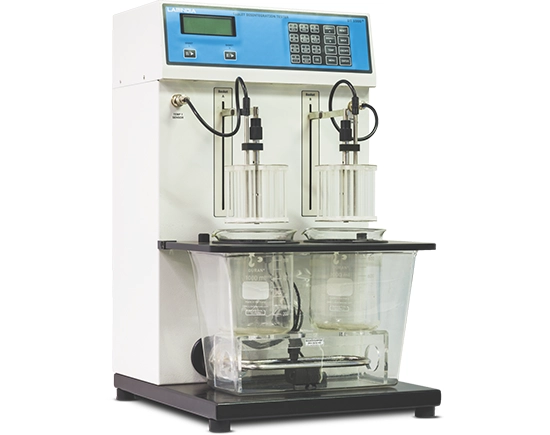
An automatic tablet disintegration apparatus uses sensors to monitor tablet disintegration. Typically, the apparatus includes:
- Temperature control system maintaining exact 37°C
- Automatic basket lifting mechanism
- Optical or mechanical sensors detecting particle displacement
- Electronic timing system
- Data logging and recording
- Often computer interface for results documentation
The procedure is similar in concept—tablets in a basket, submerged in water at body temperature—but the observation and timing are automated. You place the tablets, set the apparatus to run, and walk away. When the test completes, the apparatus prints or displays results automatically.
More importantly, the apparatus determines disintegration through physical measurement (sensors detecting particle movement) rather than human observation.
Accuracy and Reliability Benefits
Automatic systems provide several key advantages:
Objective Measurement: Sensors don’t have subjective interpretation. Either the tablet has disintegrated according to the apparatus’s sensor settings, or it hasn’t. No ambiguity, no variation between operators.
Consistency: Every test is run identically. Same temperature, same apparatus motion, same observation criteria. You eliminate operator-based variation entirely.
Precision Timing: Electronic timing is precise to the second, every time. No rounding, no estimation.
Multiple Tests Simultaneously: Most automatic systems can run 6-12 tests simultaneously. This massively increases testing capacity without proportional labor increases.
A pharmaceutical company in Karachi switched to an automatic system. They immediately noticed better batch-to-batch consistency in their results. Previously, with manual testing, they’d sometimes see borderline results that they’d retest. With automatic testing, results were more definitive and consistent, reducing the need for retesting.
Efficiency and Throughput
This is where automatic systems really shine economically. Here’s the practical reality:
With a manual system, one technician can realistically run and monitor 2-3 tests simultaneously, taking roughly 45 minutes to 1.5 hours per test cycle.
With an automatic system, one technician can run 6-12 tests simultaneously, with the apparatus handling all timing and observation. The technician loads samples and collects results—that’s it. The apparatus handles the rest.
For a busy QC lab, this difference is transformative. I worked with a pharmaceutical facility in Faisalabad that was running at capacity with their manual system. They were testing 15-18 batches weekly, which maxed out their technician time. When they upgraded to automatic testing, they could handle 40+ batches weekly with the same technician resources. They didn’t need to hire additional staff.
When an Automatic System Pays for Itself
Let me break down the math clearly:
Manual System Investment:
- Equipment: PKR 100,000-150,000
- Annual labor: PKR 300,000-400,000 (for moderate testing volume)
- Maintenance: PKR 20,000-30,000
- Total annual cost: PKR 320,000-430,000
- 5-year cost: PKR 1,600,000-2,150,000 (after year one)
Automatic System Investment:
- Equipment: PKR 500,000-700,000
- Annual labor: PKR 100,000-150,000 (significantly reduced)
- Maintenance: PKR 50,000-80,000
- Total annual cost: PKR 150,000-230,000
- 5-year cost: PKR 1,250,000-1,840,000 (including year one capital)
For a facility running moderate to high testing volumes, an automatic system pays for itself in 2-3 years through labor savings alone. After that, it’s cheaper annually than the manual system.
Regulatory Compliance and Documentation
When you Buy Tablet Disintegration Tester equipment for a facility that ships pharmaceutical products or operates under regulatory oversight, automatic systems provide significant compliance advantages:
Automatic Data Recording: Results are logged electronically with date, time, and system identification. This creates a tamper-proof record.
Traceability: You can trace exactly when tests were run, by which apparatus, under what conditions.
Audit Trails: Modern automatic systems include audit trail functionality that shows any changes to data and when they occurred.
GMP Compliance: Automatic systems with electronic recording are explicitly mentioned in GMP guidelines as best practice for pharmaceutical testing.
Export Requirements: If you’re exporting pharmaceutical products, automatic testing with electronic documentation is increasingly required by international regulatory bodies.
I worked with a pharmaceutical company preparing for FDA certification. The FDA inspector specifically asked about their disintegration testing procedure. When they showed documentation from their automatic apparatus with electronic timestamps and audit trails, the inspector was satisfied. Had they been using manual testing with hand-written records, they’d have faced more scrutiny.
Quality Assurance Benefits
Beyond just accuracy and efficiency, automatic systems provide quality assurance advantages:
Repeatability: Tests are repeatable and reliable, allowing you to confidently establish batch specifications.
Trending: With consistent electronic data, you can trend results over time, spot issues early, and optimize formulations.
Method Validation: For method validation and pharmaceutical development, automatic testing provides the precision and documentation needed for robust validation.
Equipment Qualification: Modern automatic systems come with built-in qualification features that verify equipment performance, ensuring it’s operating within specifications.
Comparative Analysis: Manual vs. Automatic
Let me create a clear comparison so you can see the differences laid out:
| Factor | Manual System | Automatic System |
|---|---|---|
| Initial Cost | PKR 80,000-150,000 | PKR 500,000-800,000 |
| Accuracy | Operator-dependent | Sensor-based, objective |
| Consistency | Variable between operators | Highly consistent |
| Testing Capacity | 2-3 simultaneous tests | 6-12 simultaneous tests |
| Labor Per Test | 45 min – 1.5 hours | 5-10 minutes |
| Documentation | Manual, paper-based | Automatic, electronic |
| Regulatory Compliance | Acceptable but basic | Best practice |
| 5-Year Total Cost | PKR 1.6M – 2.15M | PKR 1.25M – 1.84M |
| Space Required | Compact | Larger footprint |
| Technical Support | Basic | Often comprehensive |
| Maintenance | Minimal | Moderate |
| Scalability | Limited | Highly scalable |
Looking at this comparison, the automatic system’s advantages become clear, especially for facilities with moderate to high testing volumes.
Choosing Between Manual and Automatic: Practical Considerations
Now, here’s the real-world question: which should you actually choose for your lab? It’s not always straightforward.
When Manual Testing Makes Sense
Small Testing Volumes: If you’re running only 2-4 tests per week, a manual system is probably adequate. The labor cost is manageable, and your lower volume means you’re not pushing the limits of manual testing.
Limited Budget: If capital is constrained and you’re not planning to scale up, manual testing gets the job done initially. You can upgrade later.
Limited Space: Manual apparatus is compact. If your lab space is severely restricted, manual might be necessary.
Educational Settings: Universities and teaching labs sometimes use manual testing because it provides educational value—students see exactly what’s happening in the test.
Simple Formulations: If you’re primarily testing simple immediate-release tablets where disintegration is predictable and straightforward, manual testing is probably sufficient.
A small pharmaceutical boutique in Abbottabad manufactures specialty tablets for a niche market. They test perhaps 3-4 batches monthly. For their volume and budget constraints, a manual system is perfectly reasonable.
When Automatic Testing Is Essential
High Testing Volume: If you’re running 15+ tests weekly, automatic testing becomes essential. Manual testing would require multiple technicians or overtime, becoming economically irrational.
Regulatory Requirements: If you’re exporting products or operating under strict regulatory oversight, automatic systems with electronic documentation are increasingly expected.
Consistency Requirements: If you need reliable, reproducible results for method validation or product development, automatic testing provides the precision needed.
Multi-Shift Operations: If your lab operates multiple shifts or around the clock, automatic testing eliminates the inconsistency that comes from different operators.
Scalability Plans: If you anticipate growing your testing volume, an automatic system scales better and is more cost-effective for growth.
Quality Standards: If you’re pursuing ISO certification or other quality standards, automatic testing with documentation support is valuable.
A large pharmaceutical manufacturer in Lahore was running manual tests, but as their product line grew, they found themselves constantly waiting for test results. Bottlenecks formed. Automatic testing increased their throughput dramatically, allowing them to scale production.
Buy Tablet Disintegration Tester Equipment: Where to Start
When you’ve decided which type of system makes sense for your lab, actually making the purchase requires careful consideration.
Working With Manufacturers
At TOPTEC Scientific, we manufacture tablet disintegration apparatus systems right here in Pakistan. We understand local pharmaceutical quality control needs. When you Buy Tablet Disintegration Tester equipment from us, you get:
Local Manufacturing: Equipment is manufactured locally, which means faster delivery and easier support.
Customization Options: We can customize apparatus designs to meet your specific needs and facility requirements.
Training and Installation: We provide comprehensive training for your staff and proper installation at your facility.
After-Sales Support: Local support means you’re not waiting weeks for assistance if you have issues.
Compliance Assistance: We help ensure your equipment and procedures meet Pakistani pharmaceutical regulations.
Cost-Effective Pricing: Local manufacturing means competitive pricing without compromising quality.
Specifications to Verify
Before you Buy Tablet Disintegration Tester equipment, make sure you understand these key specifications:
Temperature Control Accuracy: ±0.5°C around 37°C is standard. This must be precise because temperature significantly affects disintegration rates.
Apparatus Motion: The lifting mechanism should raise the basket uniformly with consistent speed. Usually 28-32 cycles per minute is standard.
Sensing Capability: For automatic systems, verify that sensors accurately detect particle displacement and disintegration endpoint.
Number of Test Stations: Does it match your testing volume needs? 6-position is most common, but 12-position systems exist.
Display and Documentation: What kind of results display and documentation does it provide? Electronic logging is preferred.
Conformance Standards: Verify that equipment conforms to USP, BP, or other relevant pharmacopeial standards.
Budget Considerations
When budgeting for tablet disintegration apparatus equipment, factor in not just purchase price but total cost:
Equipment Cost: PKR 80,000-800,000 depending on type.
Installation and Setup: PKR 10,000-30,000
Initial Training: Often included or PKR 5,000-15,000
Annual Maintenance: PKR 20,000-80,000
Calibration/Certification: PKR 5,000-15,000 annually
Consumables: PKR 10,000-20,000 annually (filters, water, etc.)
Extended Warranty: Optional but PKR 20,000-40,000 for 3-5 years
Total first-year cost can be significantly higher than equipment cost alone. Budget accordingly.
Real-World Case Studies
Let me share actual examples from facilities where I’ve worked.
Case Study 1: Small Diagnostic Center (Multan)
Situation: Small pharmaceutical analysis and quality control center, testing about 4-6 batches monthly.
Challenge: They had no disintegration testing capability and needed to start. Budget was limited.
Solution: Purchased manual tablet disintegration apparatus for PKR 120,000.
Outcome:
- Tests run smoothly for their volume
- One technician can handle all testing
- Results documented adequately
- Meets their current regulatory needs
Lesson: For their volume and circumstances, manual testing was appropriate. They’ll upgrade later if volume increases.
Case Study 2: Mid-Size Pharmaceutical Manufacturer (Faisalabad)
Situation: Manufacturing facility running 15-20 batches weekly, previously using manual testing.
Challenge: Manual testing was becoming a bottleneck. Test results were delayed 1-2 days because testing capacity couldn’t keep up. Some batches were aging while waiting for testing.
Solution: Invested in automatic pharma disintegration tester with 6-position capacity for PKR 650,000.
Outcome:
- Testing capacity increased from 3-4 simultaneous to 6 simultaneous tests
- Turnaround time dropped from 2 days to 4 hours
- One technician instead of 1.5 technicians required
- Results more consistent and reliable
- Payback period approximately 2 years
Lesson: Mid-sized operations benefit tremendously from automatic systems through throughput improvement and cost savings.
Case Study 3: Large Pharmaceutical Company (Karachi)
Situation: Large manufacturer with multiple product lines, exporting products internationally, running 40+ tests weekly.
Challenge: Manual testing was insufficient for their volume. Multiple automatic systems would be needed to handle capacity. Electronic documentation required for international sales.
Solution: Invested in three automatic tablet disintegration apparatus systems totaling PKR 2.1 million.
Outcome:
- Can handle 60+ tests weekly with proper capacity
- Electronic documentation supports export requirements
- Consistency improved, rejected batches due to testing inconsistency reduced
- Labor costs decreased significantly
- Supports quality improvement initiatives
Lesson: Large operations require automatic systems for both capacity and compliance reasons.
Implementation Best Practices
Once you’ve decided what to Buy Tablet Disintegration Tester equipment, here’s how to implement it successfully.
Proper Installation
Environmental Conditions: Disintegration apparatus requires proper environmental control:
- Room temperature relatively stable (not in direct sunlight or near heating/AC vents)
- Humidity shouldn’t be extreme
- Electrical supply should be stable
- Adequate bench space with proper drainage for water bath
Verification After Installation: After installation, verify:
- Temperature accuracy throughout water bath (different positions)
- Apparatus motion consistency
- Sensor function (for automatic systems)
- Proper water quality in bath
- All documentation systems functioning
Staff Training
Don’t underestimate the importance of proper training. Even with automatic apparatus, operators need to understand:
- Proper tablet placement in baskets
- Water quality requirements
- Temperature verification procedures
- Result interpretation
- Troubleshooting basic issues
- Documentation procedures
- Maintenance requirements
I trained technicians at a facility where the previous operator hadn’t understood that water quality matters. They were using tap water with mineral content that affected test results. Once proper training addressed this, results improved.
Standard Operating Procedures
Develop detailed, facility-specific SOPs covering:
- Pre-test preparation and setup
- Test procedure specifics
- Observation/monitoring procedures
- Endpoint determination
- Results recording and documentation
- Equipment maintenance schedule
- Troubleshooting procedures
- Non-conformance handling
Written procedures ensure consistency even if operator turnover occurs.
Quality Assurance
Establish QA procedures for your testing:
Equipment Qualification: Periodic verification that equipment is operating within specifications.
Performance Qualification: Testing with reference standards to verify apparatus performance.
Method Validation: If required by your regulatory environment, formally validate your disintegration testing method.
Trending: Track results over time to identify patterns and potential issues.
Documentation Review: Regular review of test records to ensure consistency and compliance.
Buy Laboratory Furniture Strategy
When you’re looking to Buy Laboratory Furniture and equipment including pharma disintegration tester systems, think about your complete quality control setup.
At TOPTEC Scientific, we don’t just manufacture individual equipment pieces. We help labs think about their complete setup:
- Disintegration apparatus (manual or automatic)
- Dissolution testing equipment
- Weight variation apparatus
- Hardness testers
- Complete QC benches with proper water systems
When these systems work together coherently, your quality control lab functions much more efficiently. We can help design complete setups that support your pharmaceutical quality assurance goals.
Integration With Other Equipment
Disintegration testing doesn’t happen in isolation. It’s part of your overall quality control process:
Upstream: After tablet manufacturing, before dissolution testing
Related Tests: Hardness, weight variation, moisture content all relate to disintegration
Documentation: Results feed into batch release decisions
When you Buy Laboratory Furniture and equipment, think about how disintegration testing integrates with your other QC processes.
Maintenance and Long-Term Considerations
Whichever system you choose, maintenance is important.
Manual System Maintenance
Minimal Maintenance:
- Regular cleaning of baskets and apparatus
- Water bath needs periodic cleaning and refill
- Thermometer periodic checking
- Heating element inspection
Annual Service: Annual service and temperature verification is recommended.
Expected Lifespan: With proper care, 8-10 years easily, often longer.
Automatic System Maintenance
More Comprehensive:
- Water system maintenance (filters, quality checks)
- Sensor calibration and verification
- Motor and mechanical system lubrication
- Electronic system updates
- Temperature sensor verification
Regular Service: Annual or semi-annual service is recommended to maintain accuracy.
Expected Lifespan: With proper maintenance, 10-12 years typically, some components may need replacement after 5-7 years.
The additional maintenance requirement for automatic systems is worth the trade-off given their improved accuracy and efficiency.
Final Decision Framework
Here’s a practical framework for making your decision:
1. Assess Your Current Testing Volume
- How many tests per week do you currently run?
- What’s your growth projection for the next 3-5 years?
2. Calculate Labor Costs
- What are your technician salary costs?
- How much time would manual testing require?
- What’s the annual labor cost?
3. Evaluate Regulatory Requirements
- What regulations govern your pharmaceutical operations?
- What documentation is required?
- Will you export products internationally?
4. Consider Your Quality Standards
- What level of testing consistency do you need?
- Are you pursuing quality certifications?
- What do your customers require?
5. Analyze Total Cost of Ownership
- Equipment cost
- Annual operating costs (labor, maintenance)
- 5-year total cost comparison
6. Factor in Growth Plans
- Will your testing volume increase?
- Does your facility plan to add product lines?
- Will you need to hire additional staff?
Based on this analysis, the right choice usually becomes clear.
Looking Forward: The Future of Disintegration Testing
As pharmaceutical quality standards continue evolving globally, automatic testing is becoming more standard. At TOPTEC Scientific, we’re seeing increasing demand for automatic apparatus as companies want to comply with international standards.
If you’re starting your pharmaceutical quality control setup now, investing in an automatic system positions you better for the future. If you’re upgrading an existing manual system, the economics often favor automatic systems, especially if your volume supports it.
Conclusion: Making Your Choice
When you Buy Tablet Disintegration Tester equipment, you’re making an important investment in your pharmaceutical quality control capability. Whether you choose manual or automatic depends on your specific situation:
Choose Manual If:
- Your testing volume is low (under 5 tests weekly)
- Budget is constrained
- You have educational needs
- You’re just starting out and unsure of future volume
Choose Automatic If:
- Your testing volume is moderate to high (15+ tests weekly)
- You need regulatory compliance documentation
- You want consistent, reliable results
- You plan to scale your operations
- International standards apply to your products
At TOPTEC Scientific, we manufacture both types of tablet disintegration apparatus systems. We can help you evaluate your specific needs and recommend the right solution. We provide local manufacturing, training, installation, and ongoing support—everything you need to establish effective pharmaceutical quality control.
When you’re ready to Buy Laboratory Furniture and quality control equipment, reach out to us. We’ll help you make the right choice for your laboratory’s needs and budget.
