

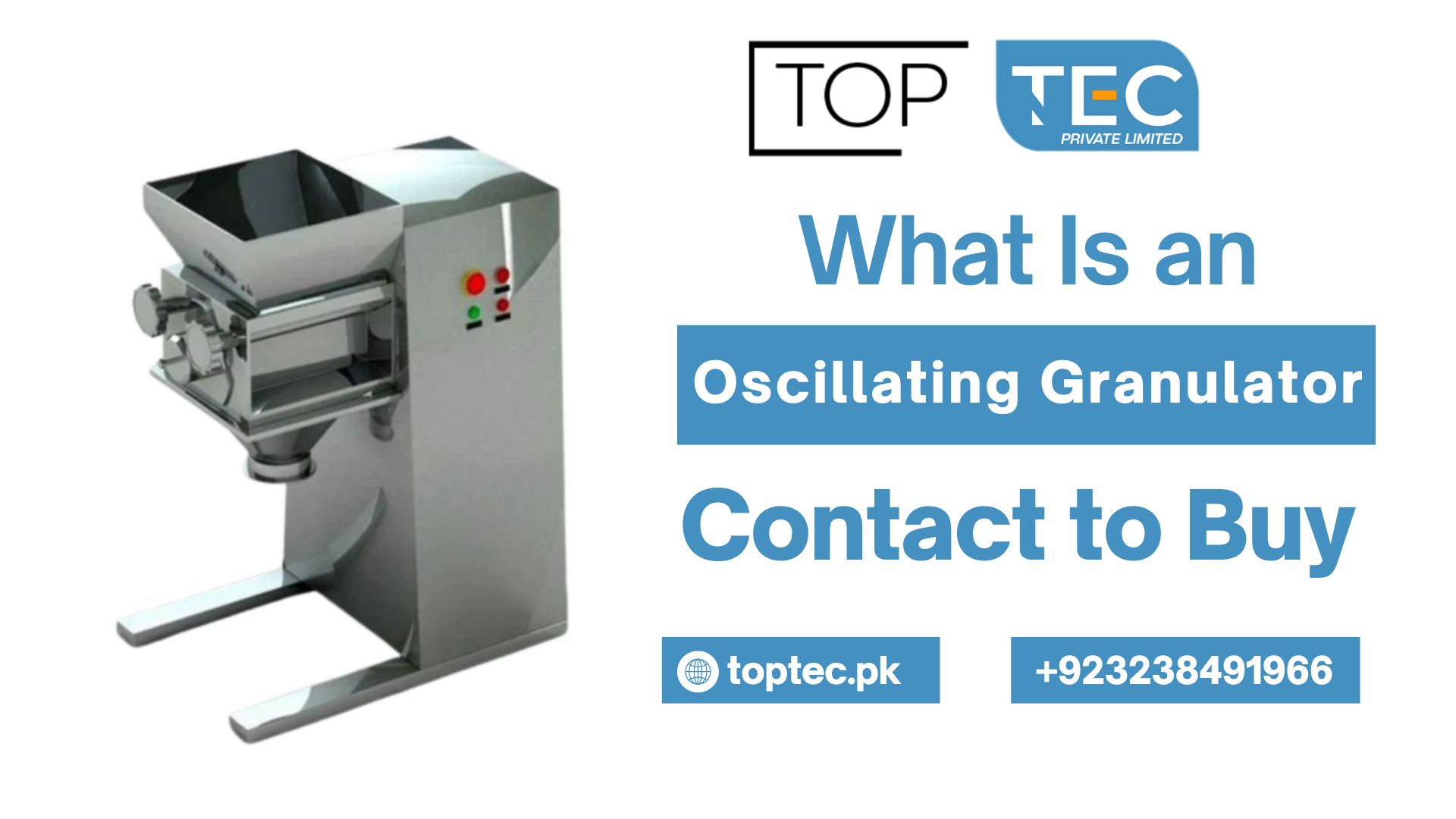
What Is an Oscillating Granulator? Learn how oscillating granulation works in wet and dry pharmaceutical processing, including screens, critical parameters, GMP design, cleaning and equipment selection.
Granulation may look like a simple size-reduction step, but the quality of the granules can influence almost everything that follows. Poorly sized material may flow unevenly, segregate during transfer or fill tablet dies inconsistently. Excess fines can create dust and compression problems, while oversized granules may affect blend uniformity.
An Oscillating Granulator is one of those machines that quietly solves several of these problems. Its controlled, back-and-forth action passes material through a selected screen without relying on the high-speed impact used by many conventional mills.
Pharmaceutical manufacturers use it for wet massing, dry sizing and the controlled reduction of compacted material. The machine is relatively straightforward, but good results still depend on screen selection, feed rate, product moisture and careful cleaning.
What Is an Oscillating Granulator?
In simple terms, an Oscillating Granulator is a pharmaceutical processing machine that pushes wet or dry material through a perforated screen using an oscillating rotor. The rotor moves backwards and forwards rather than rotating continuously in one direction.
This movement applies pressure and moderate shear to the product. Soft lumps are broken down, oversized pieces are reduced and the material exits through the screen openings as more uniform granules.
Typical applications include:
- Sizing wet mass before drying
- Reducing dried granules before final blending
- Sizing compacted ribbons or slugs in dry granulation
- Breaking soft agglomerates
- Preparing granules for tablet compression
- Improving powder flow before capsule filling
- Reworking suitable oversized granules
The machine should not be confused with a high-shear granulator. A high-shear system mixes powders and binder inside a closed bowl to create wet granules. An oscillating unit normally receives material that has already been mixed, wetted or compacted.
How an Oscillating Granulator Works
Inside an Oscillating Granulator, product enters through a feed hopper and falls into the processing chamber. A rotor fitted with bars, paddles or shaped blades moves repeatedly across a curved perforated screen.
As the rotor travels, it presses the material against the screen. Particles small enough to pass through the openings leave through the lower discharge. Oversized pieces remain in the chamber until further rotor movement reduces them sufficiently.
The process is based mainly on:
- Compression against the screen
- Moderate shear
- Gentle breaking of agglomerates
- Controlled passage through fixed openings
This low-speed action usually produces less heat than high-speed impact milling. That can be useful for heat-sensitive formulations, although product temperature should still be monitored during development.
The screen controls the maximum size of the discharged material, but it does not make every granule identical. Some variation and fines will remain. The objective is a practical particle-size distribution that supports the next manufacturing stage.
Main Machine Components
Although designs vary by capacity and manufacturer, most pharmaceutical models include the following components.
Feed Hopper
The hopper receives wet mass, dried material or compacted ribbons. It should promote steady feeding without leaving product trapped around corners or joints.
A covered hopper may be useful when processing dusty material. Potent or sensitising compounds may require a contained feed connection rather than open manual charging.
Oscillating Rotor
The rotor is the main working part. Its movement pushes the material across the screen. Rotor shape affects the pressure and shear applied to the product.
The rotor should be easy to remove for cleaning and inspection. Product-contact surfaces should not contain open threads, sharp internal corners or difficult-to-reach gaps.
Perforated Screen
The screen has a major influence on granule size, throughput and fines generation. Different products may require different aperture sizes, screen thicknesses and perforation patterns.
A smaller opening does not automatically produce a better product. It can reduce throughput, increase mechanical stress and create excessive fines.
Processing Chamber
The chamber contains the rotor and screen. For pharmaceutical service, it should have a smooth internal finish and allow complete inspection after cleaning.
Drive System
The motor and gearbox generate the oscillating movement. Depending on the model, speed may be fixed or adjustable through a variable-frequency drive.
Variable-speed control offers more flexibility during process development, but the approved operating range should be defined during qualification.
Discharge Chute
Processed granules leave through the lower discharge. The outlet should connect cleanly to a container, dryer or transfer system without excessive product loss.
Safety Guards
Modern machines should include appropriate covers, guards, emergency stops and electrical interlocks. The unit must not start while guarded sections are open.
Wet Granulation Applications
In wet processing, the Oscillating Granulator is generally positioned after wet massing and before drying. The powder blend has already been mixed with a binder solution, creating a cohesive mass that needs to be converted into manageable wet granules.
A typical process looks like this:
- Dispense and sieve the raw materials
- Blend the API with excipients
- Prepare the binder solution
- Add the binder and establish the wet-massing endpoint
- Pass the wet mass through the selected screen
- Transfer the wet granules to a tray or fluid-bed dryer
- Dry to the approved moisture endpoint
- Perform dry sizing if necessary
- Add lubricant and final excipients
- Compress tablets or fill capsules
Why Wet Granule Size Matters
Wet lumps do not dry uniformly. Large pieces retain moisture longer because water must travel farther from the centre to the surface. Fine granules dry more quickly and may become overdried before larger pieces reach the required moisture level.
A broad size distribution may therefore create variation in:
- Residual moisture
- Granule strength
- Bulk density
- Compressibility
- Tablet hardness
- Friability
- Disintegration time
- Drug dissolution
Producing a reasonably consistent wet granule helps make the drying stage more predictable.
What Happens if the Mass Is Too Wet?
Over-wet material tends to smear across the screen. It may block perforations, reduce output and increase load on the drive system. Operators sometimes respond by forcing more material into the hopper, which usually makes the situation worse.
The better response is to review:
- Binder quantity
- Binder concentration
- Mixing time
- Wet-massing endpoint
- Product temperature
- Feed rate
The machine cannot correct an unsuitable wet mass simply by changing speed.
Dry Granulation Applications
For dry processing, the Oscillating Granulator is used after compaction. Powder is first compressed into ribbons using a roller compactor or formed into slugs with a tablet press. The compacted material is then sized into granules.
It is important to make this distinction. The unit does not convert loose powder directly into dry granules because it does not provide the compaction required for particle bonding.
A typical dry granulation process includes:
- Dispensing and sieving
- Pre-blending
- Roller compaction or slugging
- Sizing compacted material
- Screening or classification
- Final blending and lubrication
- Tablet compression or capsule filling
Dry ribbons and slugs are generally harder and more brittle than wet mass. If the screen is too fine or the rotor action is too aggressive, the process may produce excessive fines.
Fines can create practical problems later:
- Poor powder flow
- Dust during transfer
- Segregation from larger granules
- Inconsistent die filling
- Variation in tablet weight
- Reduced content uniformity
Dry sizing should therefore be developed alongside the compaction pressure and ribbon properties. Treating the mill as an isolated operation often leads to repeated adjustment without addressing the real cause.
Critical Process Parameters
The output from an Oscillating Granulator depends on the interaction of the formulation, machine settings and screen. The following parameters deserve particular attention during process development.
Screen Aperture
Screen aperture controls the upper end of the particle-size distribution. Smaller openings usually create smaller granules, but they may also produce more fines and reduce output.
Screen identification should be controlled. Each screen should have a unique number or clearly recorded aperture, material and status.
Rotor Speed
Increasing speed may improve throughput, but it can also increase granule breakage and product temperature. There is no universal “best” speed. The approved range should be established for each formulation.
Feed Rate
Overfeeding loads the processing chamber, encourages screen blockage and may produce inconsistent granules. Underfeeding reduces efficiency and can expose small amounts of product to unnecessary repeated action.
A steady feed generally produces more repeatable results than adding large amounts irregularly.
Moisture Content
Wet mass that is too dry may crumble and create fines. Over-wet material may smear and block the screen. The wet-massing endpoint should therefore be defined by a validated process rather than operator judgement alone.
Rotor-to-Screen Clearance
Clearance affects how much pressure is applied to the material. Excessive clearance may reduce sizing effectiveness, while insufficient clearance can damage the screen or create unnecessary friction.
Number of Passes
Repeated processing usually increases fines. If the product needs several passes to meet the target size, the initial screen choice, feed properties or upstream process may need review.
Product Temperature
Even a low-speed machine generates some friction. Temperature monitoring may be necessary for APIs or binders that soften, degrade or become sticky when warm.
Benefits in Pharmaceutical Production
One reason an Oscillating Granulator remains widely used is its balance of gentle processing, practical output and relatively straightforward operation.
Key advantages include:
Lower Mechanical Impact
The oscillating motion is less aggressive than many high-speed mills. This may reduce unnecessary heat generation and preserve granule structure.
Flexible Screen Selection
Interchangeable screens make it possible to adjust output for wet sizing, dry sizing and different formulations.
Support for Wet and Dry Processes
A single machine may be used at more than one stage, provided cross-contamination controls and validated cleaning procedures are in place.
Straightforward Operation
The mechanical principle is easy to understand. Operators can quickly recognise problems such as screen blockage, irregular feeding or abnormal machine noise.
Easier Cleaning
Well-designed units allow removal of the hopper, rotor, screen and discharge parts without complicated tools.
Reduced Dust During Wet Sizing
Wet material produces less airborne dust than dry milling. However, dust extraction may still be required during dry sizing.
Comparison With Other Granulation Equipment
| Equipment | Main function | Processing action | Typical use |
|---|---|---|---|
| Oscillating mill | Wet and dry sizing | Rotor moves material against a screen | Wet mass, dry granules and compacted ribbons |
| Cone mill | Sizing and delumping | Rotating impeller inside a conical screen | High-throughput wet or dry milling |
| Multi-mill | Size reduction | High-speed impact and cutting | Dry milling and granule sizing |
| High-shear granulator | Wet granule formation | Impeller and chopper in a mixing bowl | Rapid mixing and binder addition |
| Roller compactor | Dry compaction | Rollers compress powder into ribbons | Moisture-sensitive formulations |
Cone mills often provide higher throughput and a compact footprint. Multi-mills offer flexibility but may generate more heat or fines. High-shear systems combine mixing and granulation but require more complex cleaning and process control.
The best machine is the one that matches the formulation and downstream quality requirements—not necessarily the newest or fastest option.
GMP Design and Safety Requirements
A pharmaceutical Oscillating Granulator should be designed around cleanability, operator safety and repeatable performance.
Important requirements may include:
- Stainless steel 316L product-contact parts
- Stainless steel 304 external construction
- Smooth product-contact finish, often Ra 0.8 µm or better where specified
- Pharmaceutical-grade gaskets and lubricants
- Tool-free removal of contact parts where practical
- No inaccessible product traps
- Enclosed drive components
- Emergency-stop control
- Motor-overload protection
- Guard and cover interlocks
- Dust-extraction connection
- Earthing and bonding for dry powder processing
- Clear screen identification
- Variable-speed display where applicable
Where combustible dust or flammable solvent vapours may be present, the equipment must be selected through a formal hazardous-area assessment. A standard motor and electrical panel should not be assumed suitable.
Potent compounds may also require contained charging, enclosed discharge and local dust extraction. Stainless steel construction alone does not provide containment.
Qualification and Process Validation
The machine should be qualified before routine GMP use.
Design Qualification
Design Qualification confirms that the proposed equipment meets the User Requirement Specification. It should address capacity, materials, screens, controls, cleaning and safety.
Installation Qualification
IQ verifies:
- Model and serial number
- Installation location
- Materials of construction
- Motor and electrical supply
- Utility connections
- Drawings and manuals
- Lubricant details
- Screen inventory
- Safety guards
Operational Qualification
OQ normally checks:
- Speed or oscillation-frequency range
- Timer operation
- Emergency stop
- Guard interlocks
- Motor-overload protection
- Direction and smoothness of movement
- Alarm functions
- Control-panel operation
Performance Qualification
PQ demonstrates that the machine repeatedly produces granules meeting approved criteria under routine operating conditions.
Tests may include:
- Particle-size distribution
- Bulk and tapped density
- Moisture content
- Flow rate
- Angle of repose
- Hausner ratio
- Compressibility index
- Assay and content uniformity
- Tablet compression performance
Cleaning, Inspection and Maintenance
Cleaning is more than washing the visible chamber. Product can collect around rotor ends, behind seals, beneath the screen and inside discharge joints.
A typical cleaning procedure may involve:
- Stop and electrically isolate the machine
- Remove remaining product safely
- Dismantle the hopper, rotor, screen and discharge parts
- Carry out the approved dry or wet cleaning method
- Inspect all product-contact surfaces
- Rinse where required
- Dry components completely
- Reassemble the machine
- Perform line clearance
- Attach the approved clean-status label
Screens require special care. A dented, stretched or cracked screen changes the particle-size distribution and may release metal fragments. It should be inspected before and after every batch.
Preventive maintenance should cover:
- Rotor condition
- Bearings and seals
- Drive belt or gearbox
- Screen-retaining parts
- Electrical interlocks
- Emergency stop
- Abnormal vibration or noise
- Earthing continuity
- Calibration of displayed speed where applicable
Selecting the Right Machine
Before choosing an Oscillating Granulator, define what the process actually requires rather than relying only on the maximum output shown in a brochure.
Discuss these points with the supplier:
- Required output in kilograms per hour
- Wet, dry or combined application
- Product moisture and consistency
- Hardness of ribbons or slugs
- Target particle-size distribution
- Available screen sizes
- Product-contact material
- Surface-finish documentation
- Variable-speed requirements
- Dust-extraction needs
- Cleaning method
- Spare-part availability
- IQ and OQ documentation
- Local installation and technical support
Actual throughput depends on the product, feed rate, screen and moisture level. A product trial is more useful than a theoretical capacity figure whenever the supplier can arrange one.
Laboratory Furniture from TOPTEC PVT. LTD
The Oscillating Granulator may be the main processing machine, but it still needs a properly planned pharmaceutical environment around it. Cleanable worktables, safe screen storage, controlled sample transfer and suitable QC furniture all support a compliant operation.
TOPTEC PVT. LTD manufactures laboratory and cleanroom furniture in Pakistan, including:
- Stainless steel worktables
- Cleanroom trolleys
- Screen and tool-storage cabinets
- Laboratory workbenches
- Pass boxes
- Fume hoods
- Biological safety cabinets
- Laminar-flow cabinets
- Chemical-storage cabinets
- Instrument benches
- Laboratory sinks
- Shelving systems
Local manufacturing offers shorter delivery times, easier customisation and accessible after-sales support. Worktables and cabinets can be sized around existing production rooms, cleanroom panels and material-flow arrangements.
Before ordering, provide TOPTEC with room dimensions, expected loads, cleaning chemicals and workflow requirements. Furniture for pharmaceutical production should be smooth, durable and easy to sanitise.
Frequently Asked Questions
Can the machine perform dry granulation without a roller compactor?
No. Dry granulation requires a compaction stage. The machine sizes the ribbons or slugs after compaction.
Can the same unit handle wet and dry material?
Yes, provided the design is suitable and cleaning procedures prevent cross-contamination. Different screens and settings may be required.
What causes excessive fines?
Common causes include material that is too dry, excessive rotor speed, an overly fine screen, repeated processing or unsuitable clearance.
How often should the screen be changed?
There is no universal replacement interval. Replace it when it becomes worn, stretched, cracked, dented or dimensionally unacceptable.
Is it suitable for heat-sensitive APIs?
Its relatively gentle action may be suitable, but product temperature should still be measured during development and validation.
Does a smaller screen always improve granule quality?
No. It may reduce throughput and increase fines. The correct screen is the one that gives acceptable flow, density and downstream performance.
Final Thoughts
A well-selected Oscillating Granulator can improve wet-mass sizing, drying consistency, powder flow and downstream tablet or capsule production. Its operating principle is straightforward, but process results depend on more than the machine alone.
Screen aperture, rotor speed, product moisture, feed rate and upstream compaction all need to work together. The equipment must also be easy to clean, properly guarded and supported by qualification, maintenance and screen-control procedures.
For locally manufactured laboratory workbenches, stainless steel tables, cleanroom furniture, pass boxes and storage solutions in Pakistan, contact TOPTEC PVT. LTD to discuss your pharmaceutical facility requirements.
