

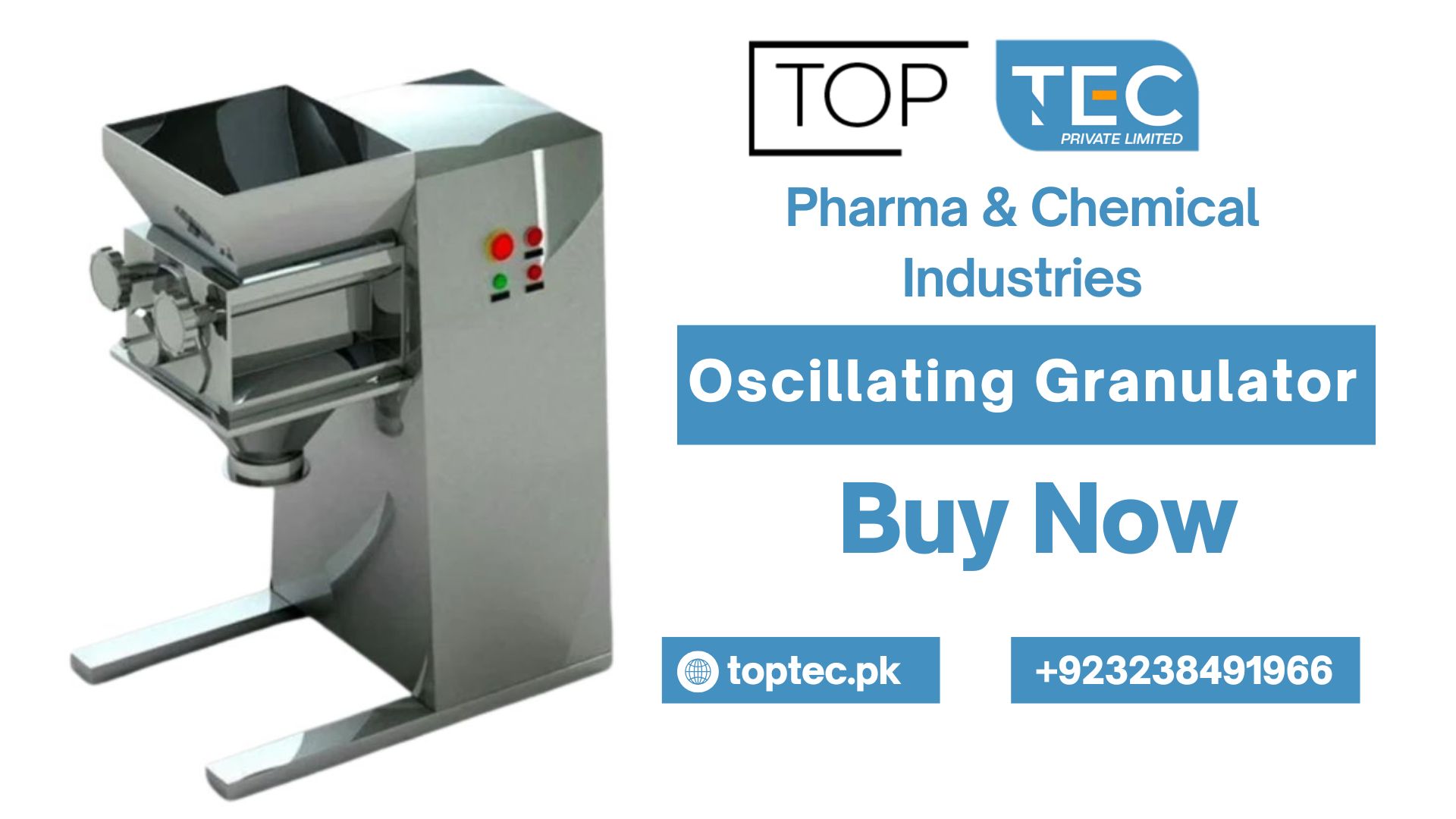
A Practical Guide for Process Engineers and Production Managers Who Need to Understand This Equipment Properly – Oscillating Granulator
Granulation — the process of converting fine powders into larger, more uniform granules — isn’t done because granules look nicer. It’s done because granules behave better. They flow better through hoppers and feed systems. They compress more uniformly in tablet presses. They mix more consistently without segregating by particle size. They generate less dust, which matters both for processing efficiency and worker safety.
The oscillating granulator is one of the workhorses of granulation operations across pharmaceutical, food, and chemical manufacturing. It’s not the most glamorous piece of equipment in a production facility, but understanding how it works, what it does well, and where it has limitations is genuinely important for anyone involved in solid dosage manufacturing, granular food production, or chemical processing.
This guide covers the oscillating granulator machine properly — operating principle, wet and dry applications, the critical role of the oscillating rotor, screen selection, and how to set up the right operating environment.
What an Oscillating Granulator Actually Is
An oscillating granulator is a size-reduction and granulation machine that forces material through a perforated screen using a rotor that oscillates — moves back and forth in a rotary motion rather than rotating continuously in one direction.
This oscillating motion is the defining characteristic of the machine and the source of its name. The oscillating rotor moves clockwise and then counter-clockwise through a defined arc angle, continuously pushing material against the screen surface and forcing it through the perforations. Material that’s too large to pass through the screen openings is broken down by the mechanical action of the rotor blades pressing against it until it’s small enough to exit through the screen.
The granules that exit through the screen have a relatively uniform size distribution determined primarily by the screen hole size. Change the screen, change the granule size range you produce.
This sounds simple — and mechanically it is relatively straightforward. But the implications of this simple mechanism for different materials and different applications are significant, and understanding them is what separates operators who get good results from operators who struggle with the same equipment.
The Oscillating Rotor: Why Oscillation Instead of Continuous Rotation
This is the technical question worth answering properly, because the oscillating rotor design is a deliberate engineering choice with specific advantages.
A continuously rotating rotor — like those used in hammer mills or other size-reduction equipment — works through impact or high-speed shear. The rotor hits material at speed, breaking it by impact forces. This is effective for size reduction but generates significant heat from friction, can damage fragile materials, and tends to produce a wider particle size distribution.
The oscillating rotor works differently. It moves at relatively low speed — typically between 60 and 200 RPM depending on the machine size and application — through an arc of perhaps 30-45 degrees in each direction. The blades press material against the screen with a combined compression and shear action rather than impact.
What this means in practice:
Gentle processing: The compression-shear action of the oscillating rotor is significantly gentler than impact milling. For pharmaceutical materials where crystal form, polymorphic stability, or chemical integrity could be affected by excessive heat or mechanical stress, this gentleness matters.
Controlled granule formation: Because the action is compression and shear rather than impact, the oscillating granulator machine tends to produce granules with more consistent shape and a tighter size distribution than impact mills. This directly affects downstream processing — more uniform granules flow more predictably and compress more consistently.
Less fines generation: Impact processes tend to produce significant fines (very small particles) as a byproduct. The oscillating rotor mechanism generates fewer fines, reducing waste and the amount of oversized/undersized material that needs to be reprocessed.
Lower heat generation: Less frictional heat means thermolabile materials are safer to process in an oscillating granulator than in higher-speed alternative equipment.
Wet Granulation Applications
Wet granulation is the process of adding a granulating liquid (binder solution) to a powder mixture to form granules, followed by drying to remove the added liquid. The oscillating granulator has a specific and important role in the wet granulation process.
Where the Oscillating Granulator Fits in Wet Granulation
In a standard wet granulation process:
- Dry mixing: excipients and API are mixed to achieve uniform powder blend
- Binder addition: granulating liquid (water, ethanol, PVP solution, etc.) is added and mixed to form a wet mass
- Wet sizing: the wet mass is passed through the oscillating granulator machine to break it into uniform wet granules
- Drying: wet granules are dried in a fluid bed dryer or tray dryer
- Dry sizing: dried granules are passed through the oscillating granulator again to break down any agglomerates formed during drying
- Lubrication and compression: granules are blended with lubricant and compressed into tablets
The oscillating granulator is used at both Step 3 (wet sizing) and Step 5 (dry sizing). This is important — the same machine performs two different functions in the same granulation process.
Wet Sizing: Breaking Down the Wet Mass
After the wet mass is formed in a high-shear mixer or planetary mixer, it’s typically a dense, cohesive material — somewhere between a thick paste and a crumbly dough, depending on the formulation. Directly loading this wet mass into a fluid bed dryer would give poor results: it would dry unevenly, with outsides drying before insides, giving inconsistent granule density and potentially trapping moisture.
Passing the wet mass through the oscillating granulator with an appropriate screen size (typically 6-10mm for wet sizing) breaks it into roughly uniform pieces before drying. These uniform wet granules dry more efficiently and consistently.
The screen selection for wet sizing is larger than for dry sizing because wet material is plastic and would just smear through very fine screens rather than being properly sized.
Dry Sizing After Drying
After drying, granules tend to stick together in agglomerates — individual granules bonded to each other by dried binder bridges. Some of these agglomerates are large, hard, and would cause inconsistent tablet weight and hardness if not broken down.
The oscillating granulator machine with a finer screen (typically 0.8-2mm for dry granule sizing) breaks these agglomerates back into uniform granules ready for tablet compression. The gentle oscillating rotor action breaks the dried binder bridges without generating excessive fines or damaging the granules themselves.
Dry Granulation Applications
Dry granulation — making granules without adding any liquid — uses the oscillating granulator as a key processing step but in a different context.
In dry granulation, powder is first compacted — typically using a roller compactor that presses powder into dense ribbons or slugs under high pressure. These ribbons/slugs are then passed through an oscillating granulator machine to break them down into granules of the desired size.
This is called milling of compacted ribbons or slug milling, and it’s a critical step for several reasons:
Why the oscillating granulator is appropriate for ribbon milling:
Roller compacted ribbons are brittle and friable — they break along fracture planes rather than requiring significant force to break down. The gentle oscillating rotor action is well-matched to this material behavior. Higher-intensity milling equipment would over-process the ribbons, generating excessive fines.
Screen selection for ribbon milling typically ranges from 0.8mm to 2mm depending on the target granule size for the subsequent tablet compression step.
Materials suited to dry granulation with oscillating granulator processing:
- Moisture-sensitive APIs where wet granulation would cause stability problems
- Thermolabile materials where drying would cause degradation
- Materials with very low dose API content where the added granulating liquid would create processing challenges
- Materials where a specific crystal form must be preserved
Screen Selection: The Most Important Operating Parameter
If there’s one aspect of oscillating granulator operation that most directly determines the quality of your granule output, it’s screen selection.
The screen — a perforated metal sheet with holes of a specific size and shape — determines the maximum size of granules exiting the machine. Material is forced through the screen openings; anything that can’t pass through is processed by the oscillating rotor until it breaks down enough to exit.
Screen Hole Size
Screen hole sizes typically range from 0.5mm to 12mm or more. The appropriate choice depends on:
- Target granule size distribution
- Material being processed (wet or dry, brittle or plastic)
- Downstream process requirements
For pharmaceutical tablet compression, typical granule sizes after final sizing are 250µm to 1000µm (0.25mm to 1mm). Screen sizes of 0.8mm to 1.5mm are commonly used for final dry sizing.
For wet sizing before drying, much larger screens (4mm to 10mm) are appropriate.
Screen Hole Shape
Round holes are the most common and most appropriate for granulation applications. They give relatively isotropic granule shapes and consistent sizing.
Other hole shapes exist — elongated slots, for example — but for pharmaceutical and food granulation, round holes are standard.
Screen Material
Pharmaceutical applications use stainless steel screens — 316L for pharmaceutical-grade contact parts. The screens are perforated metal sheets rather than woven wire, giving clean, defined hole edges that don’t generate metal contamination into the product.
Screen integrity inspection is part of proper oscillating granulator maintenance — damaged or worn screens must be replaced because screen fragments in product are a contamination risk.
Food Industry Applications
The oscillating granulator machine finds significant application in food processing where particle size control is important.
Sugar and Sweetener Processing
Granular sugar production, powdered sugar granulation, and sweetener particle size conditioning all benefit from the gentle processing action of the oscillating rotor. Sugar is a heat-sensitive material that can melt if excessive frictional heat is generated — the low-speed oscillating mechanism handles sugar processing without the thermal damage that impact mills can cause.
Spice and Herb Processing
Breaking down dried herb and spice materials to consistent particle sizes for blending and packaging uses oscillating granulator technology in food processing facilities. The screen-controlled particle size ensures consistent product quality.
Seasoning and Flavoring Blends
Many seasoning blends require consistent particle size distribution to ensure uniform coverage and consistent flavor delivery. The oscillating granulator machine provides this control without excessive fines generation that would cause clumping and flow problems.
Instant Beverage Products
Granulated coffee, tea blends, and other instant beverage products require specific particle sizes for appropriate dissolution characteristics. Granulation using an oscillating granulator creates granules with the right size and density for proper dissolution when the beverage is reconstituted.
Chemical Industry Applications
Beyond pharmaceutical and food applications, the oscillating granulator serves chemical manufacturing in several ways.
Fertilizer Processing
Granular fertilizer production requires consistent particle size for even spreading and uniform nutrient release. The oscillating granulator machine processes fertilizer materials to target size distributions suitable for agricultural application equipment.
Detergent and Cleaning Product Manufacturing
Granular detergent products need specific particle sizes for dissolution rate, flow properties, and packaging performance. The oscillating granulator provides the size control needed for consistent product performance.
Chemical Catalyst Processing
Some catalyst materials in chemical processing need to be granulated to specific sizes for reactor bed applications. The gentle processing of the oscillating rotor is appropriate for catalyst materials that might be mechanically fragile.
Pigment and Colorant Processing
Pigment granulation for paint and coating manufacturing, where consistent particle size affects color strength and dispersion behavior, uses oscillating granulator technology.
Key Operating Parameters
Understanding the operating parameters that affect output quality helps operators get consistent results from their oscillating granulator machine.
Rotor Speed
The oscillating rotor speed — measured in oscillations per minute (or equivalent RPM) — affects both granulation efficiency and granule quality.
Lower speeds: Gentler processing, less fines generation, better for fragile materials. Longer processing time for equivalent throughput.
Higher speeds: Higher throughput, more aggressive size reduction, may generate more fines. Appropriate for robust materials needing significant size reduction.
Most pharmaceutical applications use lower to mid-range rotor speeds to protect material integrity.
Feed Rate
The rate at which material is fed into the oscillating granulator affects both throughput and granule quality. Overfeeding — introducing material faster than the machine can process it — leads to:
- Overloading of the screen
- Inconsistent granule sizing
- Potential motor overload
Controlled, consistent feeding — typically via a feeding hopper with controlled outlet — is essential for consistent granule production.
Machine Cleaning and Changeover
In pharmaceutical GMP environments, oscillating granulator cleaning between products (and often between batches of the same product) is a significant operational consideration. The machine must be designed for easy disassembly of product-contact parts — rotor, screen, housing — for thorough cleaning and visual inspection.
Cleaning validation for the oscillating granulator machine follows the same principles as other pharmaceutical processing equipment — swab testing, rinse sampling, and visual inspection to confirm residue below validated limits.
GMP Considerations for Pharmaceutical Oscillating Granulators
For pharmaceutical manufacturing in Pakistan under DRAP GMP requirements, the oscillating granulator machine must meet specific expectations.
Material of construction: All product-contact parts in 316L stainless steel with appropriate surface finish (Ra ≤ 0.8 µm or better). Non-contact parts in 304 stainless steel or appropriate coated materials.
Surface finish and cleanability: Smooth, coved surfaces without dead spaces or crevices that retain product. Cleanable by the facility’s validated cleaning procedure.
Documentation: Equipment logbook, cleaning records, maintenance records. Qualification documentation — IQ/OQ/PQ — required before use in GMP manufacturing.
Screen integrity verification: Pre-use screen inspection to verify no damage or perforations outside specification. Post-use screen inspection and cleaning. Screen replacement records maintained.
Contained operation: For potent APIs, containment interfaces may be required at the feed inlet and granule outlet to prevent operator exposure to airborne particles during operation.
Setting Up Your Granulation Area
The oscillating granulator machine doesn’t operate in isolation. The production area around it needs to be properly designed for the material flows, cleaning requirements, and documentation demands of pharmaceutical or food manufacturing.
This is where TOPTEC PVT. LTD is directly relevant to your granulator installation planning.
TOPTEC PVT. LTD manufactures laboratory and pharmaceutical manufacturing furniture locally in Pakistan — genuinely manufactured here, not imported and relabeled. For granulation areas, TOPTEC provides:
Heavy-duty manufacturing benches: The oscillating granulator itself is floor-standing in most production configurations, but adjacent operations — wet mass handling, screen inspection, sampling — need proper bench infrastructure. TOPTEC’s steel-frame benches with pharmaceutical-grade surface materials handle the demands of a granulation environment.
Sampling and in-process testing stations: Granule samples taken during and after the granulation process need to be characterized — particle size, bulk density, moisture content. Dedicated sampling stations adjacent to the granulator with appropriate surface materials and storage for testing equipment.
Cleaning and maintenance areas: Granulator parts disassembled for cleaning need staging areas that keep clean and dirty parts physically separated. TOPTEC manufactures stainless steel tables and staging furniture appropriate for GMP equipment cleaning operations.
Documentation stations: Batch record completion, equipment logbook maintenance, and in-process check documentation need properly positioned, appropriately specified workstations in the granulation area.
Storage systems: Screen storage (organized, protected from damage), spare parts, cleaning materials, and batch documentation all need organized storage in the granulation area. TOPTEC’s pharmaceutical-grade storage cabinets and shelving systems serve this need.
The Practical Value of Local Manufacturing
When you’re equipping a granulation area — coordinating equipment installation with furniture delivery, commissioning timelines, and qualification schedules — lead time matters significantly.
Imported laboratory furniture takes 12-16 weeks to arrive in Pakistan. TOPTEC delivers standard items in 3-5 weeks, custom fabrications in 5-8 weeks. If your oscillating granulator machine is ready to install and commission but the surrounding workbenches and staging areas aren’t ready, you’re either delaying the project or improvising around missing infrastructure.
Custom dimensions are also practically important. Granulation areas in existing pharmaceutical buildings have fixed floor plans. TOPTEC fabricates furniture to your actual room dimensions, not standard module sizes that require compromise in layout.
PKR pricing eliminates currency exposure between quotation and delivery. Local post-installation support means adjustments and modifications are addressed quickly.
Final Thoughts
The oscillating granulator is a genuinely versatile machine — serving wet granulation sizing before and after drying, dry granulation ribbon milling, food processing particle size control, and chemical manufacturing granulation across a wide range of materials and applications.
The oscillating rotor design — with its compression-shear mechanism operating at controlled low speeds through a precise screen — provides the gentle, controlled particle sizing that pharmaceutical and food applications require. It’s not the fastest size-reduction technology, but for applications where product quality, consistent granule characteristics, and material integrity matter, the oscillating granulator machine delivers what higher-intensity alternatives can’t.
Understanding the operating parameters, the screen selection logic, and the application-specific requirements for wet and dry granulation allows you to get the best results from this equipment.
And when you’re setting up or expanding a granulation operation, the infrastructure around the oscillating granulator — workbenches, sampling stations, cleaning areas, documentation stations, storage systems — needs the same attention as the equipment itself. TOPTEC PVT. LTD manufactures this complete surrounding infrastructure locally in Pakistan, on realistic timelines, at PKR pricing, built to fit your specific facility.
Contact TOPTEC PVT. LTD
TOPTEC PVT. LTD manufactures heavy-duty manufacturing benches, sampling stations, cleaning area furniture, storage systems, and complete pharmaceutical manufacturing area infrastructure — all manufactured locally in Pakistan.
Contact TOPTEC to discuss your granulation area infrastructure requirements and receive a customized quotation.
