

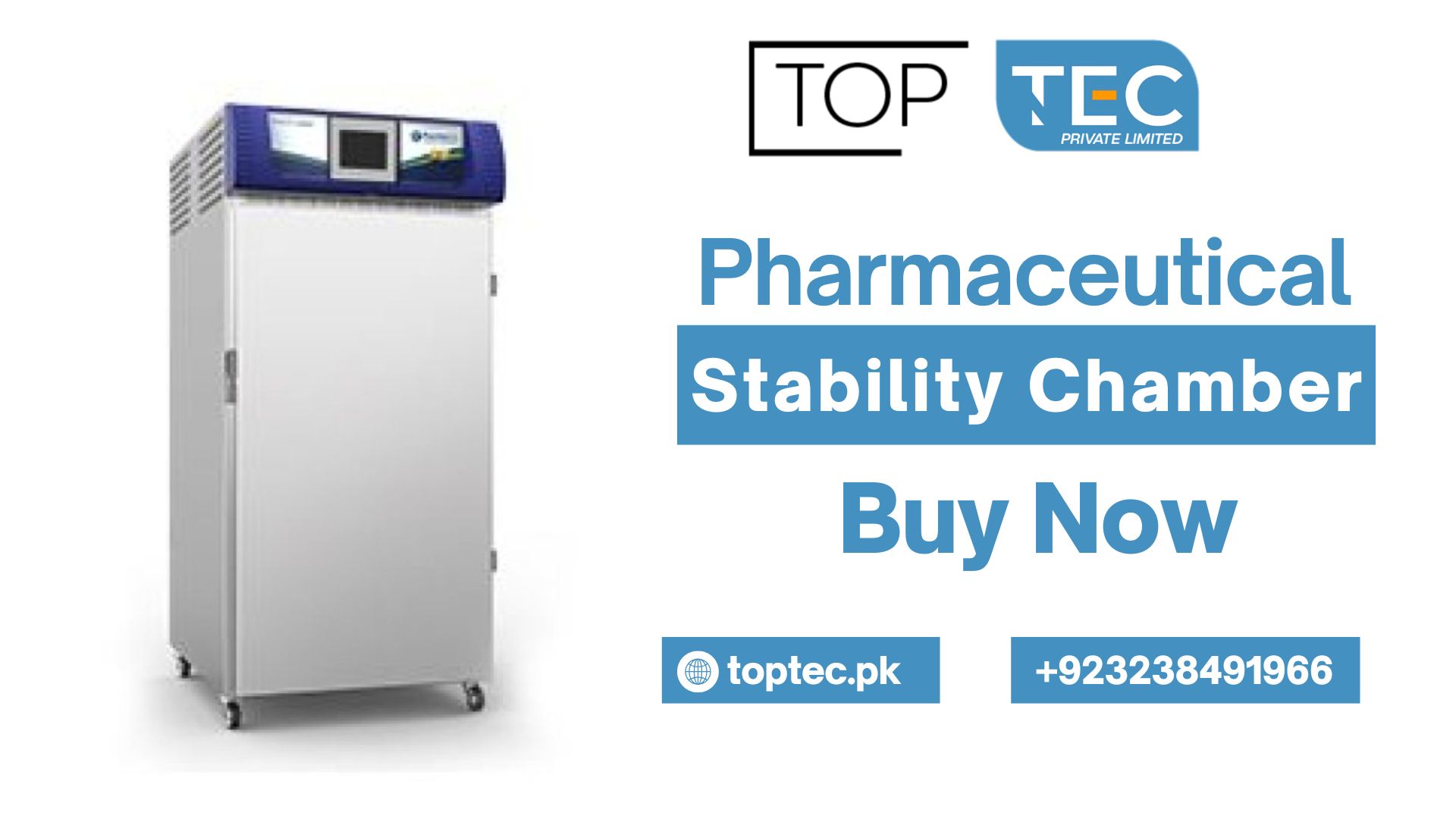
Stability testing gets treated as a regulatory checkbox rather than a genuine quality assurance activity. The pharmaceutical stability chamber gets purchased, samples get placed, time points get tested, and the data gets submitted. But whether the chamber is actually maintaining the conditions it’s supposed to maintain — whether the ICH stability testing data being generated genuinely reflects what it claims to represent — sometimes gets less attention than it deserves.
This matters because stability data is the foundation of your product’s shelf life claim. If that data was generated under conditions that weren’t what you documented, your shelf life claim isn’t supported by what you think it’s supported by. And in a DRAP inspection or an international regulatory review, that problem becomes very visible very quickly.
This guide is about doing stability testing properly — understanding what ICH requires, what pharmaceutical stability chambers need to do, and how to set up a stability program that generates data you can genuinely stand behind.
What a Pharmaceutical Stability Chamber Is and Isn’t
A pharmaceutical stability chamber is a precisely engineered environmental control system designed to maintain specific temperature and relative humidity conditions — within defined tolerances — over extended periods ranging from months to years.
What it isn’t is a sophisticated refrigerator with humidity added on. That’s how many people think about it initially, and it leads to underestimating what proper specification, qualification, and maintenance actually requires.
The precision demands are real. ICH stability testing conditions specify tolerances of ±2°C for temperature and ±5% RH for humidity. Maintaining these tolerances continuously — 24 hours a day, every day, for 24 months in a long-term study — requires sophisticated control engineering, reliable mechanical systems, and a maintenance program that treats these tolerances as non-negotiable.
A pharmaceutical stability chamber that drifts outside these tolerances, even occasionally, compromises the validity of the stability data being generated. And because the studies run for months or years, discovering the problem late means potentially invalid data that took a year to generate.
ICH Stability Testing Guidelines: What They Actually Require
ICH stability testing requirements are defined primarily in ICH Q1A(R2) — Stability Testing of New Drug Substances and Products. Understanding what this guideline actually specifies is the starting point for specifying appropriate chamber equipment.
The Climatic Zone Framework
ICH stability testing is built around a global climatic zone classification that determines the appropriate long-term storage conditions for stability studies:
Zone I (Temperate): 21°C mean kinetic temperature, 45% RH mean. UK, Northern Europe, Canada.
Zone II (Subtropical/Mediterranean): 25°C MKT, 60% RH. USA, Japan, EU.
Zone III (Hot/Dry): 30°C MKT, 35% RH. Some Middle Eastern and North African regions.
Zone IVa (Hot/Humid): 30°C MKT, 65% RH. Brazil, Southeast Asia.
Zone IVb (Hot/Very Humid): 30°C MKT, 65% RH. Pakistan, India, and other South Asian countries.
Pakistan is unambiguously Zone IVb. This classification is not optional or negotiable — it’s determined by the actual climatic conditions your population experiences when storing and using medicines.
The practical implication: pharmaceutical products registered in Pakistan, and products manufactured in Pakistan for export to similar climatic zones, require stability data generated at 30°C ± 2°C / 65% RH ± 5% RH for long-term studies. A pharmaceutical stability chamber that can’t reliably maintain these specific conditions isn’t fit for purpose in Pakistan’s regulatory environment.
Study Types Required by ICH
Long-term studies: The primary studies that directly support the proposed shelf life claim.
- Condition: 30°C/65% RH for Zone IVb products
- Duration: Minimum 12 months data at time of registration, continued to cover the full proposed shelf life
- Time points: 0, 3, 6, 9, 12 months, then at 18, 24 months and annually thereafter
Accelerated studies: Studies at elevated stress conditions intended to provide early indication of stability and support tentative shelf life predictions.
- Condition: 40°C ± 2°C / 75% RH ± 5% RH
- Duration: 6 months minimum
- Time points: 0, 3, 6 months
Intermediate studies: Required when accelerated study results show significant change, or when ICH guidelines specifically require them.
- Condition: 30°C ± 2°C / 65% RH ± 5% RH (same as Zone IVb long-term)
- Duration: 12 months
- Time points: 0, 6, 9, 12 months
Most pharmaceutical manufacturers in Pakistan need both long-term (30°C/65% RH) and accelerated (40°C/75% RH) chamber capability at minimum.
What “Significant Change” Means in ICH Terms
ICH stability testing defines specific criteria for what constitutes significant change during accelerated studies:
- 5% change in assay from initial value
- Any degradation product exceeding its specification limit
- Failure to meet specifications for appearance, physical attributes, or functionality tests
- pH outside limits (for liquid dosage forms)
- Dissolution failure for 12 units
If significant change occurs at 40°C/75% RH, an intermediate study at 30°C/65% RH is required. The accelerated study results that showed significant change cannot support a 25°C long-term storage claim.
Understanding these criteria matters for how you set up your pharmaceutical stability chamber program and how you interpret results as they come in.
Drug Substances vs. Drug Products: Different Requirements
ICH stability testing has somewhat different requirements for drug substances (APIs) and drug products (finished formulations), and this affects how you design your stability program and what your pharmaceutical stability chamber program needs to accommodate.
Drug Substance Stability (ICH Q1A)
For APIs, stability studies evaluate:
- Physical and chemical stability of the substance itself
- Storage conditions for the bulk material during manufacturing
- Retest periods (how long an API can be held before use in manufacturing)
The same climatic zones and study types apply. However, APIs are typically stored in bulk quantities with different packaging from finished products — stability container closure systems for APIs are typically the bulk storage containers.
Drug Product Stability (ICH Q1A)
For finished pharmaceutical products, stability studies must:
- Use product in its primary packaging (the actual commercial container closure system)
- Represent the commercial manufacturing process (minimum three production or pilot batches)
- Cover all intended storage conditions on the label
- Include testing for all critical quality attributes of the finished dosage form
A pharmaceutical company typically needs separate pharmaceutical stability chamber capacity for both drug substance and drug product stability studies — they may have different conditions, different packaging, and different analytical test requirements.
Pharmaceutical Stability Chamber Technical Requirements
Understanding what ICH stability testing requires translates directly into technical specifications for the pharmaceutical stability chamber equipment.
Temperature Control Specification
Target conditions and tolerances per ICH:
- Long-term (Zone IVb): 30°C ± 2°C
- Accelerated: 40°C ± 2°C
The ±2°C tolerance is the maximum allowable deviation — not a target to hover around. Best-practice chamber specifications for a pharmaceutical-grade unit target much tighter control — ±0.5°C or better at the control sensor — to provide adequate margin before approaching the ICH tolerance limit.
Temperature uniformity — the variation in temperature across different shelf positions within the chamber — is a separate specification from temperature accuracy. ICH guidelines expect temperature to be maintained at ±2°C at all sample positions, not just at the control sensor. Temperature mapping during qualification demonstrates this uniformity.
Humidity Control Specification
Target conditions and tolerances per ICH:
- Long-term (Zone IVb): 65% RH ± 5% RH
- Accelerated: 75% RH ± 5% RH
Humidity control is technically more demanding than temperature control. The control system must manage both humidification and dehumidification simultaneously, while dealing with the physical coupling between temperature and relative humidity.
A pharmaceutical stability chamber designed for ICH-compliant testing should use steam injection humidification — the most responsive and controllable approach for maintaining humidity within ±5% RH continuously.
Humidity uniformity throughout the chamber must also be demonstrated through mapping, not just assumed.
Data Logging Requirements
Continuous data logging — temperature and humidity recorded at regular intervals, typically every 5-15 minutes — throughout the entire study duration is a fundamental requirement for pharmaceutical-grade pharmaceutical stability chamber equipment.
This logging must produce:
- Complete, unbroken records for the full study duration
- Data in a format that cannot be altered without audit trail documentation
- Records that can be exported and reviewed for regulatory submission support
- Accurate timestamps verified against a calibrated time reference
For facilities operating under 21 CFR Part 11 or EU GMP Annex 11 requirements for electronic records, the chamber data logging system must comply with applicable electronic records requirements.
Alarm Systems
A pharmaceutical-grade pharmaceutical stability chamber must have alarm systems that detect and communicate:
- Temperature excursions above and below setpoint tolerance
- Humidity excursions above and below setpoint tolerance
- Power failure
- Door open beyond specified time
- Sensor failure or communication failure
Critically — alarms must reach responsible personnel 24 hours a day, 7 days a week. A temperature excursion at 3am on a Sunday that isn’t discovered until Monday morning is a serious stability data integrity problem. Remote alarm systems with SMS or email notification, or connection to a continuously monitored building management system, are essential for pharmaceutical stability programs.
Qualification: The Non-Negotiable Foundation
Purchasing a pharmaceutical stability chamber and placing samples in it doesn’t give you valid ICH stability testing data. Qualification does.
Qualification provides documented evidence that the chamber performs as specified — that it actually maintains the conditions it’s claimed to maintain, at all sample positions, consistently over time. Without qualification, you have a machine displaying numbers, not a validated system generating reliable pharmaceutical data.
IQ — Installation Qualification
IQ documents that the pharmaceutical stability chamber was received as specified, installed correctly, and connected to appropriate utilities.
IQ documentation includes:
- Equipment identity — manufacturer, model, serial number, software version
- Utility connections — electrical supply, water supply for humidifier, drain
- Environmental conditions at installation location
- Verification that delivered equipment matches purchase order specifications
- Review and filing of all manufacturer documentation
For a refurbished or relocated chamber, IQ also documents the refurbishment or relocation history.
OQ — Operational Qualification
OQ verifies that the pharmaceutical stability chamber operates within specified parameters. Key OQ tests:
Temperature accuracy and stability: Set chamber to target temperature. Allow 24 hours minimum to equilibrate. Measure actual temperature with independent calibrated thermometer. Compare to displayed value and specification. Monitor for stability over time.
Humidity accuracy and stability: Same approach for humidity. Independent calibrated reference — chilled mirror hygrometer or calibrated capacitive sensor — provides verification independent of the chamber’s own sensor.
Alarm testing: Simulate each alarm condition and verify appropriate alarm activation. Document alarm response time.
Recovery testing: Open chamber door for a defined period; record time to return to setpoint. This baseline is useful later for evaluating real door-open events.
Safety system testing: High-temperature cutout, power failure response.
PQ — Performance Qualification (Mapping)
PQ mapping is the most critical qualification activity for a pharmaceutical stability chamber. It answers the question that sensor monitoring can’t: are conditions uniform throughout the chamber at all locations where samples are actually stored?
Mapping procedure:
Place calibrated temperature and humidity data loggers at defined positions throughout the chamber — typically 9 to 27 positions or more depending on chamber size. Include positions on each shelf level, at multiple locations per shelf (front center, back corners as minimum). Record continuously for 24-72 hours with chamber under normal operating conditions.
Acceptance criteria:
All mapped positions should remain within ±2°C and ±5% RH of the setpoint throughout the mapping period. Any position that consistently exceeds these limits is identified as a location where samples should not be stored.
Document the mapping results and any excluded positions clearly. This becomes part of the chamber’s qualification file.
Remapping triggers:
- Annual requalification per GMP SOPs
- After significant maintenance or repair
- After chamber relocation
- After any event that might affect chamber performance
ICH Stability Testing for Different Dosage Forms
The ICH stability testing conditions are consistent across dosage forms, but the quality attributes tested vary significantly.
Solid Oral Dosage Forms (Tablets, Capsules)
Critical stability attributes:
- Assay (potency)
- Related substances (degradation products)
- Dissolution — often the most sensitive indicator of solid dosage form stability
- Hardness, friability, disintegration (physical stability)
- Appearance, color, odor
- Moisture content
Dissolution failure during stability — where a product that initially meets dissolution specifications fails to dissolve adequately after storage — is a particularly concerning stability failure because it directly affects bioavailability and therapeutic effect.
Parenteral Products (Injections)
Critical stability attributes:
- Assay
- Related substances and degradation products
- Particulate matter (subvisible and visible)
- pH
- Color and clarity
- Sterility (if required by study design)
- Container closure integrity
Parenteral stability studies require particular attention to container closure integrity testing — the pharmaceutical stability chamber conditions of temperature and humidity cycling can stress container closure systems, potentially creating pathways for microbial contamination or chemical degradation.
Semi-Solid Dosage Forms (Creams, Ointments, Gels)
Critical stability attributes:
- Assay
- Related substances
- Physical appearance — separation, color change, texture change
- pH
- Viscosity and consistency
- Microbial limits
Semi-solid formulations are often particularly sensitive to temperature — viscosity and physical consistency can change significantly with temperature cycling. The 30°C/65% RH condition for Pakistan can accelerate physical stability issues compared to temperate climate storage.
Biological Products and Vaccines
Critical stability attributes:
- Potency/biological activity
- Degradation products
- pH
- Physical appearance
- Sterility and microbial limits
Biologicals often have more stringent temperature requirements — many require refrigerated storage (2-8°C) or frozen storage (-20°C or lower). Pharmaceutical stability chamber equipment for biologicals typically requires refrigerated or ultra-low temperature chamber capabilities in addition to ambient-temperature ICH conditions.
Setting Up Your Pharmaceutical Stability Lab
A pharmaceutical stability chamber needs a properly designed surrounding environment to perform reliably and to support GMP-compliant operations. This is where laboratory infrastructure becomes directly relevant to your stability testing program.
TOPTEC PVT. LTD is a Pakistani manufacturer of laboratory furniture — actually manufacturing locally in Pakistan, not importing and reselling. For pharmaceutical stability labs, TOPTEC provides the complete infrastructure that surrounds and supports stability chamber operation.
What the Stability Lab Environment Needs
Room temperature control: Ambient temperature fluctuations affect pharmaceutical stability chamber performance. Large temperature swings in the room increase the chamber’s energy demand and can affect humidity control. Stability chamber rooms benefit from controlled ambient conditions.
Adequate clearances: Chamber manufacturers specify minimum clearances around units for condenser air circulation. These clearances must be maintained — blocking condenser airflow reduces cooling capacity and affects temperature control. TOPTEC’s bench and furniture design accounts for these clearance requirements.
Dedicated power: Stability chambers should have dedicated electrical circuits. Sharing circuits with other high-draw equipment can cause voltage variations that affect compressor and heater operation.
What TOPTEC Manufactures for Stability Labs
Sample preparation workbenches: Preparing samples for stability studies — weighing, packaging, labeling — requires proper bench infrastructure. TOPTEC’s steel-frame workbenches with chemical-resistant surfaces (epoxy resin, phenolic resin, or laminate) are manufactured to pharmaceutical laboratory standards. Custom dimensions accommodate any lab layout.
Documentation furniture: Stability programs generate substantial documentation — protocols, time-point worksheets, analytical results, chamber monitoring records, deviation reports. Organized documentation storage isn’t just tidier — it’s a GMP requirement. TOPTEC provides filing systems and document control furniture that integrate with lab design.
Analytical balance tables: Sample preparation for stability testing involves weighing. Analytical balances require vibration-isolated surfaces. TOPTEC manufactures dedicated balance tables with appropriate isolation and surface specifications.
Sample storage cabinets: Samples awaiting chamber placement or removed for analysis need appropriate interim storage — temperature-appropriate, protected from light, organized and identified. TOPTEC provides pharmaceutical-appropriate storage furniture.
Reference standard storage: Secure, controlled storage furniture for analytical standards used in stability sample analysis — with lock provisions and appropriate organization.
Fume hoods: Sample preparation for certain stability analyses — dissolution media preparation, sample extraction — may require fume hood access. TOPTEC manufactures ducted and ductless fume hoods locally.
Why TOPTEC’s Local Manufacturing Matters
For Pakistani pharmaceutical companies setting up or expanding stability labs, the practical advantages of local manufacturing are significant.
Lead times: Pharmaceutical stability programs have regulatory timelines. If your stability chambers arrive and laboratory furniture is still 10-14 weeks away by sea freight, you’re delaying study starts that have regulatory submission deadlines. TOPTEC delivers standard items in 3-5 weeks, custom fabrications in 5-8 weeks. Your stability lab can be operational when you need it to be.
Custom dimensions: Stability labs in existing pharmaceutical buildings often have fixed layouts that don’t match standard European or American furniture module sizes. TOPTEC fabricates to your exact dimensions — not an approximation, your actual measurements.
PKR pricing: No foreign exchange exposure between quotation and delivery. In Pakistan’s current economic environment, this is a meaningful practical advantage.
Local support: When you need modifications after installation, when additional items are required as your stability program grows, when something needs adjustment — TOPTEC is local. You’re talking to the manufacturer, not navigating an international distribution chain.
Common Compliance Issues in Pakistani Stability Programs
Based on what DRAP inspectors and international regulatory reviewers commonly identify, these are the areas where Pakistani pharmaceutical stability programs most often have gaps:
Incomplete mapping: Chamber qualification includes temperature verification at one point but not full spatial mapping. Result: no evidence that conditions are uniform at all sample positions.
Lapsed calibration: Temperature and humidity sensor calibration certificates have expired. The data generated during the lapsed period has uncertain validity.
24/7 alarm monitoring not in place: Alarms exist but only ring locally in the stability room. Excursions overnight and on weekends go undetected until Monday.
Excursion investigations not documented: Temperature or humidity excursions are corrected but not formally investigated. No assessment of impact on samples stored during the excursion.
Data logging gaps: Power failures or system errors create gaps in the continuous monitoring record. Gaps in monitoring records are data integrity concerns.
Each of these is preventable with proper setup and maintenance of your pharmaceutical stability chamber program.
Final Thoughts
ICH stability testing is not just a regulatory requirement — it’s the scientific foundation for knowing that your pharmaceutical products maintain their quality throughout their labeled shelf life. The pharmaceutical stability chamber is the instrument that makes this testing possible, and getting it right — proper specification, proper qualification, proper maintenance, proper monitoring — is what separates stability data you can genuinely rely on from data that happens to exist.
For Pakistani pharmaceutical manufacturers, Zone IVb conditions (30°C/65% RH long-term, 40°C/75% RH accelerated) are the framework. Equipment that reliably maintains these conditions, qualified and calibrated with complete documentation, surrounded by a properly designed lab infrastructure — that’s the foundation of a credible stability program.
TOPTEC PVT. LTD manufactures the laboratory furniture and infrastructure that pharmaceutical stability labs need — workbenches, documentation systems, sample storage, balance tables, fume hoods — all locally in Pakistan, on realistic timelines, at PKR pricing, built to your specific space dimensions.
Both the chamber and the environment around it need to be right. Get both right, and your stability program will generate data that stands up to regulatory scrutiny.
Contact TOPTEC PVT. LTD
TOPTEC PVT. LTD manufactures laboratory workbenches, documentation furniture, sample storage cabinets, balance tables, fume hoods, and complete pharmaceutical laboratory infrastructure — all manufactured locally in Pakistan for pharmaceutical, research, and QC laboratory environments.
Contact TOPTEC to discuss your stability lab infrastructure requirements and receive a customized quotation.
