

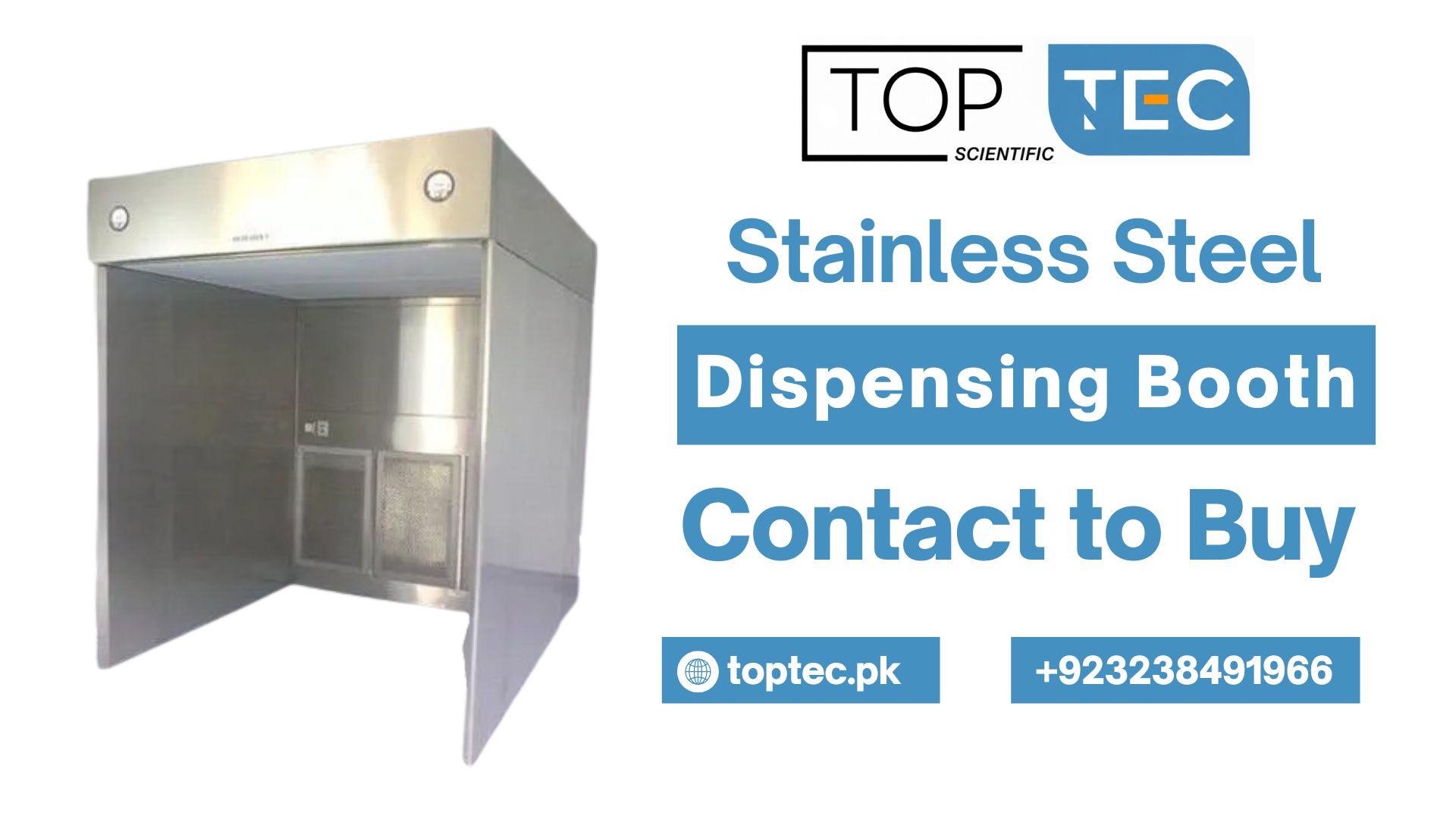
Pharmaceutical stainless steel dispensing booth for safe raw material weighing and sampling. Reverse laminar airflow with Class 100 clean air to minimize cross-contamination. Custom sizes and materials available.
There’s a moment in every pharmaceutical facility’s growth where the makeshift solutions stop working. Where you realize that doing powder weighing on an open bench, or dispensing potent APIs without proper containment, isn’t just inefficient — it’s genuinely risky. For the operators. For the product. For your regulatory standing.
That’s usually the moment when the conversation about a stainless steel dispensing booth gets serious.
If you’re at that point — or if you’re setting up a new facility and want to get it right from the beginning — this article covers everything you need to know. We’re going to talk about what these booths actually are, why the construction material and filtration system matter more than most buyers initially realize, how reverse laminar airflow works and why it’s the right airflow principle for dispensing and sampling operations, and where to source quality equipment in Pakistan without the complications of importing.
What Is a Stainless Steel Dispensing Booth?
Let’s start with the basics before getting into the technical details.
A stainless steel dispensing booth is a contained workstation — essentially an enclosure — designed to protect both the operator and the product during powder dispensing, weighing, sampling, and handling of pharmaceutical raw materials. The booth creates a controlled microenvironment within a larger facility, using a combination of physical containment and controlled airflow to prevent cross-contamination and protect personnel from exposure to potentially hazardous substances.
The “stainless steel” designation matters because pharmaceutical environments have strict requirements around surface materials. Stainless steel — particularly SS304 and SS316 grades — offers the combination of corrosion resistance, cleanability, durability, and non-reactivity that pharmaceutical and nutraceutical operations require.
These booths go by several names depending on the specific application and configuration:
- Dispensing booth — for dispensing and weighing pharmaceutical raw materials
- Weighing booth — specifically optimized for precise weighing operations
- Sampling booth — for taking samples from bulk materials
- Powder containment booth — emphasizing the containment function
In practice, the underlying engineering is similar across these variations. What changes is the specific airflow configuration, the size, and the features included to support the particular task.
Why the Construction Material Actually Matters
When you’re looking at a stainless steel dispensing booth, the grade of stainless steel isn’t just a spec sheet detail — it has real implications for how the booth performs and how long it lasts.
SS304 Stainless Steel
SS304 is the most widely used grade of stainless steel in laboratory and pharmaceutical equipment. It contains approximately 18% chromium and 8% nickel, giving it good corrosion resistance, excellent formability, and ease of cleaning.
For most pharmaceutical dispensing and sampling applications involving non-aggressive chemicals, SS304 is appropriate. It resists corrosion from cleaning agents typically used in pharmaceutical environments, it can be polished to smooth, low-roughness surfaces that don’t harbor contamination, and it’s durable enough for the long-term use these installations require.
SS316 Stainless Steel
SS316 adds molybdenum to the SS304 composition — typically 2-3%. That addition makes a significant difference in corrosion resistance, particularly against chloride-containing environments and certain aggressive chemicals.
For pharmaceutical operations involving APIs or excipients with chloride content, operations that use chlorine-containing sanitizing agents, coastal or high-humidity environments, or any application where more aggressive chemical exposure is expected, SS316 is the better choice.
The cost difference between SS304 and SS316 construction is real but often justified by the improved durability and the reduced risk of corrosion-related contamination issues over the equipment’s service life.
Why Not Painted Steel or Coated Alternatives?
In pharmaceutical environments, painted or coated steel surfaces are problematic because:
- Paint and coatings can chip, flake, or degrade — generating particles that contaminate products
- Damaged surfaces harbor microorganisms and are difficult to clean effectively
- Chemical resistance is limited compared to solid stainless steel
- They don’t meet GMP requirements for pharmaceutical manufacturing environments
A proper stainless steel dispensing booth built from solid SS304 or SS316 doesn’t have these problems. The material’s integrity isn’t dependent on a surface treatment — it’s inherent to the material itself.
Understanding Reverse Laminar Airflow: The Engineering Behind the Protection
This is the part of dispensing booth design that people sometimes gloss over — and they shouldn’t, because the airflow principle is what determines whether the booth actually protects anyone.
What Is Reverse Laminar Airflow?
Reverse laminar airflow is an airflow configuration where filtered air flows from the back of the booth toward the operator — from the clean zone behind the work surface outward toward the front opening where the operator stands.
Wait — doesn’t that sound backwards? Wouldn’t you want airflow going away from the operator and into the booth?
Here’s the logic, and it’s important: in a dispensing or weighing booth, the primary hazard is airborne powder or particulate generated during the dispensing operation. The goal is to protect the operator from inhaling that particulate.
With reverse laminar airflow:
- Clean, HEPA-filtered air flows from behind the work surface
- This airflow sweeps across the work surface and carries any generated particles downward and outward
- The particles are captured by the return air system before they can reach the operator’s breathing zone
- Fresh filtered air continuously replaces what’s exhausted
The result is that the operator is effectively working in a stream of clean air that’s carrying particles away from them rather than toward them. The powder goes into the booth’s exhaust system, not into the operator’s lungs.
How Reverse Laminar Airflow Differs from Other Airflow Configurations
Vertical laminar flow (used in cleanrooms and laminar flow benches for product protection) directs air downward from a ceiling-mounted HEPA filter. This protects the product from contamination — but it pushes any particles generated on the work surface downward and potentially toward the operator.
Horizontal laminar flow pushes clean air from the back of the workstation toward the operator — good for product protection in some applications, but it blows particles directly at the person working.
Reverse laminar airflow is specifically configured for operator protection in powder handling applications. The airflow dynamics work in favor of the person doing the work.
This is why reverse laminar airflow is the correct principle for a stainless steel dispensing booth, weighing booth, or sampling booth used in pharmaceutical environments. It’s not just a marketing term — it’s a specific engineering choice with direct implications for protection effectiveness.
The 3-Stage HEPA Filtration System: What Each Stage Does
A quality stainless steel dispensing booth doesn’t rely on a single filter to do all the work. A properly designed system uses multiple filtration stages, each targeting different particle sizes and serving a different function in the overall filtration cascade.
Stage 1: Pre-Filter
The first stage is a coarse pre-filter — typically rated at G4 or F5 by European filter standards, or equivalent. Its job is to capture larger particles: dust, lint, fiber, and other gross contamination in the recirculating air stream.
The pre-filter does the heavy lifting in terms of particle load. By catching the majority of larger particles at this stage, it protects the downstream filters from premature loading. This extends the service life of the more expensive HEPA filter significantly — which matters for operating economics over the life of the booth.
Pre-filters are relatively inexpensive and easy to replace. They should be changed on a schedule appropriate to the operating environment and the materials being handled.
Stage 2: Medium Filter (Secondary Filter)
The second stage is a medium efficiency filter — typically F7 or F8 rated. This stage captures smaller particles that passed through the pre-filter: fine dust, some microbial particles, and submicron contamination.
The medium filter further reduces the particle load on the final HEPA stage. Again, this is about protecting the HEPA filter and maintaining system performance over time. A system that skips this stage and relies on the pre-filter alone to protect the HEPA tends to have much shorter HEPA filter life and higher long-term maintenance costs.
Stage 3: HEPA Filter (High Efficiency Particulate Air)
The third stage is the HEPA filter — the heart of the filtration system. A proper HEPA filter (H13 or H14 grade per EN1822 standards) captures 99.97% or more of particles at 0.3 microns, which is the most penetrating particle size for filter media.
In practical terms, this means the air leaving the HEPA filter and entering the work zone is essentially particle-free — clean room quality air being delivered to the work surface.
For pharmaceutical dispensing operations, HEPA-filtered supply air is critical. You’re not just protecting the operator from the product — you’re also protecting the product from environmental contamination. The stainless steel dispensing booth creates a local clean environment around the dispensing operation, which is particularly important for sterile or highly sensitive materials.
HEPA filters should be integrity-tested (DOP or PAO tested) after installation and on a regular schedule thereafter. A filter that passes visual inspection but has a pinhole breach doesn’t provide the protection its efficiency rating suggests.
Key Features of a Quality Stainless Steel Dispensing Booth
Beyond construction material and filtration, here’s what distinguishes a well-engineered booth from a basic enclosure.
Smooth Internal Surfaces with Coved Corners
Sharp internal corners collect dust and are difficult to clean thoroughly. A properly designed stainless steel dispensing booth has coved (rounded) corners and smooth internal surfaces — no ledges, gaps, or recesses where powder can accumulate. This is a GMP design requirement that has direct implications for cleanability and contamination control.
Adequate Work Surface Area
The booth needs to be large enough for the actual work being done. Cramped work space leads to awkward postures, accidental spills, and poor technique — all of which undermine both safety and efficiency. Consider what equipment will be inside the booth during operation (balance, containers, scoops, documentation) when evaluating size.
Adjustable Airflow Controls
Different materials and different operations may require different airflow velocities. A quality weighing booth provides adjustable airflow control so the face velocity can be optimized for the application — high enough for effective containment, but not so high that it disturbs sensitive weighing operations on an analytical balance.
Lighting
Proper illumination inside the booth is important for accurate work. Look for flush-mounted, sealed lighting fixtures that don’t create cleaning access problems and provide adequate lux levels for the tasks being performed.
Electrical Outlets Inside the Booth
A properly positioned, appropriate electrical supply inside the booth allows balance equipment, printers, and other accessories to be powered without cables running in and out of the work space in ways that compromise containment.
Pressure Differential Monitoring
Some installations include pressure differential monitoring to confirm the booth is maintaining appropriate conditions during operation. This is particularly relevant in more sophisticated GMP applications.
Easy Access for Maintenance
Filter replacement, fan maintenance, and cleaning all need to happen regularly. A well-designed booth provides access panels and removal mechanisms that make these tasks straightforward rather than requiring the booth to be significantly disassembled.
Dispensing Booth vs. Sampling Booth vs. Weighing Booth: What’s the Difference?
These terms sometimes get used interchangeably, and the underlying technology is similar — but there are application-specific differences worth understanding.
Stainless Steel Dispensing Booth
Used for dispensing pharmaceutical raw materials — taking bulk materials from storage containers and measuring out quantities required for manufacturing batches. The primary concerns are:
- Operator protection from API or excipient exposure
- Prevention of cross-contamination between materials
- Accurate dispensing with appropriate containment
A stainless steel dispensing booth for this application is typically larger to accommodate the containers and equipment needed, and the airflow is configured to contain powders generated during dispensing operations.
Sampling Booth
A sampling booth is used when taking samples from bulk materials — incoming raw material inspection, in-process sampling, finished product sampling. The sampling booth needs to contain any particles generated when opening bulk containers and taking samples, protecting both the operator and the sample integrity.
A sampling booth configuration may be somewhat different from a dispensing booth — potentially more compact, with specific features for holding containers during sampling. But the reverse laminar airflow principle and HEPA filtration requirements are the same.
Weighing Booth
A weighing booth is specifically configured for precision weighing operations. The key consideration here is that the airflow velocity must be carefully controlled — too high, and the air movement disturbs readings on sensitive analytical balances.
A good weighing booth balances operator protection with measurement accuracy. This often involves:
- Lower face velocity than a general dispensing booth
- Anti-vibration work surfaces
- Positioning of the balance away from direct airflow
- Sometimes a draft shield around the balance in addition to the booth enclosure
Who Needs a Stainless Steel Dispensing Booth?
The market for this equipment is broader than you might think. It’s not just large pharmaceutical manufacturers.
Pharmaceutical Manufacturing Companies
The primary and most demanding market. Pharmaceutical manufacturers dispensing APIs, particularly potent or sensitizing compounds, need proper containment equipment. GMP regulations in most countries explicitly require appropriate containment for dispensing and sampling operations.
Nutraceutical and Supplement Manufacturers
The nutraceutical sector works with many of the same materials as pharmaceuticals — vitamins, minerals, botanical extracts, amino acids. Dust containment and cross-contamination prevention are equally important, even if the regulatory framework is somewhat different.
Research and Development Laboratories
R&D labs working with active pharmaceutical ingredients during formulation development need appropriate containment — often with smaller, more flexible equipment than production facilities. A lab scale stainless steel dispensing booth is appropriate here.
Quality Control Laboratories
QC labs taking samples from production batches for testing need a proper sampling booth to ensure that sampling doesn’t contaminate the sample (affecting test results) and doesn’t expose lab analysts to hazardous materials.
Universities and Research Institutions
Pharmacy and chemistry research programs handling active compounds need appropriate containment equipment. Academic institutions are increasingly being held to the same safety standards as industry, and appropriate equipment is part of meeting those standards.
Hospitals and Compounding Pharmacies
Hospital pharmacies compounding medications — particularly cytotoxic drugs — need appropriate containment during preparation. While cytotoxic compounding typically requires biosafety cabinets rather than dispensing booths, other compounding operations benefit from proper containment.
Installation Considerations for Your Dispensing Booth
Buying the booth is one part of the equation. Getting it properly installed and integrated into your facility is the other part.
Location Planning
Where the booth sits in your facility matters. Consider:
- Proximity to material storage — operators shouldn’t be carrying open containers of powder long distances through the facility
- Airflow in the surrounding room — strong HVAC airflow near the booth entrance can disrupt the booth’s containment. The booth should be positioned away from supply air diffusers
- Access for maintenance — there needs to be adequate space around the booth for filter changes and servicing
- Workflow integration — the booth should fit logically into the material flow of your dispensing area
Electrical Requirements
Confirm what electrical supply the booth requires and ensure appropriate circuits are available at the installation location. A qualified electrician should make the connections.
If the Booth Is Recirculating vs. Ducted
Some stainless steel dispensing booth configurations recirculate air within the booth after HEPA filtration. Others are ducted to an external exhaust system. For highly potent APIs or materials with occupational exposure limits (OELs) that require full exhaust containment, a ducted configuration may be required.
For recirculating configurations, confirm that the filtration system is appropriate for the materials being handled — not all compounds are compatible with recirculating systems.
Commissioning and Testing
After installation, the booth should be commissioned properly:
- Airflow velocity measured at the face opening
- Filter integrity tested
- Lighting confirmed functional
- All controls verified
- Results documented
Don’t skip this step. You need to know the booth is actually performing before you start using it for pharmaceutical operations.
Why TOPTEC Scientific Is the Right Choice for Pakistan
If your facility is in Pakistan — and you’re looking to buy a stainless steel dispensing booth, sampling booth, weighing booth, or any other laboratory or pharmaceutical equipment — the conversation should start with TOPTEC Scientific.
Here’s why.
They Manufacture in Pakistan
TOPTEC Scientific isn’t an importer or a distributor of overseas equipment. They manufacture laboratory furniture and pharmaceutical processing equipment right here in Pakistan. That fundamental fact changes the economics and the practicality of procurement in several important ways.
No import duties. Equipment purchased from TOPTEC Scientific doesn’t carry customs duties and import taxes. On a piece of equipment like a stainless steel dispensing booth — which is a significant investment — this difference is meaningful.
No international shipping costs. Shipping heavy equipment internationally is expensive. Eliminating that cost from your procurement equation is straightforward savings.
Faster delivery. Overseas equipment takes weeks to months to arrive and clear customs. TOPTEC Scientific operates on domestic timelines. When your production schedule is waiting on equipment, faster delivery has real operational value.
Spare parts available locally. When a filter needs replacement or a component needs servicing, parts are available domestically — not on a six-week international shipping timeline.
Proper Engineering Standards
TOPTEC Scientific builds their equipment to proper engineering standards. Their stainless steel dispensing booth products are constructed from appropriate grades of stainless steel (SS304 and SS316 available), with the smooth surfaces, coved corners, and cleanable design that pharmaceutical environments require.
Their reverse laminar airflow systems are engineered to deliver actual operator protection — not just the appearance of containment. The 3-stage filtration is properly specified with appropriate pre-filter, medium filter, and HEPA filter stages configured for genuine filtration performance.
Customization Is Actually Possible
Because TOPTEC Scientific manufactures locally, customization requests are realistic. If your facility needs a specific booth size, a particular electrical configuration, a ducted rather than recirculating setup, or modifications to the standard design, those conversations are productive with a local manufacturer.
An overseas supplier — particularly for a single-unit order — often can’t or won’t accommodate customization. TOPTEC Scientific can.
Complete Laboratory Furniture Range
Beyond dispensing and sampling booths, TOPTEC Scientific manufactures a complete range of laboratory furniture and equipment:
- Laboratory benches and workstations
- Fume hoods
- Laminar flow cabinets
- Safety cabinets
- Chemical storage furniture
- Sink benches
- And much more
Being able to source your entire laboratory furniture package from one local manufacturer simplifies procurement, ensures design consistency across your facility, and typically results in better overall project pricing.
Genuine After-Sales Support
When something needs attention after purchase — a maintenance question, a spare part, a warranty issue, a service visit — TOPTEC Scientific’s support comes from people who are actually in Pakistan. That means responses in the same time zone, communication without language barriers, and the ability to actually visit your facility if needed.
That kind of support is simply not available from an overseas supplier in any practical sense.
Regulatory Context: Why Proper Containment Equipment Matters for Compliance
Pakistan’s pharmaceutical manufacturing sector operates under regulatory oversight from DRAP (Drug Regulatory Authority of Pakistan), and manufacturers exporting to international markets face additional requirements from FDA, EMA, and other regulatory bodies.
GMP guidelines from these regulatory bodies are explicit about requirements for dispensing and sampling operations:
- Appropriate containment to prevent cross-contamination
- Operator protection when handling hazardous materials
- Controlled environments for dispensing operations
- Documented procedures and equipment validation
A properly specified and validated stainless steel dispensing booth with reverse laminar airflow and 3-stage HEPA filtration supports compliance with these requirements. A makeshift arrangement or inadequate containment equipment creates regulatory risk — the kind that shows up as observations during GMP inspections.
Investing in proper equipment isn’t just about safety and product quality — it’s about maintaining the regulatory standing your business depends on.
Maintenance Schedule: Keeping Your Booth Performing
Once your booth is installed and operational, ongoing maintenance is what keeps it performing as specified.
Pre-filter replacement: Typically monthly, or more frequently in high-dust environments. This is the most frequent maintenance task and the least expensive.
Medium filter replacement: Typically every 3-6 months, depending on operational intensity and material handled.
HEPA filter integrity testing: Annually at minimum, or after any event that could have compromised filter integrity (physical damage, unusual pressure event). Filter replacement when integrity testing indicates breach or when pressure differential indicates loading.
Fan and motor inspection: Annually — check bearings, belt tension if applicable, motor condition.
Airflow velocity measurement: Quarterly or after any maintenance that could affect airflow. Document results and compare to commissioning baseline.
Cleaning: After every use for product-contact surfaces, and thorough deep cleaning on a schedule appropriate to your operating procedures.
Lighting: Replace fixtures when output degrades or failures occur.
Keep complete maintenance records. In a GMP environment, undocumented maintenance is essentially maintenance that didn’t happen from a regulatory standpoint.
Final Thoughts
A stainless steel dispensing booth with proper reverse laminar airflow and 3-stage HEPA filtration isn’t a luxury item for pharmaceutical operations — it’s foundational equipment for safe, compliant, and effective dispensing and sampling work.
The engineering matters. SS304 or SS316 construction, proper airflow design, genuine 3-stage filtration, smooth cleanable surfaces — these details determine whether the booth actually protects your operators and your product, or just gives the appearance of doing so.
Whether you need a sampling booth for incoming material inspection, a weighing booth for precision dispensing operations, or a full-scale stainless steel dispensing booth for a pharmaceutical production environment, the starting point is the same: properly engineered equipment from a supplier you can trust.
For pharmaceutical companies, research institutions, nutraceutical manufacturers, and laboratories across Pakistan, TOPTEC Scientific delivers exactly that. Locally manufactured, properly engineered, genuinely supported — and without the import costs, customs delays, and overseas procurement complications that come with sourcing this equipment from abroad.
If you’re serious about getting your dispensing or sampling operations set up correctly, TOPTEC Scientific is the conversation worth having first.
