

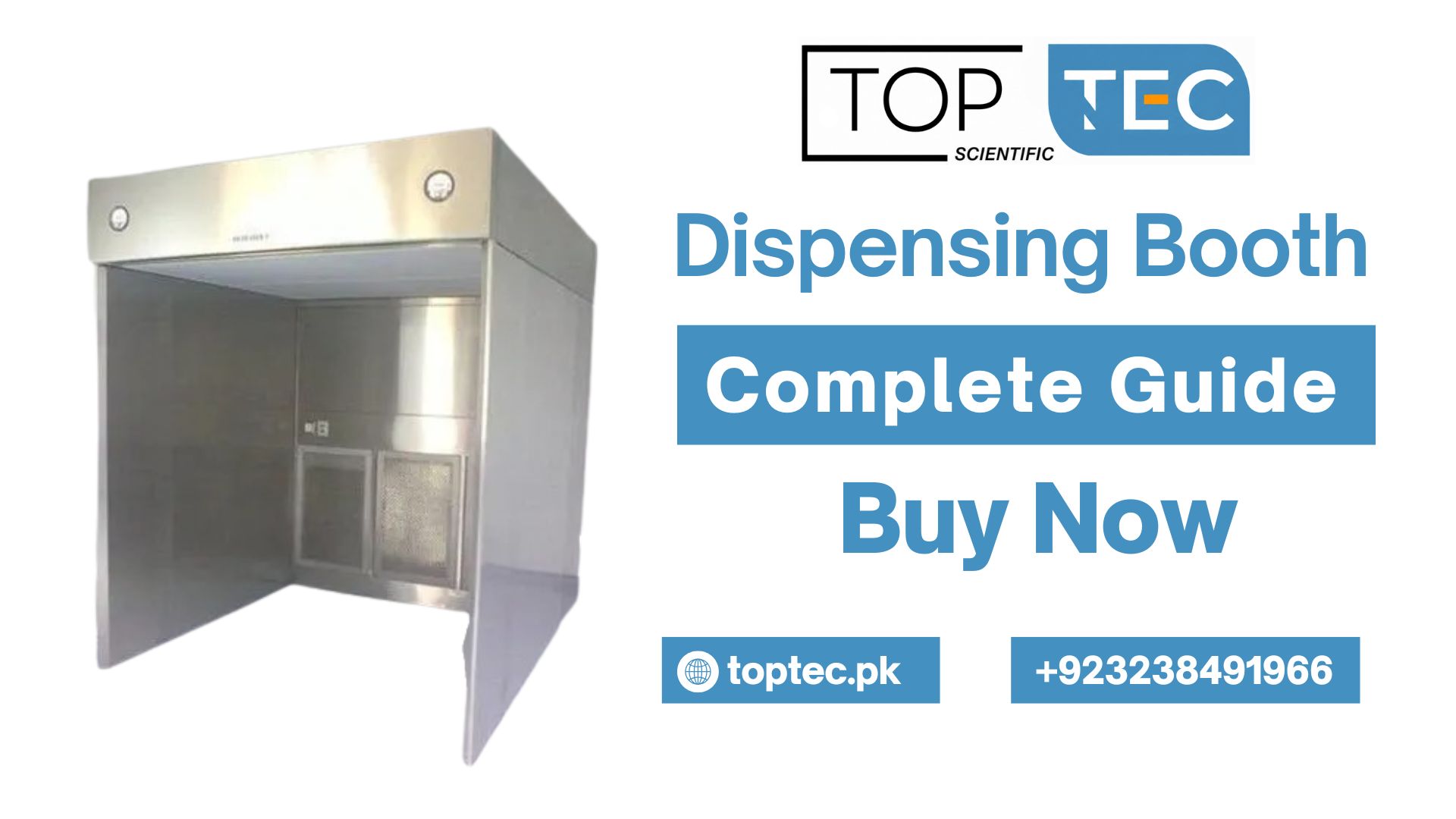
Discover high-quality dispensing booths for pharmaceutical cleanrooms. Featuring ISO Class 5 laminar airflow, HEPA filtration, and robust SS304/SS316 construction. Request a free quote from verified manufacturers today.
A production pharmacist walks into the raw material dispensing area to weigh out an API for the day’s batch. The powder is potent — a low-dose active ingredient where even milligrams of variation matter for product quality and patient safety. The weighing happens at an open bench. The scale reads accurately. The numbers look right.
But while the weighing was happening, fine API dust was drifting through the dispensing area. Some settled on surfaces that weren’t cleaned before the next material was weighed. Some was inhaled by the operator, whose respiratory protection was adequate but not ideal. And some ended up on surfaces that would carry it into the next dispensing operation — potentially contaminating a completely different product.
None of this shows up immediately. No alarm sounds. No batch fails visibly. But somewhere downstream, in a stability study result or a DRAP inspection finding or an occupational health monitoring report, the consequences appear.
A properly specified dispensing booth with appropriate reverse laminar airflow engineering prevents this scenario entirely. Not partially — entirely. That’s what this guide is about.
What Is a Dispensing Booth and Why Does It Exist?
A dispensing booth — also called a weighing booth, powder dispensing unit, or pharmaceutical dispensing enclosure — is a contained workspace engineered to protect two things simultaneously: the pharmaceutical product being handled, and the operator handling it.
Product protection means preventing environmental contamination from entering the dispensing zone and preventing cross-contamination between different pharmaceutical materials handled in the same area.
Operator protection means containing pharmaceutical dust — including potent API dust — within the booth’s control envelope rather than allowing it to disperse into the surrounding environment where operators breathe it.
The engineering that achieves both goals simultaneously is the reverse laminar airflow system at the heart of every properly designed dispensing booth. Understanding how this airflow works is fundamental to understanding what makes a good weighing booth different from an inadequate one.
The Reverse Laminar Airflow Principle — The Engineering That Makes It Work
This is the technical foundation of everything that follows, and it’s worth understanding properly.
Why “Reverse” Laminar Airflow?
Standard laminar airflow — as used in laminar flow cabinets for microbiological work or sterile compounding — flows from the back of the cabinet toward the operator. This protects the product from contamination originating from the operator and the room. But it does the opposite of what pharmaceutical dispensing needs: it blows air — and any powder dust generated during dispensing — toward the operator.
Reverse laminar airflow reverses this direction. Clean filtered air flows from the front of the booth (from a ceiling-mounted or front-mounted supply plenum) downward and toward the rear of the booth, where it’s captured by a rear extract system. This creates an airflow pattern that:
- Continuously sweeps generated dust away from the operator toward the rear extract
- Creates a clean air “curtain” at the open front face of the booth, preventing room air (which may carry contamination) from entering the work zone
- Maintains a slight negative pressure within the booth relative to the surrounding room, preventing dust escape
This airflow pattern achieves both objectives simultaneously: product protection through the clean air supply and controlled environment, and operator protection through the dust capture toward the rear extract.
The Airflow Velocity Requirement
The airflow velocity at the face of a dispensing booth — where the operator’s hands and the open powder containers are positioned — determines containment effectiveness. Too low a velocity and dust escapes around the operator before being captured by the rear extract. Too high a velocity and turbulence is created that actually disperses dust rather than containing it.
Pharmaceutical GMP guidance and containment engineering standards typically specify face velocities in the range of 0.3-0.5 meters per second for weighing booth and dispensing booth applications. This range provides effective containment without creating turbulent conditions that work against containment.
The uniformity of this face velocity matters as much as the average value. Hot spots (high velocity areas) and dead spots (low velocity areas) across the face both create containment problems. A well-engineered reverse laminar airflow system produces uniform velocity distribution across the entire booth face — verified through airflow mapping measurements.
HEPA Filtration — The Air Quality Component
The supply air entering a pharmaceutical dispensing booth passes through HEPA filtration. HEPA filters (High-Efficiency Particulate Air) capture 99.97% of particles 0.3 micrometers and larger — effectively removing all pharmaceutical dust particles from the recirculated or fresh air before it enters the clean supply zone.
For containment booths where all air is recirculated (no exhaust to atmosphere), the rear extract air passes through HEPA filtration before being returned to the supply plenum. This maintains air quality within the booth and prevents cross-contamination through the air recirculation system.
For exhaust booths where air is exhausted to atmosphere (more common in facilities with high-potency API handling), the exhaust air passes through HEPA filtration before atmospheric release, preventing pharmaceutical dust from entering the environment outside the facility.
Types of Dispensing Booths — Understanding the Configurations
The dispensing booth and sampling booth category includes several distinct configurations suited to different applications. Getting this distinction right before you buy Dispensing Booth equipment prevents significant specification mistakes.
Downflow Dispensing Booths (Powder Dispensing Units)
The most common configuration for pharmaceutical weighing and dispensing. Clean air flows downward from a ceiling-mounted supply plenum through HEPA filters, creates the protective airflow across the work surface, and is captured by perforated floor grating or a low-level rear extract system.
This downflow pattern is particularly effective for pharmaceutical powder handling because it works with gravity — powder dust falling downward is captured by the downward and rearward airflow rather than needing to be transported upward against gravity to reach an extract point.
Best applications: General pharmaceutical raw material weighing and dispensing. API dispensing for solid dose manufacturing. Excipient weighing. Material sampling for quality control purposes.
Reverse Laminar Airflow Booths (Horizontal Airflow Containment)
A more specialized configuration where clean air enters from the front face (or top), flows horizontally toward the rear, and is captured by a full-rear extract plenum. The horizontal flow creates a clear directional sweep across the work zone.
True reverse laminar airflow booths provide excellent containment for operations where the operator is positioned at the front face and generates dust in the middle of the work zone — capturing generated dust before it can reach the operator.
Best applications: High-containment API dispensing. Operator protection applications where potent API exposure limits are very tight. Any application where conventional downflow containment is insufficient.
Sampling Booths
A sampling booth is a contained enclosure specifically designed for the act of sampling — opening containers, taking representative samples from bulk materials, and closing containers — without spreading the sampled material into the surrounding environment.
Sampling generates significant dust — more so than careful weighing operations because opening bulk containers releases accumulated dust and the physical act of sample extraction disturbs the material more than careful dispensing. The sampling booth airflow design must handle these peak dust generation events without losing containment.
Best applications: Raw material sampling upon goods receipt. In-process sampling from bulk containers. Finished product sampling for quality control testing.
Weigh Dispensing Suites
For large pharmaceutical manufacturing operations with high dispensing volumes, individual booths are sometimes replaced by dedicated weigh dispensing suites — full rooms with controlled environment, contained dispensing areas for multiple materials, and comprehensive environmental monitoring. These represent a step up from individual weighing booth equipment in terms of both capability and investment.
Critical Design Features — What Separates Good Equipment from Inadequate
When you evaluate options and prepare to buy Dispensing Booth equipment, these design features consistently separate pharmaceutical-grade equipment from equipment that merely looks the part.
Work Surface Height and Ergonomics
The work surface in a weighing booth needs to be at the right height for comfortable operation over extended dispensing periods. Too high or too low and operators adopt compensating postures that affect both accuracy (holding containers awkwardly) and safety (working in ways that compromise the protective airflow envelope).
Standard pharmaceutical dispensing work surface heights are typically 850-900mm from the floor — similar to standard laboratory bench height. But the depth of the booth and the positioning of the analytical balance within it also matters — the balance needs to be positioned within the optimal containment zone, not pushed toward the back of the booth where airflow conditions may differ.
Antistatic and Balance Vibration Considerations
Pharmaceutical powders are often electrostatically charged — fine particles develop static charges during handling that cause them to cling to surfaces, float in air longer than gravity would suggest, and resist settling. A weighing booth designed for pharmaceutical use should incorporate antistatic measures:
Antistatic work surface materials that prevent charge buildup. Earth bonding of the booth frame and work surface. Optionally, ionization equipment to neutralize charged particles in the airflow.
The analytical balance positioned in the weighing booth also presents a challenge: airflow creates air movement that can destabilize sensitive balances, particularly at the 0.1mg resolution level used in pharmaceutical dispensing. Good dispensing booth design positions the balance in a location within the booth where airflow velocity is sufficient for containment but not so turbulent as to disturb the balance. Some designs incorporate balance enclosures or shields that maintain the balance in stable conditions while preserving the containment airflow.
Filter Specification and Monitoring
The HEPA filters in a pharmaceutical dispensing booth are the primary air quality control elements. Their specification, installation integrity, and ongoing monitoring are critical for performance:
Filter grade: H14 HEPA (99.995% efficiency at 0.3 micrometers) is the pharmaceutical standard. Lower-grade filters may be offered in lower-cost equipment but don’t provide equivalent pharmaceutical-grade containment.
Filter integrity testing: New dispensing booth equipment should be factory-tested for filter integrity using DOP (dioctyl phthalate) or PAO (poly-alpha-olefin) aerosol challenge. Filter scan testing verifies that there are no pinholes or frame leaks in the installed HEPA filters. This factory testing should be documented and provided with the equipment.
Differential pressure monitoring: A magnehelic gauge or electronic differential pressure sensor monitoring the pressure drop across the HEPA filters indicates filter loading — increasing pressure drop indicates filter clogging that requires replacement. Continuous monitoring allows planned filter replacement rather than emergency replacement when filters fail.
Filter replacement accessibility: HEPA filters in sampling booth and dispensing booth equipment need to be replaceable — typically annually or when differential pressure indicates loading. The filter replacement procedure must be practical for trained maintenance technicians and must be possible without contaminating the surrounding environment with the captured pharmaceutical dust in the loaded filter.
Rear Extract Design and Velocity Distribution
The rear extract system — where contaminated air leaves the work zone heading for HEPA filtration — must capture generated dust efficiently across the full width of the booth. Poorly designed extract systems create areas of low velocity near the sides of the booth where dust can escape the capture zone.
Perforated rear panels with uniform perforation distribution, properly sized plenum chambers behind the perforated extract face, and balanced extract volume — matched to supply volume to maintain the intended face velocity — are design elements that distinguish properly engineered reverse laminar airflow equipment from simpler designs.
Spillage and Cleaning Design
Pharmaceutical dispensing generates spillage — pharmaceutical powder that misses the container, spills from the balance pan, or falls from transfer equipment. The weighing booth must be designed to contain this spillage and make it easy to clean completely between dispensing operations.
Sealed internal joints — no open seams where powder can accumulate. Smooth, chemically resistant internal surfaces that don’t retain powder. Drainable collection trays below the work surface. Easy access for manual cleaning. These design features determine how effectively the booth can be cleaned between products — critical for multi-product facilities with cleaning validation requirements.
Containment Performance Levels — OEB and OEL Ratings
When pharmaceutical manufacturers are specifying dispensing booth equipment for potent API handling, containment performance needs to be quantified rather than described qualitatively.
The pharmaceutical industry uses Occupational Exposure Bands (OEB) and Occupational Exposure Limits (OEL) to classify the potency of pharmaceutical compounds and specify the containment performance needed when handling them.
OEB 1-2 / OEL > 100 µg/m³: Low potency compounds. Standard pharmaceutical hygiene measures — including basic weighing booth or dispensing booth with respiratory protection — typically adequate.
OEB 3 / OEL 10-100 µg/m³: Moderately potent compounds. Properly designed dispensing booth with reverse laminar airflow and appropriate face velocity. RPE (respiratory protective equipment) as additional protection.
OEB 4 / OEL 1-10 µg/m³: Potent compounds. High-performance dispensing booth with verified containment performance, comprehensive airflow engineering, and enhanced RPE. Some facilities use isolator technology at this band.
OEB 5 / OEL < 1 µg/m³: Highly potent compounds (HPAPIs). Typically requires contained handling isolators rather than open-front booth technology. Some advanced dispensing booth designs with special additional containment measures may be appropriate for the upper end of this band.
Understanding where your APIs sit in this classification system helps you specify the appropriate containment level when you buy Dispensing Booth equipment. A standard weighing booth adequate for OEB 3 handling isn’t appropriate for OEB 4 or 5 compounds.
GMP Requirements for Pharmaceutical Dispensing Areas
DRAP GMP requirements for pharmaceutical manufacturing facilities establish specific expectations for raw material dispensing and sampling operations that directly affect dispensing booth specification requirements.
Dedicated dispensing area: Pharmaceutical raw materials should be dispensed in a dedicated area separate from other production activities. The dispensing area should be appropriately classified — typically Grade C (ISO 7) background environment — with the dispensing booth providing localized Grade A (ISO 5) conditions within the active dispensing zone.
Equipment qualification: Dispensing booth and weighing booth equipment in pharmaceutical production use must be qualified through IQ/OQ/PQ activities. Factory Acceptance Testing (FAT) documentation, site Installation Qualification confirming correct installation, Operational Qualification verifying airflow performance, and Performance Qualification demonstrating consistent containment — all required before the booth enters GMP production use.
Environmental monitoring: Air particle counts and microbial monitoring within the dispensing zone, documented in the facility’s environmental monitoring program, are ongoing GMP requirements.
Maintenance and filter monitoring: Documented maintenance procedures, filter replacement records, and ongoing airflow velocity verification maintain the validated performance of the sampling booth or dispensing booth over time.
Operator training: Personnel operating pharmaceutical dispensing equipment must be trained in the specific procedures that maintain containment effectiveness — not just trained on the equipment operation, but trained on why those procedures matter and what behaviors compromise containment.
Dispensing Booth vs. Fume Hood vs. Laminar Flow Cabinet — Clearing Up the Confusion
These three types of equipment are sometimes confused because they all involve controlled airflow in an enclosed workspace. The differences are fundamental and determine their appropriate applications.
Dispensing Booth / Weighing Booth
Purpose: Protect both product and operator during pharmaceutical powder dispensing. Achieve this through reverse laminar airflow that sweeps powder away from the operator.
Airflow direction: Into the booth from the front/top, through the work zone, captured at the rear/bottom.
Use for: Pharmaceutical raw material weighing, API dispensing, material sampling.
Conventional Laminar Flow Cabinet (LAF)
Purpose: Protect the product from environmental contamination. Provides ISO 5 environment for sensitive product operations.
Airflow direction: From the back of the cabinet toward the operator (horizontal LAF) or from above (vertical LAF).
Use for: Aseptic manipulation, microbiological operations, sterile product preparation.
NOT suitable for: Pharmaceutical powder dispensing — the airflow blows dust toward the operator.
Fume Hood
Purpose: Protect the operator from chemical fumes and vapors. All air exhausted to atmosphere through the ducted exhaust system.
Airflow direction: Inward from the open front face, through the work zone, exhausted through ductwork.
Use for: Chemical synthesis, solvent handling, volatile reagent work.
NOT suitable for: Pharmaceutical powder dispensing where product contamination protection is also required.
Understanding these differences is essential when you’re evaluating what to buy Dispensing Booth versus other containment equipment. Buying the wrong type — a conventional laminar flow cabinet for pharmaceutical dispensing, for example — creates a containment failure that’s invisible until it shows up in an environmental monitoring excursion or an operator health monitoring report.
Practical Installation and Validation Considerations
When you’ve decided to buy Dispensing Booth equipment and are planning installation, several practical considerations affect the outcome:
Room Design and HVAC Integration
The dispensing booth doesn’t operate in isolation — it interacts with the room’s HVAC system. The booth’s air supply and extract must be balanced with the room’s overall air supply and extract to maintain the intended room pressure differential and environmental classification.
For exhaust-to-atmosphere booths used with potent APIs, the exhaust system must connect to the facility’s HVAC extract ductwork with appropriate interlock to prevent operation if the exhaust system fails.
For recirculating booths, the heat generated by the booth’s blower motor becomes a room heat load that the room HVAC must handle. This is not usually a significant issue but should be considered in room thermal load calculations.
Location and Workflow Design
The weighing booth or sampling booth should be positioned to support efficient dispensing workflows:
Adjacent to the raw material storage area, minimizing the distance and number of transfers between storage and dispensing.
With adequate space around the booth for safe material handling — container handling, trolley positioning, operator movement.
Away from high-traffic areas where air currents from passing people or equipment could disturb the controlled airflow within the booth face.
With adequate lighting — both from the booth’s own lighting and from room lighting — for the precise visual operations that pharmaceutical dispensing requires.
Performance Verification After Installation
After installation, before the booth enters GMP production use:
Airflow velocity mapping across the booth face using a calibrated anemometer verifies that face velocity is within the specified range and uniformly distributed.
HEPA filter integrity testing (DOP/PAO challenge) at the installed location verifies filter integrity was maintained during transport and installation.
Containment performance testing — using surrogate powder challenges or tracer gas techniques — verifies that the installed booth achieves the containment performance specified and required for your application.
Particle count measurement within the booth during simulated dispensing operations confirms that the ISO 5 environment is maintained under operational conditions.
All of these verification activities generate documentation that becomes part of your IQ/OQ records and ongoing equipment qualification file.
TOPTEC Scientific — Local Manufacturer of Dispensing Booths and Complete Laboratory Infrastructure
When Pakistani pharmaceutical manufacturers are ready to buy Dispensing Booth or sampling booth equipment, working with a local manufacturer who genuinely understands pharmaceutical applications and GMP requirements makes the complete project significantly more manageable.
TOPTEC Scientific is a Pakistan-based manufacturing company producing high-specification laboratory furniture, cleanroom equipment, and pharmaceutical production infrastructure for facilities throughout Pakistan. Everything they manufacture is produced locally — with the practical advantages this brings: no import delays, direct technical communication, local installation support, and pricing that reflects local manufacturing economics.
For pharmaceutical dispensing operations specifically, TOPTEC Scientific manufactures:
Pharmaceutical Dispensing Booths with Reverse Laminar Airflow
Properly engineered dispensing booth systems with H14 HEPA filtration, uniform face velocity delivery, rear extract systems designed for effective pharmaceutical powder capture, and antistatic work surfaces. Built from SS304 and SS316 materials throughout product-contact areas with smooth, chemically resistant internal surfaces designed for pharmaceutical GMP cleaning requirements.
Each weighing booth is manufactured with pharmaceutical GMP design principles embedded from the beginning — not retrofitted after the fact. Material certificates, factory airflow testing, and documentation to support IQ/OQ qualification activities are provided as standard.
Sampling Booths for Raw Material Quality Control
Dedicated sampling booth enclosures for raw material sampling operations, designed for the higher dust generation loads characteristic of bulk container sampling. Appropriate airflow engineering for sampling operations rather than the more controlled conditions of careful weighing — because sampling generates different airflow challenges than dispensing.
Complete Dispensing Area Workbenches and Infrastructure
Beyond the containment equipment itself, TOPTEC Scientific manufactures the complete dispensing area infrastructure:
Stainless steel workbenches surrounding the dispensing booth for auxiliary operations — container management, label preparation, paperwork completion. Pharmaceutical-grade construction — seamless welds, smooth surfaces, chemical-resistant finishes appropriate for the dispensing area environment.
Balance and instrument stands designed to minimize vibration transmission to sensitive weighing equipment positioned in and around the weighing booth.
Material transfer trolleys for moving raw material containers between storage and dispensing areas — pharmaceutical-grade stainless steel, smooth and fully cleanable, appropriate load ratings for pharmaceutical container weights.
Storage systems for dispensed materials — organized, labeled, environmental conditions maintained between dispensing and use in production. TOPTEC Scientific manufactures pharmaceutical-grade storage furniture appropriate for dispensing area environments.
Pass-through systems for controlled material transfer between the dispensing area and production areas — maintaining environmental zone integrity during material transfer.
Garment Room Furniture
Personnel entering pharmaceutical dispensing areas follow gowning procedures appropriate for the environmental classification. TOPTEC Scientific manufactures complete gowning room furniture — benches, lockers, organized storage, and mirror systems — supporting consistent compliance with pharmaceutical gowning requirements.
QC Laboratory Furniture
Pharmaceutical samples taken in the sampling booth go to QC laboratories for testing. TOPTEC Scientific manufactures complete QC laboratory furniture — chemical-resistant benches, analytical instrument workstations, stability chamber support furniture, and organized sample storage — providing the complete laboratory infrastructure for pharmaceutical quality control operations.
The comprehensive local manufacturing capability of TOPTEC Scientific means pharmaceutical manufacturers in Pakistan can source their complete dispensing area infrastructure — from the dispensing booth itself through the surrounding workbenches, storage systems, and QC laboratory furniture — from a single local supplier who understands pharmaceutical requirements and delivers without import complications.
The local manufacturing advantage becomes particularly valuable when facility requirements evolve — additional booth capacity needed, configuration modifications required, expansion of the dispensing area. TOPTEC Scientific‘s local presence means these modifications are addressed efficiently rather than through international procurement processes.
Common Mistakes When Buying Dispensing Booth Equipment
These patterns come up consistently when pharmaceutical manufacturers reflect on dispensing booth purchases that didn’t serve them well:
Buying conventional laminar flow cabinets for pharmaceutical dispensing
Perhaps the most consequential mistake — and more common than it should be. Conventional laminar flow cabinets blow air toward the operator, making operator exposure worse rather than better during powder dispensing. The containment requirement for pharmaceutical dispensing requires reverse laminar airflow, not conventional LAF. If a supplier is recommending conventional laminar flow for pharmaceutical powder dispensing, they don’t understand the application.
Underspecifying for actual API potency
Buying a weighing booth adequate for low-potency materials and using it for moderately or highly potent APIs creates operator exposure risks that are invisible until health monitoring reveals a problem. Know your OEB/OEL requirements before specifying equipment.
Skipping filter integrity testing
Factory-tested airflow performance and site-installed performance can differ if filters are damaged during transport and installation. Filter integrity testing at the installed location is necessary, not optional.
Ignoring cleaning validation design
Internal seams, ledges, and inaccessible areas in a dispensing booth become cross-contamination risk points when cleaning between products. Evaluate cleaning accessibility before purchase, not after.
Treating documentation as optional
IQ/OQ documentation for pharmaceutical dispensing booth equipment is a GMP requirement. Buying equipment without documentation support creates qualification problems that are expensive to resolve retrospectively.
Not planning the complete dispensing environment
Buying a quality dispensing booth and surrounding it with inadequately specified furniture and infrastructure creates contamination control gaps that the booth itself can’t compensate for. Plan the complete dispensing area — booth plus surrounding infrastructure from TOPTEC Scientific — as an integrated project.
Closing Thoughts
The dispensing booth — whether a weighing booth for careful pharmaceutical dispensing or a sampling booth for raw material sampling — is the piece of equipment that simultaneously protects your products from contamination and protects your operators from pharmaceutical dust exposure. Getting this right isn’t optional for a pharmaceutical facility that takes GMP compliance and occupational health seriously.
Understanding reverse laminar airflow engineering, specifying appropriate containment performance for your actual API potency range, confirming HEPA filter specification and integrity testing, and planning the complete dispensing environment — including surrounding infrastructure from TOPTEC Scientific — are the elements of a dispensing area investment that genuinely serves your pharmaceutical manufacturing operation.
When you’re ready to buy Dispensing Booth equipment for your facility, work with suppliers who understand the pharmaceutical application and can provide the documentation and qualification support that GMP manufacturing requires.
TOPTEC Scientific manufactures this equipment locally in Pakistan, with pharmaceutical GMP understanding and the complete laboratory furniture capability to equip your entire dispensing area comprehensively.
