

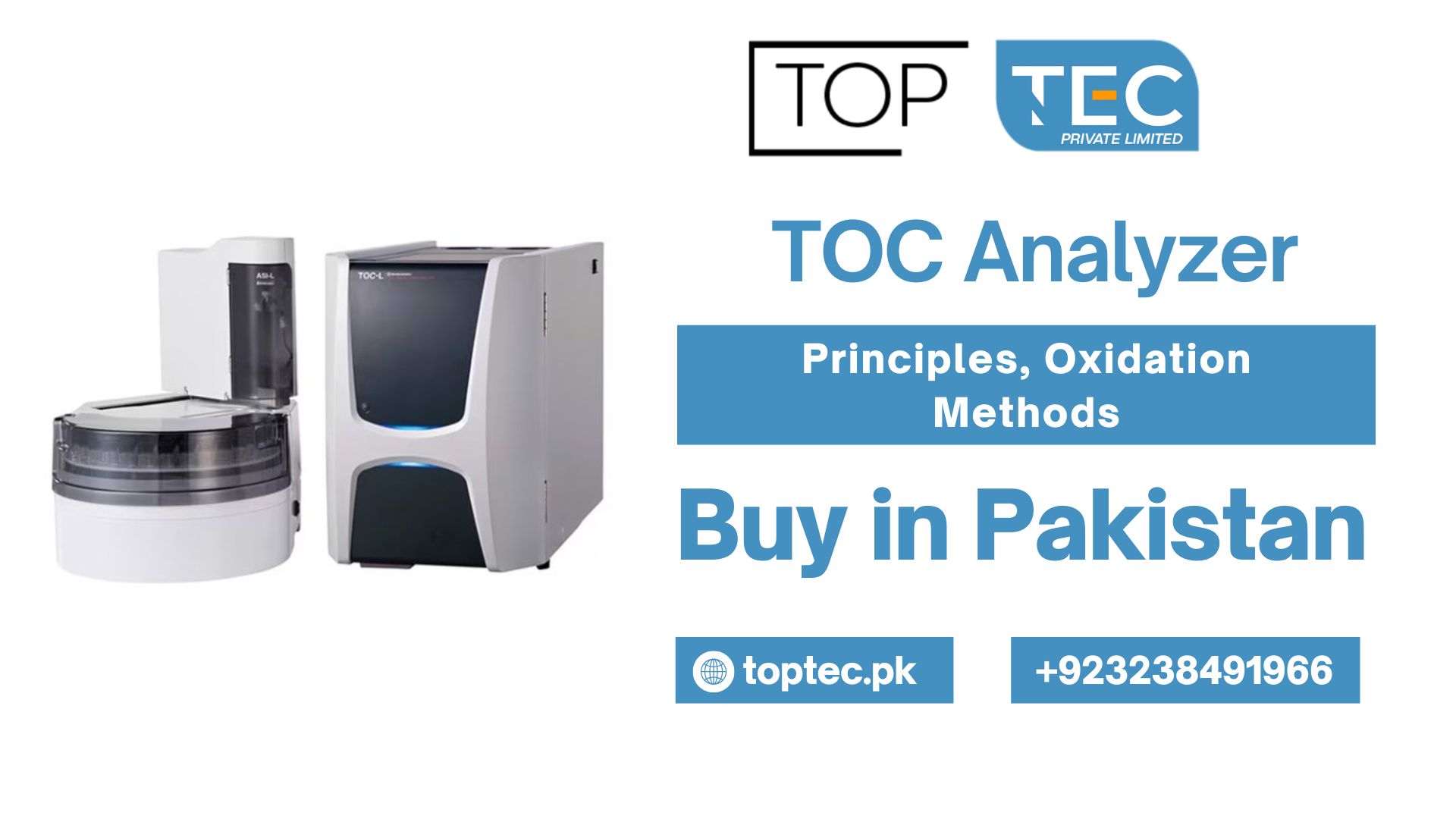
What are the main Principles of TOC Analyzer 101? Let me start with a question that stumps a lot of experienced lab people when they actually think about it carefully.
You test water for purity. You run conductivity, resistivity, pH, endotoxins. But how much organic carbon is actually dissolved in that water? And why would that number matter more than some of those other parameters you’re already measuring?
That’s where a TOC analyzer enters the conversation — and where most people realize they’ve been thinking about water quality with an incomplete picture.
Total organic carbon analysis touches nearly every regulated industry: pharmaceutical water systems, environmental monitoring, food and beverage production, semiconductor manufacturing, industrial process control. If your lab works with water quality, process fluids, or environmental samples, the chances are high that total organic carbon analysis belongs somewhere in your testing portfolio.
This guide walks through the principles, oxidation methods, detection techniques, and practical considerations you need before choosing a TOC analyzer for your lab.
What Total Organic Carbon Analysis Actually Measures
Let’s strip this down to fundamentals before getting into instrument specifications.
Organic carbon enters water and liquid samples from countless sources — raw feed water, process chemicals, human contact, bacterial growth, solvent residues, cleaning agents, and airborne contamination. Knowing how much organic carbon is present tells you something that other water quality tests simply don’t capture.
Conductivity tells you about ionic content. Endotoxin testing detects bacterial cell wall fragments. Neither tells you about dissolved organic molecules — sugars, alcohols, organic acids, residual solvents, humic substances, or process-related organic contaminants.
A TOC analyzer solves this by measuring total carbon in a sample and subtracting the inorganic carbon fraction. What remains is the organic carbon — every carbon atom that was part of an organic molecule in your sample.
The measurement works in two stages:
Stage 1: Convert all organic carbon to CO₂ through oxidation. Every carbon atom bonded to hydrogen or oxygen in an organic molecule must be fully oxidized to carbon dioxide.
Stage 2: Detect and quantify the CO₂ produced. The amount of CO₂ is directly proportional to the organic carbon in the original sample.
That’s the essence of total organic carbon analysis. The complexity — and the cost differences between instruments — lives in how each stage is implemented.
The Oxidation Methods: Where Most of the Important Decisions Live
Not all organic molecules break apart easily. Some are genuinely stubborn. The oxidation method a TOC analyzer uses determines whether the instrument can fully handle your specific sample types — and getting this wrong means incomplete oxidation and systematically low results.
UV/Persulfate Oxidation
The most common method in pharmaceutical-grade TOC analyzer instruments, particularly for purified water and WFI testing.
A sample is mixed with sodium persulfate reagent. Ultraviolet light — typically at 185 nm — irradiates this mixture. UV energy breaks the persulfate’s peroxide bonds, generating highly reactive sulfate free radicals that oxidize most organic compounds to CO₂.
Where it works well: Pharmaceutical water systems. Clean, low-TOC samples. The kind of water you’d find in purified water loops, WFI systems, or dialysis water. This is also the method referenced in pharmacopeial standards — USP <643> and EP 2.2.44 — which is the regulatory context for most Pakistani pharmaceutical labs.
Where it has limitations: Complex environmental samples with humic acids, highly halogenated compounds, or high organic loads can resist complete oxidation. Performance also depends on UV lamp intensity, which degrades over time — something to factor into your maintenance schedule.
Honest assessment: for pharmaceutical water testing in Pakistan, UV/persulfate is usually sufficient. Don’t pay for combustion capability you won’t need.
High-Temperature Combustion Oxidation
This is the heavy-duty approach and genuinely different in character from UV/persulfate.
The sample is injected into a furnace operating at 600–1000°C or higher in an oxygen-rich environment. At these temperatures, virtually all organic carbon is completely oxidized. No refractory compounds survive.
Where it works well: Environmental samples — wastewater, soil extracts, seawater, industrial process fluids with complex organic matrices and high organic loads. If your samples routinely contain difficult compounds that resist chemical oxidation, combustion is the answer.
The trade-offs: Higher capital and operating cost, more complex engineering (high-temperature components have finite lifespans), and genuinely overkill for pharmaceutical water system monitoring. Combustion adds cost and complexity without meaningful benefit for clean water applications.
If your lab handles both pharmaceutical water and complex environmental samples, you’re in the difficult middle ground of choosing one instrument type or two.
Matching Method to Application
The decision framework is actually fairly straightforward:
- Pharmaceutical water (purified water, WFI): UV/persulfate
- Environmental wastewater, soil extracts, complex matrices: Combustion
- Research lab with varied unknown samples: Combustion gives you more flexibility
- Low budget, straightforward water monitoring: UV/persulfate at lower cost
Detection Techniques: How You Measure the CO₂
Once oxidation is complete, you need to measure how much CO₂ was produced. Detection technology is where instrument sensitivity, accuracy, and cost diverge significantly.
Non-Dispersive Infrared (NDIR) Detection
This is the standard in modern TOC analyzer instruments and worth understanding properly because it determines your detection capability.
CO₂ molecules absorb infrared radiation at a specific wavelength — 4.26 micrometers. An IR source emits light; a filter selects this specific wavelength; a detector measures the intensity that passes through the sample gas. More CO₂ means more IR absorption and a lower detector signal.
Why NDIR became the standard:
- Sensitive enough to detect CO₂ at parts-per-billion levels — translating to TOC detection limits in the low µg/L range
- Selective — CO₂’s specific IR absorption wavelength means other gases don’t interfere significantly
- Stable over time — NDIR detectors don’t drift the way some other detection systems do
- Wide dynamic range — useful from very low ppb through high ppm concentrations
For pharmaceutical total organic carbon analysis where you need detection limits of 1–50 µg/L, NDIR is what you want. Most quality TOC analyzer instruments use it.
Conductivity Detection
An older approach still found in some lower-cost instruments. CO₂ dissolves in water to form carbonic acid, which dissociates into ions that change the solution’s electrical conductivity. Conductivity change is proportional to CO₂ concentration.
The problems are real: lower sensitivity, non-specific response (any ionic change affects conductivity, not just your TOC), and high background from reagent water. For regulated pharmaceutical or environmental applications, NDIR is clearly preferable. Conductivity detection belongs in screening or educational contexts.
A Note on Detection Limits in Practice
Instrument specification sheets often claim impressive detection limits measured under ideal conditions. Ask specifically: what detection limit is achieved with your actual sample matrix, using your actual reagent water, in routine operation? The gap between spec sheet numbers and real-world performance can be meaningful.
Direct vs. Difference Measurement
This is a design choice that affects accuracy in ways that matter specifically for pharmaceutical water testing.
The most common approach: measure total carbon (TC) by fully oxidizing everything, then separately measure inorganic carbon (IC) by acidifying the sample to release dissolved carbonate CO₂. TOC = TC minus IC.
The problem with this subtraction in clean water samples: if your TC is say 520 µg/L and your IC is 480 µg/L, your TOC is 40 µg/L. But small measurement errors in either TC or IC — entirely normal analytical variation — get magnified when subtracted. A 2% error in each measurement can produce a much larger percentage error in the TOC result.
Some modern TOC analyzer designs measure organic carbon directly without relying on this subtraction. For pharmaceutical water systems where you’re working near the low end of the measurement range, this can meaningfully improve accuracy and reproducibility.
When evaluating instruments for pharmaceutical water total organic carbon analysis, ask specifically about the measurement approach and what detection limits are achievable in your concentration range.
Where TOC Analysis Is Essential: Key Applications
Pharmaceutical Water Systems
This is the most common driver for TOC analyzer purchases in Pakistan. USP <643> requires TOC testing of purified water and water for injection as a compendial test. The pharmacopeial limit is 500 µg/L, though many facilities set internal action limits considerably lower as an early warning system.
For pharmaceutical manufacturers under DRAP GMP requirements, total organic carbon analysis of water systems is not optional — it’s a pharmacopeial requirement. Every batch of WFI needs TOC verification. The instrument performing this testing must be properly qualified, calibrated, and maintained within a GMP framework with complete documentation.
Environmental Monitoring
Wastewater treatment plants monitor TOC to assess organic pollution and treatment efficiency. Environmental testing labs analyze river water, groundwater, and industrial effluents for organic contamination. These applications typically deal with more complex matrices and higher organic loads — which is where combustion methods start to make more sense.
Cleaning Validation
For pharmaceutical equipment cleaning validation, TOC measurement of rinse water is a sensitive, non-specific method for confirming removal of organic residues. Rather than analyzing for specific compounds (which requires knowing what you’re looking for), TOC testing detects any remaining organic carbon regardless of source.
This application is growing in Pakistani pharmaceutical manufacturing as cleaning validation requirements become more rigorous.
Semiconductor and High-Purity Applications
Ultra-pure water for semiconductor manufacturing requires TOC below 1–2 µg/L. High-sensitivity TOC analyzer instruments with NDIR detection are standard in these environments. This represents the most demanding end of the TOC measurement spectrum.
What to Actually Look For When Evaluating Instruments
When you’re seriously evaluating a TOC analyzer purchase, here are the specifications and features that genuinely matter:
Detection limit and dynamic range. For pharmaceutical water testing, you want reliable detection below 10 µg/L — well below the pharmacopeial limit — to enable meaningful trending and early warning capability. Verify this with actual performance data, not just the specification sheet.
Oxidation method and efficiency. Confirm the method is validated for your sample types. For UV/persulfate instruments, ask how UV lamp degradation is managed — do you have to remember to replace it at intervals, or does the instrument track lamp hours and alert you?
Sample volume. Some instruments need 50 mL per analysis, others work with a few mL. Relevant if sample volume is constrained.
Autosampler capability. For high-volume pharmaceutical QC labs, automated sample processing significantly improves throughput. A TOC analyzer that can run an overnight batch of samples unattended is a different productivity proposition than one requiring manual sample loading.
Data integrity features. For GMP pharmaceutical environments, this is non-negotiable. Electronic audit trails, user access control, 21 CFR Part 11 compliance capability, and data export in formats suitable for batch records and regulatory submissions. Verify this isn’t just claimed but actually implemented in the software.
Calibration approach. Potassium hydrogen phthalate (KHP) is the standard TOC reference standard. How frequently does the instrument need recalibration? Does it support automated calibration routines? What’s the calibration stability?
Local service and spare parts. This point is genuinely critical for labs in Pakistan. Before committing to any TOC analyzer, find out specifically where the nearest qualified service engineer is based and what the realistic response time is. UV lamps need periodic replacement. Pump tubing wears. A TOC analyzer waiting weeks for an imported UV lamp while it’s supposed to be releasing WFI batches is a serious operational problem. Get clarity on this before purchasing, not after.

Setting Up Your TOC Analysis Area
A TOC analyzer is a benchtop instrument — it doesn’t demand the infrastructure footprint of a stability chamber or a large fume hood. But the environment around it still affects data quality in ways worth thinking through.
Vibration isolation. Precise syringe-based sample introduction systems benefit from a stable bench. Vibration from adjacent equipment can affect injection reproducibility.
Organic contamination control. You’re measuring organic carbon at µg/L levels. The immediate lab environment should be clean — away from areas with active solvent use or heavy foot traffic. Nearby sources of airborne organic contamination can contribute to elevated backgrounds that mask what you’re actually trying to measure.
Sample handling area. Proper sample collection for TOC testing requires specific container preparation — baked or acid-washed glass sample bottles, proper collection technique to avoid contamination. A dedicated sample preparation area with appropriate storage for prepared containers is part of a functional TOC testing setup.
Reagent and waste management. UV/persulfate instruments consume reagents and generate liquid waste containing acid and oxidation byproducts. Waste containment and appropriate disposal are practical requirements, not afterthoughts.
TOPTEC PVT. LTD: Lab Infrastructure for Your TOC Setup
When you buy TOC analyzer equipment, the surrounding infrastructure matters more than most buyers initially appreciate.
TOPTEC PVT. LTD manufactures laboratory furniture in Pakistan — genuinely manufactures locally, not imports and relabels. For labs setting up TOC analyzer workstations, TOPTEC provides:
Instrument benches: Steel-frame construction with clean, chemical-resistant surfaces — epoxy resin, phenolic resin, or appropriate laminate. Load-rated for the analyzer plus associated equipment. Custom dimensions to fit your specific lab space rather than adapting to standard module sizes that may not suit your layout.
Sample preparation stations: Organized bench space for sample bottle handling, collection point setup, and the clean sample management that low-level total organic carbon analysis demands.
Storage systems: Appropriate storage for TOC reagents, calibration standards, sample containers — organized and accessible.
Complete supporting furniture: Sink units, overhead shelving, documentation areas, reagent storage cabinets — the infrastructure that keeps a pharmaceutical lab organized and GMP-appropriate.
Why Local Manufacturing Is Practically Relevant
Your TOC analyzer will likely arrive within a few weeks of ordering. Your lab infrastructure shouldn’t take three months longer.
Imported laboratory furniture — from European or other international manufacturers — typically takes 12-16 weeks to arrive in Pakistan when you account for manufacturing, ocean freight, port clearance, and inland delivery. If WFI release testing can’t start because benches haven’t arrived, that’s a real operational problem.
TOPTEC delivers standard items in 3-5 weeks. Custom fabrications in 5-8 weeks. Your lab comes together on a realistic coordinated timeline rather than staggered by months.
Custom dimensions mean the bench fits your actual space — not an approximation based on whatever module sizes an international manufacturer decided to standardize on. PKR pricing means no currency exposure between quotation and delivery. And when something needs adjustment after installation, you’re talking to the manufacturer locally rather than navigating an international support chain.
Quick Reference Checklist
Before finalizing any TOC analyzer purchase:
- ☐ Application clearly defined — pharmaceutical water, environmental, cleaning validation, research?
- ☐ Sample types identified — clean water matrices or complex organic samples?
- ☐ Oxidation method confirmed appropriate — UV/persulfate or combustion?
- ☐ Detection limit verified with actual performance data — not just specification sheet
- ☐ Autosampler capacity matched to throughput requirements
- ☐ Data integrity features verified for GMP compliance
- ☐ Calibration requirements and costs understood
- ☐ Local service engineer identified and response time confirmed
- ☐ Spare parts availability — UV lamps, pump tubing, reagents — confirmed locally
- ☐ Lab bench, sample preparation area, and waste management planned alongside instrument
Final Thoughts
Total organic carbon analysis is one of those techniques that becomes increasingly central to lab operations the more carefully you think about water quality and process cleanliness. A good TOC analyzer — properly matched to your application, correctly installed, fully qualified, and maintained with genuine attention to lamp life and calibration stability — delivers reliable data that supports pharmaceutical batch release, environmental compliance, and cleaning validation.
Match your oxidation method to your samples. Choose NDIR detection. Verify detection limits with real performance data. Confirm local service support before committing. And plan your lab infrastructure alongside the instrument, not as an afterthought.
TOPTEC PVT. LTD manufactures the laboratory furniture and infrastructure your TOC analysis setup needs — locally in Pakistan, on timelines that work for your project, at PKR pricing, built to your exact lab dimensions.
Contact TOPTEC PVT. LTD
TOPTEC PVT. LTD manufactures laboratory workbenches, preparation stations, storage cabinets, sink units, and complete laboratory furniture solutions — all manufactured locally in Pakistan for pharmaceutical, environmental, research, and industrial laboratory environments.
Contact TOPTEC to discuss your requirements and receive a customized quotation.
