

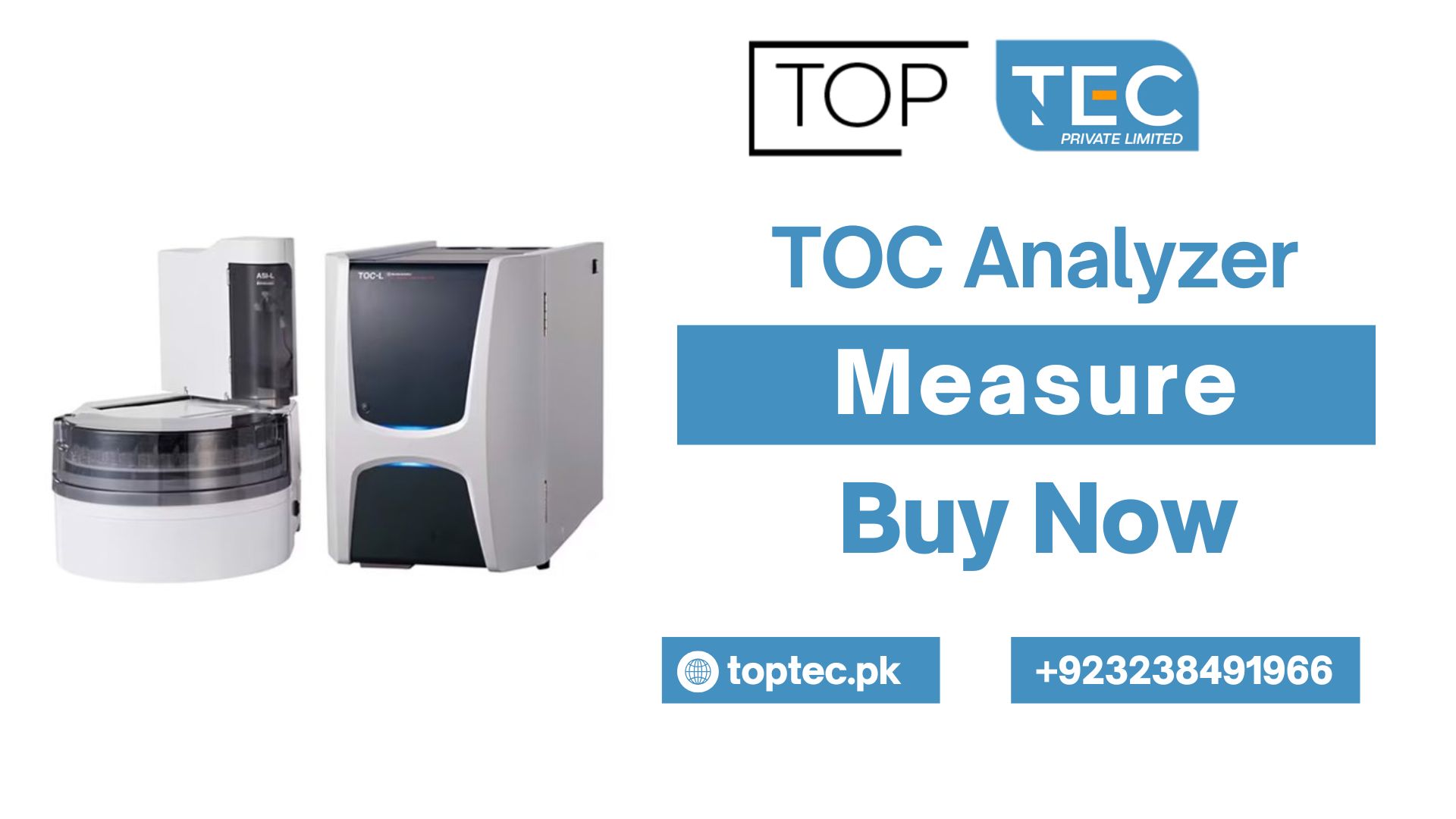
A lab technician is running samples on a TOC analyzer — routine pharmaceutical water testing, nothing complicated. The results come back with several columns of numbers: TC, IC, TOC, TIC. The technician reports the TOC figure to the QC manager. Nobody questions it. But nobody in the room could explain, if pressed, exactly what the difference between TC and TOC is, or why the IC value matters, or when you’d use NPOC instead of TOC as your reporting parameter.
This guide is specifically about fixing that gap. The four measurement modes — TC, IC, TOC, and NPOC — represent genuinely different things. Confusing them doesn’t just create intellectual confusion; it creates analytical errors that affect whether your data is actually valid for the purpose you’re using it for.
So let’s work through each mode properly.
The Big Picture First
A TOC analyzer measures carbon in liquid samples. But “carbon” in a water sample isn’t a single thing — it comes in different chemical forms, and those forms behave differently analytically and have different significance depending on what you’re trying to know about your sample.
The primary distinction is between:
Organic carbon — carbon atoms that are part of organic molecules: sugars, alcohols, organic acids, proteins, residual solvents, pharmaceutical compounds, humic substances. This is what total organic carbon analysis is primarily interested in.
Inorganic carbon — carbon atoms that exist in inorganic forms: dissolved CO₂ gas, carbonic acid (H₂CO₃), bicarbonate ions (HCO₃⁻), and carbonate ions (CO₃²⁻). This carbon is present in virtually all water samples to some degree and needs to be either measured or removed for accurate organic carbon determination.
Every measurement mode a TOC analyzer offers is essentially a different way of partitioning, combining, or separating these two forms of carbon. Understanding that distinction is the foundation for understanding everything else in this guide.
TC — Total Carbon
TC is the simplest concept: everything.
When a TOC analyzer measures TC, it oxidizes the sample completely — converting all carbon, both organic and inorganic, to CO₂ — then measures the total CO₂ produced. Organic carbon molecules burn to CO₂. Dissolved carbonates and bicarbonates decompose to CO₂. All of it gets counted.
TC = Organic Carbon + Inorganic Carbon
Or equivalently:
TC = TOC + IC
What TC actually tells you: The absolute total carbon burden of the sample, without distinguishing source or chemical form.
When TC alone is useful: Honestly, not often in isolation. TC as a standalone number is mainly useful in situations where you’re confident the inorganic carbon content is negligible — such as in certain high-purity organic solvent samples, or when you’re doing quick screening where rough total carbon is sufficient.
The problem with reporting TC as if it were TOC: This is where the real-world error occurs. If your sample contains significant dissolved CO₂ or carbonates — which virtually all natural water samples do — the TC value will be substantially higher than the organic carbon content. Reporting TC when you mean TOC overstates the organic contamination. In pharmaceutical water testing, this could lead to unnecessary investigation of what appears to be a failing result when the organic carbon content actually passes.
A TOC analyzer that doesn’t properly account for inorganic carbon — either by measuring and subtracting it, or by removing it before measurement — will give you TC and call it TOC. This is a specification issue worth understanding when evaluating instruments.
IC — Inorganic Carbon
IC is the inorganic carbon fraction: dissolved CO₂, carbonic acid, bicarbonate, and carbonate in the sample.
How a TOC analyzer measures IC: the sample is acidified (typically with phosphoric acid), which converts all inorganic carbon species to CO₂ gas. This CO₂ is then purged from the sample with a carrier gas and detected. The carbonate-bicarbonate system chemistry is:
CO₃²⁻ + 2H⁺ → H₂O + CO₂↑
HCO₃⁻ + H⁺ → H₂O + CO₂↑
CO₂(dissolved) → CO₂(gas)↑
The critical point: under controlled acidification conditions, only inorganic carbon converts to gas and gets detected. Organic carbon molecules remain in solution and don’t contribute to the IC measurement.
What IC tells you: How much dissolved carbonate, bicarbonate, and CO₂ is in your sample. This is important for:
- Understanding your sample’s water chemistry (buffering capacity, pH, alkalinity)
- Calculating accurate TOC from TC measurements (TOC = TC – IC, so you need IC to be accurate)
- Assessing whether IC content is high enough to cause interference in your TOC determination
When IC values are particularly important: Environmental water samples almost always have significant IC — natural water equilibrates with atmospheric CO₂ and picks up carbonates from geological sources. IC values of 50–200 mg/L are entirely normal in natural fresh water. If you’re measuring TOC in a sample with 150 mg/L IC and your TOC is around 5 mg/L, IC removal or accurate IC measurement is critical — a small error in IC measurement creates a large relative error in TOC.
For pharmaceutical purified water and WFI, IC is typically very low because the purification processes that produce these waters (RO, deionization, distillation) remove both organic and inorganic carbon. But it’s still measured and reported as part of total organic carbon analysis to confirm this.
TOC — Total Organic Carbon
TOC is what most people think the TOC analyzer is measuring when they ask for a “TOC result.” It’s the organic carbon content of the sample — every carbon atom that was part of an organic molecule.
But here’s the subtlety that matters: TOC is not directly measured. It’s calculated.
The standard calculation:
TOC = TC − IC
The TOC analyzer measures total carbon by fully oxidizing everything, then measures inorganic carbon by acidification and purging, and subtracts one from the other. The remainder is total organic carbon.
Why this matters analytically:
When TC and IC are both large numbers, and TOC is the difference between them, measurement errors in either TC or IC propagate into the TOC result. In environmental water samples where IC is 100 mg/L and TC might be 105 mg/L, TOC is 5 mg/L. A 2% measurement error in IC (2 mg/L) represents a 40% error in your TOC result.
This isn’t a reason to abandon the TC-IC method — it’s well-validated and widely used. But it’s why pharmaceutical water testing applications, where TOC values are very low and precision matters, sometimes prefer instruments that measure TOC more directly through methods that remove IC before oxidation rather than relying on a subtraction.
Where TOC is the right reporting parameter:
Almost always. Total organic carbon analysis reporting is built around TOC as the primary parameter. USP <643>, EP 2.2.44, environmental standards, and industrial specifications all express limits in terms of TOC or equivalent. When your compliance test requires a number below a defined limit — 500 µg/L for pharmaceutical water, various mg/L limits for environmental discharge — TOC is the number to report.
The difference between TOC and DOC:
You may encounter DOC — Dissolved Organic Carbon — in environmental testing contexts. DOC is measured by filtering the sample through a 0.45 µm membrane before analysis, so only dissolved organic carbon (not suspended particulate organic carbon) is measured. TOC without filtration includes both dissolved and suspended organic carbon. For pharmaceutical water applications, filtration isn’t typically done because particulate organic matter would itself be a contaminant of interest. For environmental surface water analysis, DOC is often more meaningful than total TOC.
NPOC — Non-Purgeable Organic Carbon
NPOC is the measurement mode that confuses people the most, partly because the name is counterintuitive and partly because it solves a specific problem that you need to understand to appreciate why it exists.
What NPOC Is Solving
The TC-IC method works by measuring total carbon, then inorganic carbon, then subtracting. But there’s a vulnerability: if the sample contains volatile organic compounds — organic molecules that form vapor at room temperature or under the mild acidification conditions used for IC removal — some of those organic molecules will escape with the purge gas during the IC removal step.
When you acidify the sample and purge to remove IC, you’re also inadvertently purging volatile organic compounds like:
- Methanol
- Ethanol
- Acetone
- Other short-chain alcohols and ketones
- Some chlorinated solvents
These volatile organics get carried off with the CO₂ from the IC removal step and are never measured in the subsequent TC analysis. Result: your TOC value is understated — you’ve lost some of your organic carbon before you measured it.
NPOC solves this by taking the problem head-on rather than trying to work around it.
How NPOC Is Measured
The NPOC method:
- Acidify the sample with phosphoric acid — same as IC removal
- Purge with carrier gas — aggressively. Remove all inorganic carbon AND all volatile organic carbon. Both leave the sample.
- What remains in solution is the non-volatile, non-purgeable fraction of organic carbon
- Oxidize what remains — this is your NPOC value
- Detect the CO₂ produced
NPOC = (organic carbon that doesn’t volatilize under acidification/purging conditions)
NPOC is NOT the same as TOC unless volatile organic compounds are absent from your sample.
When NPOC Is the Right Mode
High-IC samples where TC-IC subtraction is imprecise: Instead of measuring TC and IC and subtracting (which introduces compounding measurement errors when IC is large), measuring NPOC directly gives you the organic carbon value without relying on a potentially imprecise subtraction.
Samples where volatile organics are not the concern: If your sample may contain ethanol, methanol, or other volatile organics, and you know those aren’t your target analytes, NPOC actually gives you a cleaner measurement of the non-volatile organic contamination you care about.
Environmental water samples with high carbonate: River water, groundwater, and drinking water samples often have high IC (50–300 mg/L) and relatively low TOC (1–20 mg/L). In these samples, NPOC is often the preferred measurement mode in environmental testing standards because the IC-subtraction approach is insufficiently precise.
When NPOC Is Not Appropriate
If your sample contains volatile organic compounds that you want to measure — certain solvents, VOC monitoring in environmental samples, solvent residue testing — NPOC will miss them completely. Using NPOC for volatile organic monitoring gives you dangerously incomplete data.
For pharmaceutical water testing where TOC and NPOC are essentially equivalent (purified water and WFI don’t normally contain significant volatile organic compounds, and the IC content is low), either method is acceptable. Some modern TOC analyzer instruments default to NPOC for pharmaceutical water specifically because it avoids the IC subtraction entirely and simplifies the measurement.
TIC — Total Inorganic Carbon
TIC is simply another name for IC. Some TOC analyzer instruments and reporting software use TIC rather than IC — Total Inorganic Carbon rather than Inorganic Carbon. They measure the same thing using the same principle. If you see TIC in your results, read it as IC.
POC — Purgeable Organic Carbon
POC is the volatile organic fraction that gets removed during the IC purging step in NPOC measurement.
POC = TOC − NPOC
If your TOC analyzer reports both TOC (by TC-IC method) and NPOC, the difference between them is POC — the volatile organic carbon that was purged off during acidification.
This is rarely reported as a standalone parameter, but understanding it helps you interpret the relationship between your TOC and NPOC values. If TOC and NPOC are significantly different for a sample type that shouldn’t contain volatile organics, it’s a quality flag worth investigating.

How These Modes Apply to Total Organic Carbon Analysis in Practice
Let me put this together practically for the contexts where Pakistani labs most commonly need total organic carbon analysis.
Pharmaceutical Water Testing (USP <643>)
The pharmacopeial standard for total organic carbon analysis of pharmaceutical water uses a specific method — the system suitability check and sample measurement approach described in USP <643>. The reporting parameter is TOC (or equivalently NPOC, as the standard recognizes both).
For purified water and WFI with very low IC content (because RO/DI/distillation removes inorganic carbon), TOC and NPOC give essentially equivalent results. The standard approach on most pharmaceutical TOC analyzer instruments is either:
- TC measurement with IC removal (acidification and purge) before oxidation — giving NPOC
- TC-IC subtraction — giving TOC
Both are acceptable. The limit is 500 µg/L as carbon, expressed as TOC.
Environmental Water Testing
Environmental labs doing total organic carbon analysis on river water, groundwater, or wastewater typically work with samples having significant IC content. In these applications:
- NPOC is often preferred to avoid IC subtraction precision issues
- If volatile organics are a concern, TOC by TC-IC method is needed to capture them
- Always specify which measurement mode was used when reporting, because TOC and NPOC values can differ significantly for samples with volatile organic content
Cleaning Validation
For equipment rinse water in pharmaceutical manufacturing, the choice of measurement mode depends on what cleaning agents and process residues you’re looking for. Most common pharmaceutical cleaning agents — detergent residues, API residues — are non-volatile, making NPOC appropriate. If solvents are involved in the cleaning process, TOC by TC-IC method captures both volatile and non-volatile residues.
Instrument Selection Considerations
Understanding the measurement modes helps you ask the right questions when evaluating a TOC analyzer for total organic carbon analysis in your lab.
Does the instrument support all four modes? Basic TOC analyzer instruments may only support NPOC, which is adequate for pharmaceutical water but may be limiting for environmental or research applications.
What is the IC removal efficiency? For NPOC measurement to be accurate, the acidification and purging step must remove essentially all IC. Incomplete IC removal leaves residual inorganic carbon that gets oxidized and reported as organic carbon — a positive bias error.
How is IC measured? For TC-IC TOC calculation, the IC measurement needs to be accurate across the range of IC concentrations in your samples. An instrument with poor IC accuracy gives poor TOC accuracy when using the subtraction method.
What is the detection limit for each mode? Some instruments have excellent TOC detection limits but limited IC measurement precision. Depending on your samples’ IC-to-TOC ratio, this may or may not matter for your application.
Setting Up Your TOC Lab Properly
A TOC analyzer performing total organic carbon analysis at µg/L levels is an inherently sensitive measurement. The lab environment and infrastructure around the instrument affect result reliability.
Sample contamination at the µg/L level is surprisingly easy to introduce from organic contamination on sampling containers, from airborne sources near the instrument, or from reagent water that isn’t itself low in organic carbon. Your sample preparation area needs to be clean — away from active chemical handling and solvent use.
The instrument bench needs to be stable and vibration-free, since precise syringe-based sample introduction is sensitive to mechanical disturbance.
This is where TOPTEC PVT. LTD becomes relevant to your TOC analysis setup.
TOPTEC PVT. LTD: Lab Infrastructure for Your TOC Analysis Lab
TOPTEC PVT. LTD manufactures laboratory furniture in Pakistan — genuinely manufacturing locally, not importing and relabeling. For labs doing total organic carbon analysis, TOPTEC provides the infrastructure that keeps your measurements clean and your workflow organized.
Instrument benches: Steel-frame construction with appropriate surface materials — epoxy resin, phenolic resin, or chemical-resistant laminate. Stable, load-rated surfaces that provide the vibration-free base a sensitive TOC analyzer sample introduction system needs. Custom dimensions fabricated to your specific lab space — not standard modules that may not fit your layout.
Sample preparation stations: Clean, organized bench areas for sample collection container preparation, sample handling, and blank preparation. For total organic carbon analysis at pharmaceutical water quality levels, keeping the sample preparation area clean and organized directly affects data quality.
Chemical and reagent storage: Appropriate storage for phosphoric acid, persulfate reagents, and calibration standards. Organized and labeled cabinets that keep your analytical chemistry in order.
Sink units and water access: For glassware cleaning, reagent preparation, and general laboratory use adjacent to your TOC analysis area.
Complete laboratory furniture: TOPTEC manufactures the complete range — overhead shelving, documentation areas, fume hoods, general workbenches — that makes a laboratory function as an integrated space rather than a collection of mismatched furniture.
Why TOPTEC Makes Sense for Pakistani Labs
The practical advantage of local manufacturing comes down to a few specific things.
Lead times: imported laboratory furniture takes 12-16 weeks to arrive in Pakistan. If your TOC analyzer arrives in 6 weeks and your benches arrive 10 weeks after that, you’re running the instrument on improvised surfaces or waiting. TOPTEC delivers standard items in 3-5 weeks, custom fabrications in 5-8 weeks — timelines that coordinate realistically with instrument delivery.
Custom dimensions: TOPTEC fabricates to your actual room measurements. Your lab space has specific dimensions that may not align with standard module sizes from international manufacturers. Furniture that fits the space properly makes a real operational difference.
PKR pricing: no currency exposure between quotation and delivery. No import duty surprises. What you’re quoted is what you pay.
Post-delivery support: local manufacturer means local support. When a shelf needs adjusting or an additional cabinet is needed six months later, you’re talking to the team that built your furniture.
Summary: Which Mode for Which Application
| Application | Recommended Mode | Why |
|---|---|---|
| Pharmaceutical water (USP <643>) | TOC or NPOC | Equivalent for low-IC water; NPOC simpler |
| High-IC environmental water | NPOC | Avoids IC subtraction precision issues |
| Samples with volatile organics | TOC (TC-IC method) | NPOC misses volatile fraction |
| Cleaning validation (non-solvent) | NPOC | Non-volatile residues only |
| General water quality screening | TOC | Most comprehensive, widely understood |
Final Thoughts
The four measurement modes of a TOC analyzer — TC, IC, TOC, and NPOC — are genuinely different things that answer different questions about your sample’s carbon content. Using the wrong mode for your application, or not understanding what your instrument is reporting, produces data that may technically be a number but isn’t actually answering the question you need answered.
For total organic carbon analysis in pharmaceutical water testing: TOC or NPOC, both acceptable, essentially equivalent for clean water matrices. For environmental samples with high IC: NPOC preferred. For samples with volatile organic compounds you want to capture: TOC by TC-IC method.
Understanding these distinctions makes you a more capable analyst and a more informed buyer when evaluating TOC analyzer instruments for your lab.
And when you’re setting up the lab around that instrument — the bench, the sample preparation area, the storage, the supporting furniture — TOPTEC PVT. LTD manufactures it all locally in Pakistan, on realistic timelines, at PKR pricing, to your specific dimensions.
Contact TOPTEC PVT. LTD
TOPTEC PVT. LTD manufactures laboratory workbenches, sample preparation stations, chemical storage cabinets, sink units, and complete laboratory furniture solutions — all manufactured locally in Pakistan.
Contact TOPTEC to discuss your laboratory infrastructure requirements and receive a customized quotation.
