

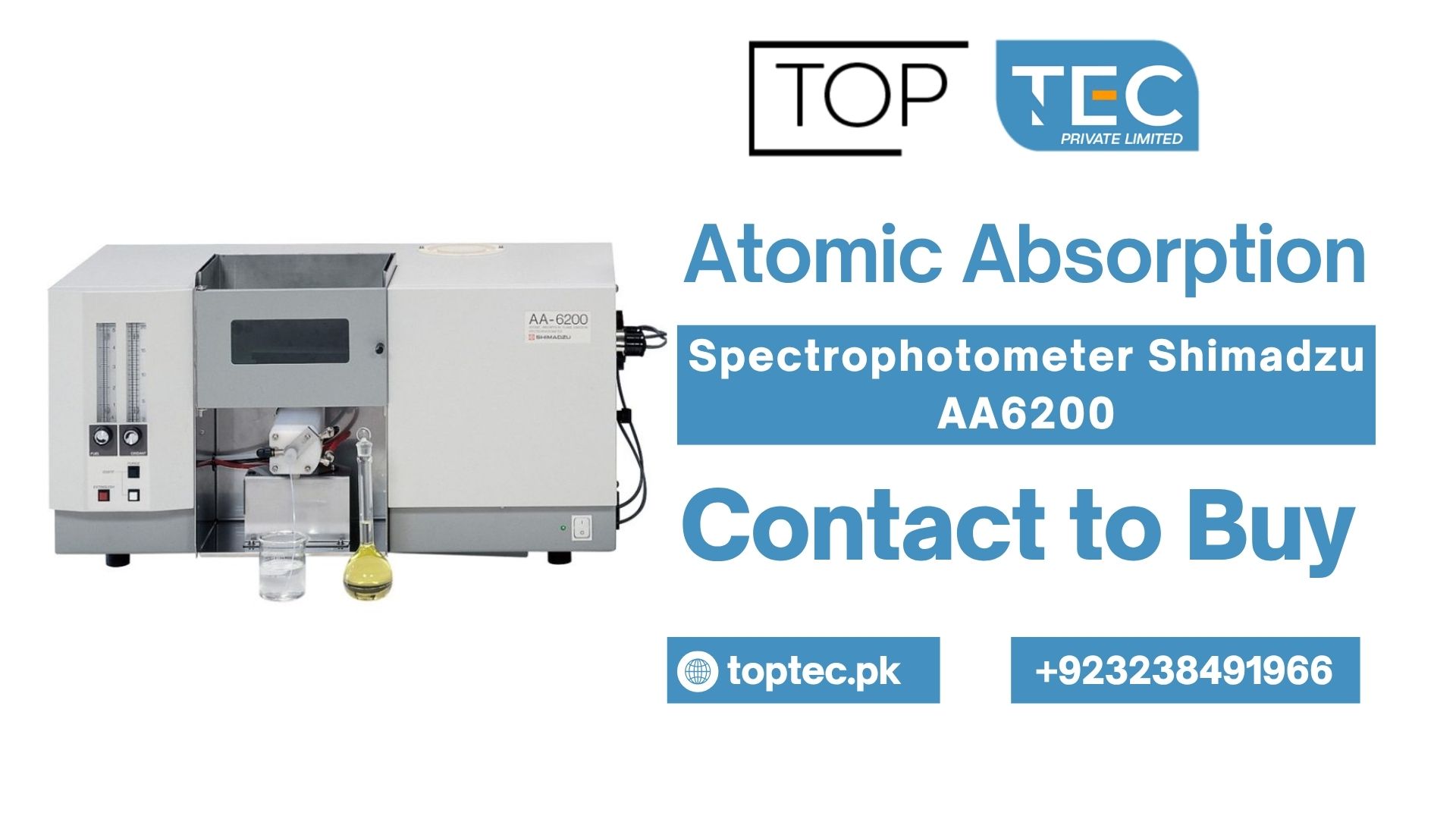
I have spent enough time around analytical labs to know that purchasing decisions rarely come down to specs alone. Budget politics, service availability, the reliability track record of an instrument brand in your specific region — all of these shape the final call. So when a lab manager in Lahore or Karachi sits down to buy Atomic Absorption Spectrophotometer equipment, the Shimadzu AA-6200 keeps showing up on shortlists for good reason. It works. It holds up. And it does not demand the budget of an ICP system to keep running.
Let me walk you through what this instrument actually delivers, what it costs in the real world, and how to set up your lab space around it without burning through your entire annual capital budget.
What Makes the AA-6200 Worth Considering in 2026?
Look, there are flashier instruments out there. Shimadzu themselves sell more advanced models. But here is the thing about the AA-6200 — it occupies a sweet spot that most mid-tier labs genuinely need. You get flame atomic absorption that handles your routine metals testing without the operational headaches and consumable costs of graphite furnace or ICP platforms.
I have watched university labs in Islamabad and commercial testing facilities in Faisalabad run these machines hard for years. The complaints are few. The data holds up under audit. And when something does go wrong, parts are generally available through Shimadzu’s Asian distribution network without the four-month wait times you sometimes face with European brands.
Labs that buy Atomic Absorption Spectrophotometer units in this category are usually testing water for heavy metals, checking pharmaceutical raw materials against DRAP specifications, or screening food samples for lead and cadmium contamination. The AA-6200 handles all of that comfortably.
Technical Specifications — The Stuff That Actually Matters
I will spare you the marketing language and focus on what affects your daily work.
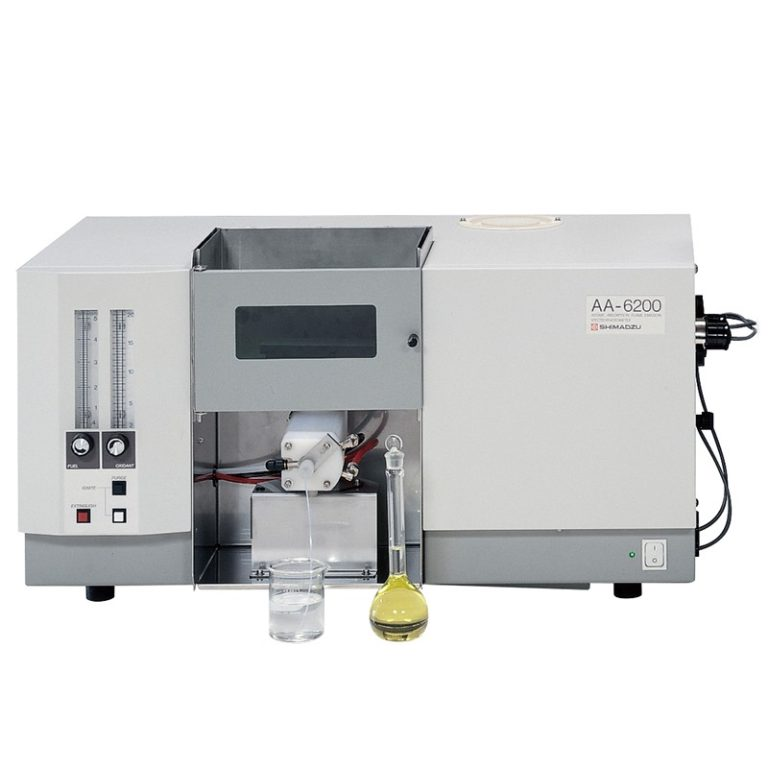
The optical engine is a single-beam Czerny-Turner monochromator with a 175 mm focal length. Some people get nervous about single-beam designs, worrying about baseline drift during long runs. Honestly, for flame work where your measurement window per sample is seconds rather than minutes, this is rarely a practical issue. The wavelength range stretches from 185 nm out to 900 nm, covering every element you would realistically chase with flame AAS.
The lamp turret holds six hollow cathode lamps, motorized and automatically positioned. This matters more than it sounds like it should. I have seen analysts waste fifteen minutes per element change on older manual systems, fiddling with alignment. The AA-6200 eliminates that time sink.
On the business end, you get a pre-mix burner chamber with a titanium head. It handles both air-acetylene and nitrous oxide-acetylene flames — the second one being essential if you need to measure aluminum, silicon, or refractory elements. The glass concentric nebulizer is adjustable, so you can trade off sensitivity against tolerance for dirty or high-dissolved-solids samples.
Detection is through a photomultiplier tube. Not a CCD, not a solid-state array — a PMT. Before you dismiss that as outdated, remember that PMTs still deliver excellent signal-to-noise for sequential flame measurements. You do not need simultaneous multi-element detection capability here because you are running one element at a time anyway.
Shimadzu’s WizAArd software runs on Windows and covers everything from method building to calibration to final report generation. It is not glamorous, but it works, and a new technician can learn it properly within a couple of days of supervised use. For GMP-regulated pharmaceutical labs, the software supports audit trails and user access controls, which keeps your quality team happy during inspections.
The physical footprint is manageable — roughly 670 × 505 × 475 mm and about 40 kg. You need a sturdy bench, but you do not need to sacrifice half your lab to accommodate it. When you buy Atomic Absorption Spectrophotometer hardware, always check the dimensions against your available bench space before signing the purchase order. I have personally seen instruments arrive at labs where nobody measured the doorway first. Do not be that lab.
Real-World Performance Numbers
Here is where the rubber meets the road. Characteristic concentration figures tell you what the instrument can actually detect in practical terms.
Copper at 324.8 nm gives you roughly 0.04 mg/L characteristic concentration. Zinc at 213.9 nm comes in around 0.01 mg/L. Lead at 283.3 nm sits near 0.1 mg/L. These are flame figures, mind you — perfectly adequate for drinking water monitoring under WHO guidelines and Pakistan’s own regulatory thresholds.
Repeatability on ten replicate readings of a mid-range standard typically stays below 0.5% RSD. That is solid for routine work. Nobody is going to challenge your data based on precision if you are maintaining the instrument properly and running your QC checks.
If you need lower detection limits — sub-ppb levels for things like arsenic in groundwater — you will either need the graphite furnace accessory or a vapor generation system for specific elements. But for the bread-and-butter metals analysis that most Pakistani labs perform every single day, the flame configuration handles it.
What Does It Actually Cost?
This is the question everyone asks first, and instrument companies make it annoyingly difficult to answer. Shimadzu does not publish retail prices. Neither does any other major analytical instrument manufacturer. Everything flows through distributors who adjust margins based on territory, competition, and how badly they want your account.
From conversations I have had with lab managers and procurement officers across Pakistan, here is roughly what you should expect.
A brand-new AA-6200 in a basic flame configuration — mainframe, single hollow cathode lamp, burner, nebulizer, software license, and a starter accessory package — lands somewhere between $18,000 and $28,000 USD at the distributor level. Once you add Pakistani import duties, freight, insurance, and the local distributor’s margin, budget between PKR 5,500,000 and PKR 8,500,000 for an installed, operational system.
Want an autosampler? That adds $4,000 to $7,000. Graphite furnace attachment? Another $12,000 to $20,000. Mercury-hydride vapor generation kit? Around $3,000 to $5,000. A full set of twelve to fifteen hollow cathode lamps for a comprehensive analyte menu adds another $3,000 to $5,000.
These numbers shift with exchange rate fluctuations, so always get fresh quotes. But they give you a realistic planning baseline when you buy Atomic Absorption Spectrophotometer instrumentation new.
The Refurbished Route — And Why It Makes Sense for Many Labs
Not everyone has new-instrument money. I have worked with startup environmental testing labs that launched on refurbished equipment and grew into profitable, accredited operations. There is absolutely no shame in buying used, as long as you do it wisely.
The global market for refurbished analytical instruments has matured enormously. Professional refurbishment dealers strip instruments down, clean every component, replace worn parts like burner heads and nebulizer assemblies, verify optical alignment, check electronics, recalibrate wavelength accuracy, and run performance verification tests before shipping the unit out.
A refurbished Shimadzu AA-6200 in good flame-ready condition typically sells for 40% to 60% of new pricing. That puts you in the $8,000 to $15,000 USD range, or approximately PKR 2,500,000 to PKR 4,500,000 landed in Pakistan.
For anyone looking to buy Atomic Absorption Spectrophotometer equipment on a tight budget — a new university lab, a small industrial QC operation, a municipal water testing facility — this is a genuine lifeline.
But you need to be careful. I have heard enough horror stories to fill a separate article. Here is what smart buyers do:
Demand a detailed service report showing exactly what was inspected, tested, replaced, and recalibrated. Ask specifically about the photomultiplier tube — these degrade over time, and a weak PMT means poor sensitivity from day one. Inspect the burner head for warping or corrosion, especially if the previous owner ran nitrous oxide-acetylene regularly. Confirm the WizAArd software license is legally transferable. And never accept less than a 90-day warranty on parts and labor from the refurbishment dealer. If they will not stand behind the instrument for three months, walk away.
Getting Your Lab Space Ready
An instrument sitting on a wobbly bench next to an open window is an instrument producing unreliable data. Before you buy Atomic Absorption Spectrophotometer hardware, your physical lab environment needs to be sorted.
The AA-6200 needs a bench rated for at least 60 kg, stable enough that footsteps across the room do not cause the flame to flicker. It needs to be positioned away from air conditioning vents, doorways, and windows — drafts disturb flame stability and ruin your absorbance readings. You need a dedicated fume extraction duct positioned directly above the burner with a minimum extraction rate of around 5 to 6 cubic meters per minute.
Gas infrastructure is non-negotiable. You need acetylene with proper flashback arrestors and a pressure regulator. You need clean, oil-free compressed air — either from a dedicated compressor or cylinders. If you are running refractory element analyses, you need nitrous oxide with its own regulator and safety interlocks. All gas lines should be checked for leaks before the installation engineer shows up.
Electrical supply should be stable and ideally backed by a UPS. Voltage fluctuations play havoc with sensitive electronics and can introduce noise into your detector signal.
Laboratory Furniture — Go Local, Save Money, Save Time
Here is something that drives me a little crazy about the way some Pakistani labs handle procurement. They will spend months negotiating the best possible price on an imported instrument, then turn around and import laboratory benches and fume hoods from China or Europe — paying massive shipping costs, waiting weeks at customs, and sometimes receiving furniture damaged in transit that nobody wants to claim responsibility for.
TOPTEC PVT. LTD manufactures laboratory furniture right here in Pakistan. Benches, fume cupboards, reagent shelving, anti-vibration tables, gas cylinder storage racks — the full range of what an analytical lab needs. Manufacturing locally means you get shorter lead times, easier customization to your exact room dimensions, and you cut out the international freight and customs headaches entirely.
When you buy Atomic Absorption Spectrophotometer equipment like the AA-6200, the instrument bench needs to meet specific requirements — chemical-resistant surface, stable frame, integrated channels for gas lines and electrical cables, and the right height for comfortable operation during long analytical runs. TOPTEC builds to these specifications.
Their fume hoods can be configured with the duct diameter and extraction capacity that matches AAS safety requirements. If you are setting up a complete new laboratory from the ground up, TOPTEC PVT. LTD can handle everything from the casework to the ceiling-mounted service panels. One supplier, one point of contact, far less coordination headache.
Who in Pakistan Is Actually Using the AA-6200?
Knowing how your peers use this instrument helps you evaluate whether it fits your own operation.
Water testing labs process the highest volumes. Punjab alone has dozens of government and private labs testing drinking water and industrial effluent for heavy metals. The AA-6200’s straightforward operation means you can train junior analysts relatively quickly and maintain reasonable throughput even with high sample loads.
Pharmaceutical QC labs use it for heavy metals limits testing in accordance with DRAP and pharmacopeial requirements. The software’s compliance features help, but honestly, most auditors care more about your SOPs, calibration records, and proficiency testing results than about the specific software bells and whistles.
Food testing has grown significantly as a market. With increasing awareness of contamination in spices, rice, edible oils, and dairy products, labs serving the food industry need reliable, cost-effective metals analysis. The AA-6200 delivers that without the operating expense of an ICP.
University departments — chemistry, environmental science, pharmacy — use these instruments for both research and teaching. A refurbished unit works perfectly well for student practicals, where the priority is hands-on learning rather than pushing detection limit boundaries.
Running Costs Nobody Tells You About Upfront
When you buy Atomic Absorption Spectrophotometer systems, the sticker price is just the beginning. Here is what the ongoing costs actually look like.
Hollow cathode lamps run $150 to $400 each depending on the element. Multi-element lamps cost more. Each lamp lasts roughly 3,000 to 5,000 milliamp-hours. A busy lab running five or six elements daily might go through several lamps per year.
Acetylene consumption during flame operation is about 1.5 to 4 liters per minute. One standard 40-liter cylinder gives you somewhere around 8 to 12 hours of continuous operation. At Pakistani gas supplier prices, this adds up — especially if you are also using nitrous oxide, which burns faster and costs more per cylinder.
Nebulizer tubing, drain tubing, and O-rings are cheap individually but need regular replacement. Burner head cleaning is a daily task; inspection for slot blockage or corrosion should happen monthly at minimum.
Annual preventive maintenance from a Shimadzu-certified engineer — covering optical alignment, wavelength verification, safety interlock checks, and electronics inspection — runs between $800 and $1,500. Skipping this to save money is a false economy. I have seen labs produce questionable data for months because nobody bothered to verify wavelength calibration after a power surge. Do not cut corners here.
Head-to-Head: How the AA-6200 Stacks Up Against Alternatives
Anyone about to buy Atomic Absorption Spectrophotometer hardware will naturally compare options.
The Agilent 240FS offers faster sequential analysis and better throughput for multi-element work, but the price premium is significant and the service network in Pakistan is thinner than Shimadzu’s. The PerkinElmer PinAAcle 500 has a double-beam optical system that delivers superior baseline stability during long runs — a real advantage if you are processing fifty-plus samples in a single session — but consumable costs tend to run higher. The Analytik Jena novAA 350 brings solid automation features but finding qualified service engineers in Pakistan can be a challenge.
The AA-6200 wins on the combination of proven reliability, reasonable cost, manageable running expenses, and accessible after-sales support through Shimadzu’s regional network. In a market like Pakistan where getting a service engineer to your lab within a reasonable timeframe can be the difference between a two-day downtime and a two-month nightmare, that last factor carries enormous weight.
Practical Buying Steps
Let me lay out how I would approach this if I were setting up an analytical lab today and needed to buy Atomic Absorption Spectrophotometer instrumentation.
First, pin down your analytical requirements. Which elements, which matrices, what detection limits, how many samples per day. Write it down. Share it with your team. Get agreement before you start talking to vendors, because scope creep during procurement leads to overspending every single time.
Second, request quotations from Shimadzu’s authorized distributor in Pakistan and from at least two reputable refurbished equipment dealers. Compare the total package — not just the instrument price, but warranty duration, installation included or extra, training days, first-year consumable bundles, and service contract options.
Third, get in touch with TOPTEC PVT. LTD early — ideally in parallel with your instrument procurement. Discuss bench dimensions, fume hood specifications, gas line routing, and electrical provisions. If the furniture and the instrument arrive at the same time and installation happens in one coordinated effort, you save weeks compared to doing them sequentially.
Fourth, set up your gas supply accounts and order your initial hollow cathode lamp inventory before the instrument ships. Nothing is more frustrating than having a brand-new spectrophotometer sitting in your lab while you wait for an acetylene cylinder delivery.
Fifth, insist on proper training. Even if your analysts have used other AAS instruments before, every platform has quirks. Two days of hands-on, instrument-specific training will pay for itself in avoided errors, faster method development, and better troubleshooting during inevitable hiccups.
Wrapping Up
The Shimadzu AA-6200 is not going to win any awards for innovation at this point in its lifecycle. What it will do is show up every day, produce defensible analytical data, and avoid burning a hole in your operating budget with outrageous running costs. For the majority of Pakistani labs that need reliable flame AAS for routine metals analysis, that is exactly the right value proposition.
Whether you buy Atomic Absorption Spectrophotometer equipment new or go the refurbished route, pair it with properly designed laboratory furniture from TOPTEC PVT. LTD to build a workspace that actually supports good analytical work. Getting the instrument right matters. Getting the lab environment right matters just as much.
Reach out to TOPTEC PVT. LTD for your furniture requirements and start collecting instrument quotes today. The sooner both conversations are moving, the sooner your lab goes from planning stage to producing results.
TOPTEC PVT. LTD — Manufacturing quality laboratory furniture in Pakistan for labs that need reliability without the import headaches. Contact them for benches, fume hoods, storage solutions, and complete lab setup.
