

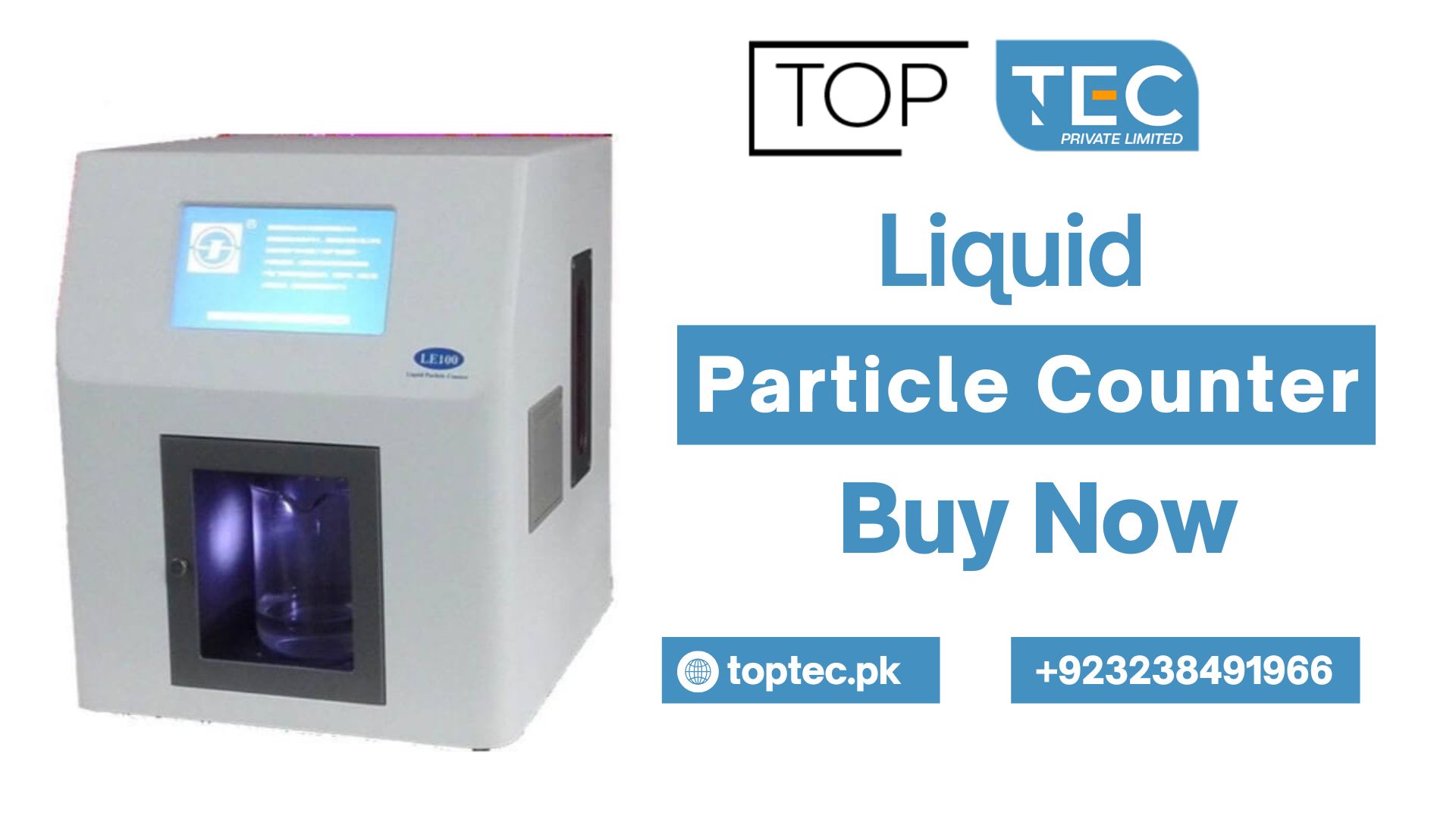
With the global liquid particle counter market growing at 7.3% annually and expected to reach $992 million by 2032, understanding the technology options — from light scattering to single particle optical sizing (SPOS) — is essential for making an informed purchasing decision.
I was standing in a pharmaceutical plant last month watching a technician stare at a small box on the wall with numbers flickering across the display. “What’s that do?” I asked. He shrugged. “Monitors something about the water. It’s always running.”
Turned out it was a liquid particle counter—probably cost $25,000, critical for regulatory compliance, and the guy working next to it every day didn’t actually know what it measured or why it mattered.
That’s the problem with these instruments. They’re absolutely essential for certain applications, but information about them is either buried in dense technical manuals or scattered across supplier websites that assume you already know everything.
So if you’re trying to figure out whether you need to Buy Liquid Particle Counter equipment, or if you’re just trying to understand what the thing in your facility actually does, let’s talk about it in plain language.
What These Things Actually Count
Start simple. A liquid particle counter detects and counts tiny particles floating in liquids. Usually water, but could be other process fluids, hydraulic oil, whatever.
The size range—like that 0.05 to 600 micron spec—tells you the smallest and largest particles the counter can see. Not all counters handle the full range. Some are built for tiny particles, others focus on bigger stuff.
To give you perspective on how small we’re talking:
- Your hair is about 70-100 microns thick
- Red blood cells are maybe 7-8 microns
- Most bacteria fall between 0.5 and 5 microns
- Viruses are usually too small for these counters to catch (0.02-0.3 microns)
Why bother counting particles in water or other liquids? Because in some industries, particles wreck everything.
Pharmaceutical companies can’t have particles in injectable drugs. Regulatory agencies will shut down production. Semiconductor fabs? A single 0.1-micron particle landing on a silicon wafer can destroy an entire microchip. Power plants worry about particles causing corrosion and turbine damage. Hydraulic systems fail when contaminated fluid damages precision valves.
Different industries, same basic problem—particles don’t belong there.
How They Actually Work
Most liquid particle counters use something called light scattering. A few use light obscuration, but that’s less common now.
Light scattering works like this:
Laser beam shoots through the liquid sample. When a particle crosses that beam, it scatters light. Sensors positioned at specific angles pick up the scattered light. Bigger particles scatter more light. Smaller particles scatter less.
The instrument counts each scattering event and figures out the size based on how much light scattered. Modern ones can process thousands of particles per second, building up a size distribution in real time.
This method excels at catching really small particles—down to 0.05 microns or even smaller in high-end models. That’s why pharmaceutical and semiconductor industries use it.
Light obscuration is different:
The particle physically blocks some of the light trying to reach a detector on the other side. How much light gets blocked tells you particle size.
This works better for larger particles and higher concentrations. You’ll see it more in hydraulic fluid monitoring. Not as useful for ultra-pure water where particles are tiny and rare.
Things that affect accuracy:
What the particle is made of matters. Polystyrene beads scatter light differently than silica particles or metal contaminants. Calibration usually uses polystyrene latex (PSL) spheres as a standard.
Flow rate matters too. Push sample through too fast and you can’t count accurately. Too slow and testing takes forever. Most run somewhere between 30 and 100 milliliters per minute.
There’s also something called coincidence error—when you have so many particles that multiple ones cross the laser beam at the same time. The counter sees one big particle instead of two small ones. Gets messy real fast.
Oh, and air bubbles. Bubbles scatter light just like particles. A good counter has degassing built in to prevent false counts from bubbles pretending to be particles.
What to Look For When You Buy Liquid Particle Counter Equipment
Bunch of specs determine whether a counter actually does what you need.
Size Range and Channels
That advertised range like “0.05–600µm” tells you minimum and maximum. But how many size channels does it have?
Basic counter might give you 2-4 channels. Something like: 0.5µm, 1.0µm, 5.0µm, 10µm. It counts particles in each bin. Tells you there’s X particles above 0.5 microns, Y particles above 1 micron, etc.
Fancier counters have 8, 16, maybe 32 channels. Way more detail about the size distribution. Great for research when you’re trying to figure out where contamination comes from. Probably overkill for routine monitoring.
How Sensitive Is It Really?
Just because the spec sheet says “0.05 micron detection” doesn’t mean it reliably catches every 0.05 micron particle. Real-world sensitivity depends on what the particle is made of, how the optics are designed, sensor quality.
Pharma applications usually need solid detection around 0.2 to 0.5 microns. Semiconductor work might actually need that 0.05 micron sensitivity. Hydraulic fluid monitoring? Usually caring more about 2-10 micron particles.
Sample Volume and Flow Rate
How much sample does it actually analyze? Some instruments pull in 1-5 mL. Others process 50-100 mL or more.
Larger sample volumes give better statistics when you’ve got very clean water with low particle counts. Think about it—if there’s only a couple particles per milliliter, testing 1 mL doesn’t tell you much. Testing 100 mL gives you real data.
Flow rate affects how fast you get results. A 50 mL/min flow gets you answers faster than 30 mL/min. But faster isn’t automatically better if it compromises accuracy.
Standards and Reporting
Different industries count particles differently, which is annoying.
Pharmacopeias (USP, EP, JP) have guidelines for pharmaceutical water—how to sample, what the limits are, how to report it.
ISO standards (4406, 4407, 4572) cover hydraulic fluid cleanliness codes.
SEMI standards are for semiconductor ultra-pure water.
Before you Buy Liquid Particle Counter equipment, make absolutely sure it reports results in the format your industry uses. Converting between standards is possible but it’s a pain in the ass.
Environmental Tolerance
Some counters are picky about temperature. Others handle swings just fine. If you’re installing this in a mechanical room that gets hot in summer and cold in winter, temperature tolerance matters.
Sample temperature compatibility varies too. Can it handle a hot sample straight from a process line? What about cold samples? What’s the acceptable range before things go haywire?
Online vs. Portable: Two Completely Different Animals
Big decision when you Buy Liquid Particle Counter systems: permanently installed or portable?
Online Counters (Fixed Installation)
These mount on your water system permanently. They sit there 24/7 continuously monitoring. Sample water flows through automatically via plumbing connections.
Makes sense when:
You’re running pharmaceutical water loops where FDA basically requires continuous monitoring. Semiconductor ultra-pure water where even a brief contamination event ruins expensive production. Power plant water systems that need constant surveillance.
What’s good:
You get continuous data. No manual sampling. The counter runs itself. You can track trends over time, see exactly when contamination started. Set up alarms so you know immediately if particle counts spike.
The downsides:
Expensive. Talking $15,000 to $40,000+, sometimes way more for high-end models. Installation isn’t plug-and-play—you need plumbing work, electrical, maybe network drops for data. Maintenance requires shutting down the system or building in bypass plumbing.
Portable Counters
Handheld or benchtop units you carry around. Draw samples manually at different points and analyze on the spot, or bring samples back to the lab.
When they make sense:
Quality control testing where you sample once a day or once a week. Troubleshooting contamination sources. You’ve got multiple sample points but can’t justify spending $30k on individual online counters for each one. Validation work during system commissioning.
Advantages:
Way cheaper—$8,000 to $20,000 typically, sometimes less for basic models. Total flexibility to test anywhere. No installation headaches. When it needs calibration, you just send it off.
Limitations:
Manual sampling introduces variables. Different operators, different techniques, different results. Not suitable for continuous monitoring obviously. Takes time if you’re doing routine checks at multiple points.
Most facilities I’ve seen use both. Online counters on critical systems, portable unit for everything else.
Where These Things Actually Get Used
Understanding real applications helps you figure out if you even need to Buy Liquid Particle Counter equipment.
Pharmaceutical Water Systems
Probably the biggest market. Regulatory requirements essentially force you to monitor particles in purified water and water for injection (WFI).
Injectable drugs with particles in them can kill people. Even oral medications have limits—nobody wants to swallow pills with visible particles floating in the coating.
Typical setup: Online counters on the purified water loop, maybe the WFI loop too. Portable counter for checking use points and verification testing. Everything logs data for FDA inspections.
They focus on 0.3 to 25 micron particles. Pharmacopeia limits usually specify counts at ≥10µm and ≥25µm.
Semiconductor Manufacturing
Ultra-pure water for chip making has to be cleaner than anything else. We’re talking parts-per-trillion levels of contamination.
Requirements get nuts. Detection down to 0.05 microns or smaller. Incredibly low background noise. Super sensitive calibration.
They install online monitoring at critical use points and on recirculation loops. Data feeds into fab-wide monitoring systems.
Here’s the kicker—at these purity levels, the particle counter itself can contaminate the water if it’s not designed perfectly. Materials compatibility becomes a huge deal.
Power Generation
Boiler feedwater, condensate return, steam systems—all need particle monitoring to prevent damage.
Particles cause corrosion, deposits build up, turbines erode. Monitoring catches problems before they cause expensive damage.
Often portable counters for periodic testing. Some facilities have online counters on critical loops.
Different focus than pharma or semiconductor—they’re usually worried about bigger particles, 2-100 microns.
Hydraulic Systems
Hydraulic fluids and lubricating oils need cleanliness monitoring. Particles damage pumps, wreck valves, contaminate precision components.
They report using ISO 4406 cleanliness codes—particle counts at 4µm, 6µm, and 14µm.
Usually portable counters for oil sampling. Some critical systems have online monitoring.
Challenge with oil: it’s harder than water. Different refractive index, often colored or cloudy, sometimes you need to dilute it.
Installing Fixed Systems Without Creating Problems
When you Buy Liquid Particle Counter equipment for permanent installation, getting the setup right determines whether it works or drives you crazy.
Picking the Sample Point
Location matters enormously. Sample where contamination would show up first or where it most affects what happens downstream. Avoid spots with air getting pulled in, turbulence, or dead flow.
Pharmaceutical water loops often have multiple sample points—return line to the storage tank, after the distribution pump, before critical use points.
Plumbing and Flow
Sample flow must be controlled. Too fast overwhelms the sensor. Too slow gives terrible response time. Most counters want 30-100 mL/min regulated flow.
Where does the sample go after passing through the counter? Back to the system? Down the drain? Recycling maintains water quality. Drain wastes water but eliminates any contamination risk from the counter.
Materials matter. Use high-purity tubing—usually PVDF, PTFE, or specialty polymers. Stainless works for less critical stuff. Never use materials that shed their own particles.
Power and Data
Check power requirements. Some run on standard 110V/220V. Others want 24V DC. Make sure you’ve got what it needs.
Data output varies wildly. Analog (4-20mA signals), digital (RS-485, Ethernet), relay contacts for alarms. If you’re tying this into building automation or SCADA systems, confirm compatibility before buying. Nothing worse than discovering after installation that it won’t talk to your existing systems.
The Workspace and Furniture Nobody Plans For
Here’s what people forget when they Buy Liquid Particle Counter equipment: where does this thing physically live?
Portable counters need a proper bench. Fixed counters mount on panels or in racks, but you still need workspace for sampling supplies, storage for calibration standards, room to work when doing maintenance.
TOPTEC PVT. LTD makes laboratory furniture in Pakistan specifically for analytical equipment. This isn’t generic office furniture.
Stability matters: Sensitive optical instruments don’t like vibration. TOPTEC builds benches that can handle the weight without flexing or vibrating.
Chemical resistance: Water system work involves sanitizers, cleaning agents, acids for maintenance. Their surfaces resist chemical attack without staining or degrading.
Actual workspace: You need more than just a spot for the counter. Storage for bottles, space for sample prep, maybe documentation areas, possibly sinks for rinsing. TOPTEC designs complete workstations, not just benches.
Custom work: Every facility is different. Ceiling heights, floor space, workflow—it all varies. TOPTEC handles custom dimensions and configurations that imported catalog furniture can’t touch.
Local advantage: Made in Pakistan means delivery in weeks instead of waiting months for a shipping container. Direct communication without language barriers or time zones. Pricing that makes sense. Support you can actually reach.
I’ve watched facilities spend $30,000 on a liquid particle counter then stick it on a $500 table that wobbles. Makes no sense.
Maintenance and Calibration (The Ongoing Costs Nobody Mentions)
Liquid particle counters need regular attention.
Calibration
Annual calibration is pretty standard. Regulated industries might need more frequent checks.
They test it with known standards—usually polystyrene beads of specific sizes—to verify it’s correctly sizing and counting particles.
Your options:
Send it to a calibration lab. Weeks of downtime, shipping both ways, risk of damage in transit.
Get a service tech to come on-site. Faster but costs more.
Some facilities keep their own standards and do in-house verification between official calibrations.
Cost: Factory calibration runs $800 to $2,000 typically, depends on how complex the counter is. On-site costs more but you avoid the downtime.
Regular Maintenance
Sample pathways need cleaning periodically. Frequency depends on how dirty your water is and how much you use the counter.
If it’s got a degassing system, the degasser needs attention. Membrane cartridges wear out.
Flow rate verification—check periodically that flow still matches spec. Flow drift messes up accuracy.
Consumables like filters, tubing, whatever—these need replacement on schedule.
Budget maybe PKR 30,000 to 60,000 per year for calibration and routine maintenance on a typical counter.
When Things Go Wrong
Even good counters develop problems. Knowing what to check saves you from expensive service calls.
Readings all over the place: Usually air bubbles. Check the degassing system. Make sure your sample doesn’t have air entrapped in it. Look for leaks in the sample lines.
Counts always high: Could be real contamination (verify with a different method). Could be bubbles again. Could be the counter itself is contaminated—clean the sample pathway.
No flow or weak flow: Clogged filter, kinked tubing, pump died, or supply pressure is too low. Check the obvious stuff before calling service.
Communication errors: Loose cables, network problems, software acting weird. Basic IT troubleshooting usually fixes it.
Calibration drifting: Normal over time. If it’s drifting a lot between calibrations, something’s wrong with sample handling or the environment.
Making Your Decision
Bunch of factors determine if you should Buy Liquid Particle Counter equipment and which one.
Figure Out What You Actually Need
What liquid are you monitoring? What particle sizes matter for your process? What concentration range are you expecting? Any regulatory requirements? How often will you test—continuous or periodic?
“We need to monitor water” doesn’t narrow it down enough. Get specific about the application.
Real Budget Numbers
Equipment cost is just the beginning. You also need money for:
- Installation if it’s a fixed system
- Training people to use it right
- Annual calibration
- Maintenance and consumable parts
- Spare parts inventory
- Documentation and validation if you’re in a regulated industry
Total cost over 5-10 years tells you way more than the sticker price.
Check Out the Supplier
Technical support quality varies like crazy. Can you actually reach someone who knows the product? Do they have experience with your specific application? What’s the warranty? Can you get parts when you need them? How fast do they respond to service requests?
I’ve seen people buy cheaper equipment from suppliers with terrible support. Ends up costing more long-term than buying premium equipment with good backing.
Think About Where You’ll Be in Two Years
Will your requirements expand? Sometimes better to buy slightly more capability now than upgrade in two years. But don’t waste money on features you’ll legitimately never use.
Different Testing Strategies
You don’t automatically need to Buy Liquid Particle Counter equipment. Other options might work better.
Contract lab testing: Send samples to outside labs. Works if you test infrequently and can’t justify the capital investment. But sample handling can screw up results, turnaround is slow, ongoing costs add up.
Share a portable counter: If you’ve got multiple sites with modest testing needs, one portable rotating between locations might work. Just manage calibration carefully.
Online where critical, portable for backup: Pretty common strategy. Continuous monitoring on systems that really matter, portable unit for troubleshooting.
New vs. Used Equipment
Budget pressures sometimes push people toward used equipment when they Buy Liquid Particle Counter systems.
Used can save money: Often 40-60% below new pricing. Sometimes available immediately.
Risks are real: Optical components degrade over time. You don’t know the history. Calibration might be questionable. Parts for older models might be hard to get. Warranty is limited or nonexistent.
If you’re considering used:
Get a recent calibration certificate from an accredited lab. See it actually work with your sample type. Confirm parts are still available. Read the warranty terms carefully. Factor in near-term calibration costs.
For critical applications or regulated work, buy new. For research or less critical monitoring, good refurbished units can work fine.
Training People to Actually Use It
Operating these things isn’t rocket science, but training prevents stupid mistakes.
Regular operators need:
- Basic how-to
- Sample handling without contaminating things
- Recognizing when results look wrong
- Simple troubleshooting
- When to call for help
- How to interpret data
- Record keeping procedures
Quality and technical staff need:
- Deeper technical understanding
- Calibration verification procedures
- Maintenance requirements
- Regulatory compliance stuff
- Method validation
- Investigating weird results
Plan at least 4-6 hours training for routine users. More for technical staff. Refresher training catches bad habits that develop over time.
Data and Compliance
For regulated industries, particle count data isn’t just numbers—it’s legal documentation.
Modern counters have data logging, network connections, integration with LIMS systems. This matters for:
- Automatic records
- Trend analysis
- Regulatory inspections
- Investigating problems
- Process optimization
If you’re under regulatory oversight, verify the counter meets data integrity requirements. FDA-regulated industries need 21 CFR Part 11 compliance, for example.
Wrapping This Up
Liquid particle counters do critical work across tons of industries. Understanding what they measure, how they work, and what you actually need prevents expensive mistakes.
When you’re ready to Buy Liquid Particle Counter equipment:
Get specific about your application. Understand which particle sizes matter for your process. Pick online or portable based on actual monitoring needs. Budget for total ownership, not just purchase price. Check supplier support quality thoroughly. Plan workspace properly—talk to TOPTEC about furniture. Set up training and maintenance programs before you need them.
The right counter, installed properly and maintained consistently, gives you reliable contamination monitoring for years. The wrong counter—or the right one poorly supported—just creates frustration and questionable data.
For Pakistan facilities needing laboratory furniture for water quality monitoring equipment, TOPTEC PVT. LTD makes locally manufactured solutions with customization that imported furniture simply can’t match.
