


What Is a Bag Filter? Here’s something most facility managers don’t want to admit — they have no idea how much money they’re losing to bad air filtration. Not a rough estimate, not a ballpark figure, nothing. They know their electricity bills are high. They know their maintenance teams are busy. They know their product rejection rates are creeping upward. But they haven’t connected the dots back to the filtration system that’s been running on autopilot since the day the building opened.
I’ve walked through factories where the air handling units are caked in dust, the ductwork hasn’t been inspected in years, and the filters look like they were installed during the last government. And when I ask about their filtration strategy, the answer is almost always some variation of “we just buy whatever the maintenance guy orders.”
That’s not a strategy. That’s a coin toss.
If you’re responsible for air quality in any industrial or commercial setting and you’ve never really understood bag filters — what they are, how they work, why the media choice matters, and how to pick the right one — then this guide is going to change how you think about something you’ve probably been taking for granted.
So What Exactly Is a Bag Filter?
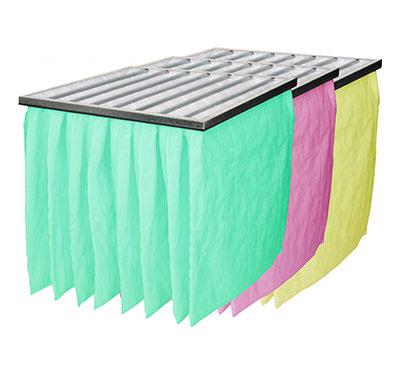
A bag filter — sometimes called a pocket filter or multi-pocket filter — is an extended surface air filter made of synthetic or natural fibre media sewn into a series of individual pockets or bags. These pockets are attached to a rigid header frame, typically made from galvanised steel or plastic, which slots into a standard filter holding frame inside an air handling unit.
When the system’s fans pull or push air through the unit, the bags inflate like little wind socks. Air passes through the media from the outside of each bag to the inside (or vice versa, depending on the design), and particles get trapped in the fibre matrix of the media. The filtered air continues downstream to the next stage of the system — which might be another filter, a cooling coil, a heating element, or directly into the occupied space.
The beauty of the bag design is surface area. A single bag filter housing might contain six, eight, ten, or even twelve individual pockets, each one offering a substantial area of filter media. Add up the total media area across all the pockets and you get a filter with enormous dust-holding capacity crammed into a relatively compact frame.
When you buy bag filter units for the first time, the sheer amount of filtration surface packed into that frame is genuinely surprising. A bag filter with eight 600mm deep pockets can easily have six to eight square metres of total media area. That’s a lot of particle-catching real estate for something that fits in a standard 592mm × 592mm housing.
The Anatomy of a Bag Filter — Breaking It Down Piece by Piece
Understanding how a bag filter is built helps you understand why certain design choices matter. Let me walk through the major components.
The header frame is the rigid structure at the front of the filter. It’s what you grab when you’re installing or removing the filter, and it’s what sits in the holding frame of the air handling unit. Most header frames are made from galvanised sheet steel or, in lighter-duty applications, injection-moulded plastic. The frame needs to be stiff enough to hold its shape under the pressure of airflow and durable enough to survive handling during installation without bending or cracking.
The pockets or bags are the working elements of the filter. They’re sewn from sheets of filter media, stitched along the edges and attached to the header frame at the open end. When air flows through the filter, these pockets inflate and present their full surface area to the incoming airstream. The quality of the stitching matters more than people realise — a blown seam under operating conditions means unfiltered air bypassing the media entirely.
Internal support frames or stiffeners are sometimes built into each pocket to prevent the bags from collapsing under airflow or fluttering excessively. In high-velocity applications, bags without adequate stiffening can oscillate back and forth, causing the media to fatigue and eventually tear. Better quality bag filters include internal wire frames or plastic splines that keep each pocket properly inflated and stable.
The gasket or sealing surface on the header frame ensures an airtight fit against the filter holding frame. Just like with HEPA filters, any gap between the filter frame and the housing lets unfiltered air sneak through, completely undermining the filter’s purpose.
When you buy bag filter products from a quality manufacturer, all of these components are engineered to work together as a system. Cheap knock-offs cut corners on stitching, use flimsy header frames, and skip the internal support structures. You get what you pay for.
Filter Efficiency Ratings — Making Sense of the Numbers
This is where things get confusing for a lot of people, and honestly, the industry hasn’t done a great job of making it simple. Multiple rating systems exist, and they don’t always translate neatly from one to another.
The current international standard for rating general ventilation air filters is ISO 16890, which replaced the older EN 779 standard. Under ISO 16890, filters are classified based on their ability to capture particles in three size ranges — ePM1 (particles ≤ 1 micron), ePM2.5 (particles ≤ 2.5 microns), and ePM10 (particles ≤ 10 microns). These categories align with the particle sizes that matter most for human health and ambient air quality.
In the older ASHRAE/MERV system still commonly used in North America and parts of Asia, bag filters typically fall in the MERV 7 to MERV 15 range, covering moderate to high efficiency general ventilation filtration.
Under the now-superseded EN 779 standard, bag filters were commonly rated between F5 and F9, with F5 and F6 being coarse to medium efficiency and F7, F8, and F9 being fine efficiency grades.
What does this mean in practical terms? An ePM10 50% rated bag filter captures at least 50% of particles in the 10 micron and smaller range. An ePM1 60% rated bag filter captures at least 60% of particles down to 1 micron. The higher the capture percentage and the smaller the particle size category, the more efficient the filter.
For most commercial HVAC applications — offices, shopping centres, hospitals (non-critical areas), schools — a bag filter rated ePM2.5 or ePM1 provides appropriate protection. For pre-filtration ahead of HEPA filters in cleanrooms, laboratories, and pharmaceutical facilities, you want the higher end of the efficiency spectrum.
If you’re uncertain about what rating you need when you buy bag filter units, ask your supplier to recommend based on your specific application. A responsible manufacturer like TOPTEC PVT. LTD will help you match the filter specification to your actual requirements rather than just selling you whatever’s in stock.
Filter Media Options — This Is Where the Real Decisions Happen
The filter media is the heart of any bag filter. Everything else — the frame, the stitching, the support structures — exists to present the media to the airstream in the most effective way possible. Choose the wrong media and nothing else matters.
Synthetic Fibre Media
The most common media for bag filters is synthetic, typically made from polypropylene or polyester fibres arranged in a progressively denser structure. The upstream (dirty air) side has a more open fibre arrangement that catches larger particles first, while the downstream (clean air) side is denser and captures the finer particles. This gradient density structure maximises dust-holding capacity and minimises pressure drop.
Synthetic media is durable, moisture resistant, and maintains consistent performance throughout its service life. It doesn’t support microbial growth under normal conditions, and it’s available across the full range of efficiency ratings from ePM10 through ePM1.
Most commercial and industrial applications are well served by synthetic media. When you buy bag filter units for standard HVAC systems, commercial buildings, or industrial ventilation, synthetic media is almost certainly what you should be specifying.
Glass Fibre Media
Glass fibre media offers higher efficiency than most synthetic alternatives at a given pressure drop. The ultrafine glass fibres create a very dense matrix that captures extremely small particles, making glass fibre bag filters popular for applications requiring near-HEPA pre-filtration performance.
The downside is that glass fibre media is more fragile than synthetic alternatives. It doesn’t handle moisture well, and it’s more susceptible to damage from rough handling during installation. In applications with high humidity or where filters might get wet — poorly maintained air handling units in humid climates, for example — glass fibre media can break down prematurely.
Glass fibre bag filters are typically specified for pharmaceutical cleanroom pre-filtration, hospital HVAC systems serving critical areas, and electronics manufacturing facilities where the highest possible pre-filtration efficiency is needed to extend HEPA filter life.
Electrostatically Charged Media
Some synthetic bag filter media carries an electrostatic charge that enhances particle capture efficiency. The charge attracts particles to the fibre surface through electrostatic forces in addition to the mechanical filtration mechanisms (interception, impaction, and diffusion) that all filter media relies on.
Electrostatically charged media can achieve higher efficiency at lower pressure drop than equivalent mechanically-filtered media. However — and this is important — the electrostatic charge degrades over time, particularly in environments with high humidity, elevated temperatures, or exposure to certain chemicals. As the charge diminishes, the filter’s efficiency drops, sometimes quite significantly.
If you’re considering electrostatically charged media, make sure you understand how the filter will perform not just when it’s new but throughout its service life. Some manufacturers quote initial efficiency numbers that look impressive but don’t reflect real-world performance after several months of operation. When you buy bag filter products, ask specifically whether the rated efficiency accounts for charge decay.
Activated Carbon Infused Media
For applications where odour control or gaseous contaminant removal is needed alongside particulate filtration, some bag filters incorporate activated carbon particles into or onto the filter media. These hybrid filters provide both particle capture and gas-phase adsorption in a single stage.
They’re useful in applications like waste treatment facility ventilation, kitchen exhaust recirculation systems, and indoor air quality improvement in environments near sources of volatile organic compounds. However, they’re not a substitute for dedicated gas-phase filtration systems in applications with heavy chemical contamination.
Nanofibre Coated Media
At the premium end of the market, some manufacturers offer bag filter media coated with a layer of nanofibres on the upstream surface. These nanofibres — typically electrospun polyamide or similar polymers — create an extremely fine surface layer that captures particles before they penetrate deep into the base media.
The advantage is that particles are captured on the surface rather than embedded deep within the media structure. This makes the filter more cleanable in some applications and helps maintain a more consistent pressure drop over the filter’s life. The technology is still relatively expensive, but for high-value applications where filter performance consistency is critical, nanofibre-coated media is worth evaluating.
Bag Depth and Pocket Count — Size Matters
Bag filters come in various pocket depths and pocket counts, and both of these dimensions directly affect performance, capacity, and system compatibility.
Common pocket depths range from about 300mm on the shallow end to 900mm on the deep end, with 500mm and 600mm being the most widely used in commercial HVAC applications. Deeper pockets mean more media surface area per filter, which translates into higher dust-holding capacity and longer service life — but deeper pockets also require more physical space inside the air handling unit.
If your air handling unit was designed for 600mm deep bag filters, you can’t just switch to 900mm deep bags without confirming there’s enough clearance downstream. Conversely, if you have the space, moving to deeper pockets can extend filter change intervals and reduce total cost of ownership.
Pocket counts typically range from four to twelve, with six and eight being the most common configurations. More pockets in the same frame size means more total media area, but the individual pockets are narrower and may not inflate as effectively at low air velocities. The right balance depends on your system’s airflow characteristics and the filter frame size you’re working with.
When you buy bag filter products, specify both the pocket depth and pocket count that match your existing housing dimensions — or if you’re designing a new system, work with the filter manufacturer to optimise these parameters for your airflow requirements and maintenance schedule.
Where Bag Filters Fit in the Filtration Chain
No single filter does everything. Air filtration in any serious facility is a multi-stage process, and understanding where bag filters sit in that chain is essential for making good purchasing decisions.
In a typical commercial or pharmaceutical HVAC system, the filtration chain looks something like this. Air enters the system through an intake, passes through a coarse pre-filter (usually a panel filter or washable metal mesh) that catches large debris — leaves, insects, sand, large dust particles. It then passes through the bag filter, which handles the medium to fine particle range. In systems requiring very high air quality, the air then continues through to a final-stage HEPA or ULPA filter.
The bag filter’s job in this chain is to do the heavy lifting on fine particles while protecting any downstream high-efficiency filters from premature loading. A good bag filter significantly extends the life of expensive HEPA filters downstream, and this is where the real economic argument for quality bag filtration gets interesting.
Let’s say a HEPA filter costs five to ten times what a bag filter costs. If a high-quality bag filter extends the HEPA filter’s life by even six months, the net saving on HEPA replacements alone can dwarf the cost of the bag filter. This is why it’s actually counterproductive to cheap out on bag filters — a substandard pre-filter means your expensive final filters bear the burden and need replacing sooner.
Every time you buy bag filter units, you’re really making an investment in the entire downstream filtration system. Think about it that way and the procurement conversation changes completely.
Selection Criteria — Getting the Right Filter for Your Application
Choosing a bag filter isn’t just about picking an efficiency rating and calling it a day. There are several factors that should inform your decision, and skipping any of them can lead to poor performance, premature failure, or wasted money.
Airflow Rate and Velocity
Every bag filter is rated for a specific range of airflow. Operating below the minimum rated flow means the bags won’t inflate properly, leading to uneven air distribution across the media and reduced efficiency. Operating above the maximum rated flow increases pressure drop, stresses the media and stitching, and can cause premature failure.
Know your system’s actual airflow — not the design airflow from twenty years ago, but the current measured airflow. Systems change over time as ducts are modified, dampers are adjusted, and fans wear. Match the filter to the actual operating conditions, not the nameplate.
Temperature and Humidity
Standard synthetic bag filter media works well up to about 70 to 80 degrees Celsius. Beyond that, you need media specifically rated for high-temperature applications. If your system handles process exhaust or operates in extremely hot climates without cooling the intake air, confirm the temperature rating before purchasing.
Humidity matters too. In humid environments — Pakistan’s coastal cities come to mind — moisture can cause some media types to swell, increasing pressure drop and potentially promoting microbial growth on the filter surface. Look for media that’s been treated or inherently resistant to moisture in these conditions.
Chemical Exposure
In industrial settings where the air contains chemical vapours, solvents, acids, or other reactive substances, standard filter media may degrade rapidly. If you’re filtering air from a chemical processing area, painting booth, or any environment with significant chemical contamination, discuss the specific chemicals present with your filter supplier before you buy bag filter products. They may recommend specialised media or a completely different filtration approach.
Dust Concentration and Particle Type
A bag filter in the fresh air intake of an office building in Islamabad faces a very different challenge than a bag filter in the ventilation system of a cement plant. The concentration, size distribution, and nature of the particles in the air directly affect filter loading rate, required efficiency, and expected service life.
High dust concentration environments need bag filters with maximum dust-holding capacity — deep pockets, high media area, gradient density structure. Low dust concentration environments might get away with shallower pockets but might need higher efficiency to capture the finer particles that dominate the particulate profile.
Space Constraints
This is purely practical but can be a deal-breaker. Measure the available space inside your air handling unit before ordering filters. Confirm the frame size, the available depth for pocket inflation, and any clearances needed for downstream components. There’s nothing worse than receiving a shipment of bag filters that physically won’t fit in your system.
TOPTEC PVT. LTD — Manufacturing Filtration Solutions in Pakistan
I keep coming back to the point about local manufacturing because it genuinely matters, particularly in a market like Pakistan where the laboratory and industrial sectors are growing rapidly but the supply chain for technical products hasn’t always kept pace.
TOPTEC PVT. LTD is a Pakistani manufacturer — not a trading house with a warehouse, not an agent for a foreign brand, but an actual manufacturer with production capability right here in the country. They build laboratory furniture, cleanroom equipment, biosafety cabinets, laminar flow systems, fume hoods, and the filtration products that go inside them, including bag filters and HEPA filters.
When you buy bag filter units from TOPTEC, you’re getting products built by people who understand the local operating environment. They know about the dust levels in Karachi and Lahore. They know about the humidity along the coast. They know about the power fluctuations that cause fan speeds to vary. They know about the procurement challenges that Pakistani facilities face every day. And they build their products to handle all of it.
This kind of contextual understanding is something you simply don’t get from an overseas supplier whose nearest technical representative is a fourteen-hour flight away.
The Real Cost of Cheap Filters
I need to address this directly because I see it constantly and it drives me crazy. Procurement departments fixated on unit price — the cost per filter printed on the purchase order — while completely ignoring the total cost of ownership.
A cheap bag filter might save you a few thousand rupees per unit at the point of purchase. But if it has half the dust-holding capacity of a quality filter, you’ll be replacing it twice as often. That means twice the filter cost over the same period, twice the labour for changeover, twice the system downtime, and twice the disposal cost. The “savings” evaporate before the ink is dry on the purchase order.
Even worse, a cheap bag filter with poor media quality or sloppy construction might allow more particles through to the downstream HEPA filter, loading it faster and forcing an early replacement of a filter that costs five to ten times more. You saved a few thousand rupees on bag filters and lost tens of thousands on HEPA filters. Brilliant.
When you buy bag filter products, evaluate the total cost — purchase price plus installation labour plus disposal cost plus impact on downstream filter life plus energy consumption — over the full expected service life. That’s the number that matters, and it almost always favours the higher-quality product.
Installation Best Practices
Getting a bag filter into its housing seems straightforward, and it mostly is, but there are a few things that regularly go wrong.
First, confirm the orientation. Most bag filters are designed to be installed with the pockets pointing downstream — away from the incoming air. Installing them backwards means the pockets can’t inflate properly and the media isn’t presented to the airstream as designed. It sounds like an obvious mistake, but I’ve found backwards-installed bag filters in facilities that should know better.
Second, check the gasket seal. The filter’s header frame should sit firmly against the holding frame with the gasket compressed evenly all around. If the holding frame is damaged, corroded, or bent, the seal will be compromised. Fix the holding frame before installing the new filter.
Third, don’t force it. If a filter doesn’t slide easily into the holding frame, something’s wrong — the dimensions don’t match, there’s an obstruction, or the holding frame is misaligned. Forcing a filter into place can bend the header frame, tear the gasket, or damage the pocket media before the filter even starts its service life.
Fourth, record the installation. Note the date, the filter model and batch number, the initial pressure drop reading, and the person who performed the installation. This documentation is valuable for tracking filter life, identifying trends, and satisfying audit requirements.
Monitoring During Service Life
Once a bag filter is installed and running, the single most important thing you can do is monitor its pressure drop. A differential pressure gauge mounted across the filter bank gives you real-time visibility into how loaded the filter is.
Record the initial pressure drop at the time of installation. This is your baseline. As the filter captures particles, the pressure drop will rise gradually. The rate of rise tells you how quickly the filter is loading, which in turn tells you roughly when you’ll need to replace it.
Most bag filter manufacturers specify a recommended final pressure drop — the point at which the filter should be replaced. This is typically somewhere between 250 and 450 Pascals, depending on the filter type and efficiency class. Don’t exceed this value. An overloaded filter restricts airflow, reduces system performance, increases energy consumption, and in extreme cases can suffer structural failure — bags tearing, seams blowing, media collapsing.
Some facilities also do periodic visual inspections of their bag filters, which is fine as far as it goes. A visual check can reveal gross problems like torn bags, collapsed pockets, or visible bypass around the gasket. But it won’t tell you about gradual efficiency degradation or subtle increases in pressure drop. Instruments trump eyeballs every time.
When to Replace — And When Not To
Replace bag filters when the pressure drop reaches the manufacturer’s recommended maximum. That’s the simple answer.
Don’t replace them on a fixed calendar schedule unless you’ve correlated that schedule to actual pressure drop data over multiple change cycles and confirmed it’s accurate. Some facilities change filters every three months like clockwork, regardless of how loaded they actually are. If the filters still have life in them, that’s waste. If the filters are overloaded before the three months are up, that’s risk. Neither is acceptable.
Also don’t replace bag filters because they “look dirty.” A discoloured filter is a working filter. It’s supposed to get dirty — that’s literally its job. The question isn’t whether the filter is dirty; it’s whether the dirtiness has reached the point where the pressure drop is excessive.
When you buy bag filter replacements, order them in advance based on your projected change schedule derived from actual pressure drop trends. Keep a reasonable buffer stock on hand so you’re never caught short. And establish a relationship with your supplier so reorders are quick and painless.
Bag Filters in Laboratory Settings
While bag filters are most commonly associated with commercial HVAC and industrial ventilation, they play an important role in laboratory settings too.
Most laboratory buildings have central air handling units that condition and filter the supply air before distributing it to individual labs. These central systems typically include bag filters as the intermediate filtration stage. The better the bag filtration, the cleaner the air entering the laboratory — and in labs where further HEPA filtration is provided by biosafety cabinets or laminar flow hoods, cleaner supply air means longer HEPA filter life and better overall air quality.
In this context, the bag filter is a team player. It’s not the star of the show — that role belongs to the HEPA filter — but without a good supporting cast, the star can’t perform.
TOPTEC PVT. LTD understands this integrated approach to laboratory air quality because they manufacture both the bag filters in the central air handling system and the HEPA filters in the terminal equipment. When you buy bag filter units and HEPA filters from the same manufacturer, you get a filtration system where every stage is designed to complement the others. No gaps, no redundancies, no mismatched specifications.
Custom Solutions and Technical Support
One of the things I appreciate about working with a manufacturer rather than a distributor is the ability to get genuine technical support. A distributor can read you the data sheet and maybe help you match dimensions. A manufacturer can discuss media options, recommend design modifications for unusual applications, produce custom sizes, and troubleshoot problems based on deep knowledge of how the product is actually built.
TOPTEC PVT. LTD offers this kind of hands-on technical partnership. If your air handling unit uses non-standard filter housing dimensions, they can build bag filters to fit. If you’re dealing with an unusual contamination challenge — corrosive fumes, sticky particles, high-temperature exhaust — they can recommend media and construction options suited to those conditions.
This is especially valuable in Pakistan, where many industrial and laboratory facilities have been built or modified over decades using a mix of equipment from different manufacturers and different eras. Standard off-the-shelf filters don’t always fit, and having a local manufacturer who can bridge those gaps is genuinely useful.
The Environmental Angle
Used bag filters are waste, and in a world that’s paying increasing attention to waste reduction and environmental responsibility, the disposal question matters.
Most spent bag filters end up in landfill. The media, frame, and captured contaminants all go into the waste stream together. In some jurisdictions, filters from certain applications — healthcare, pharmaceutical, chemical processing — may be classified as hazardous waste requiring special handling and disposal.
Some manufacturers are working on more sustainable approaches — recyclable frames, media made from recycled materials, incinerable media for energy recovery. This is still an evolving area, but it’s worth considering when you buy bag filter products. Ask your supplier about the end-of-life options for their filters and whether any recyclable or reduced-waste versions are available.
TOPTEC PVT. LTD is aware of these environmental considerations and can discuss sustainable options with customers who prioritise environmental responsibility in their procurement decisions.
Common Mistakes and How to Avoid Them
After years of working with air filtration systems, I’ve compiled a mental list of the mistakes I see most frequently. Here they are, in no particular order.
Specifying by price alone. I’ve beaten this drum already, but it bears repeating. Total cost of ownership is the only metric that matters. Unit price is one small part of that equation.
Ignoring pre-filtration. Running bag filters without adequate upstream pre-filtration is like using your car’s engine air filter without a pre-cleaner in a dusty environment. The bag filter loads up faster, costs more to replace more often, and still doesn’t protect downstream components as well as a properly staged system would.
Neglecting pressure drop monitoring. If you’re not measuring pressure drop across your bag filters, you’re flying blind. You don’t know when to change them, you can’t track loading rates, and you have no data to support procurement planning or energy analysis.
Storing filters improperly. Bag filters should be stored in their original packaging, in a clean dry area, protected from damage. I’ve seen filters stored in leaky warehouses, stacked under heavy equipment, and left on loading docks in the rain. All of these situations result in filters that are compromised before they’re even installed.
Skipping documentation. Every filter installation, every pressure drop reading, every replacement — document it all. When an auditor shows up, when management asks about filtration costs, when you need to justify a budget request for better filters, that documentation is your evidence.
Bringing It All Together
Bag filters are a foundational element of any serious air filtration system. They’re not as exotic as HEPA filters or as visible as the intake louvres on the side of the building, but they do critical work every minute of every day, quietly capturing the particles that would otherwise degrade your indoor air quality, damage your equipment, contaminate your products, and shorten the life of your expensive terminal filters.
Choosing the right bag filter — the right efficiency rating, the right media type, the right pocket depth and count, the right construction quality — requires thoughtful consideration of your specific application. It’s not a commodity purchase where you just pick the cheapest option and move on. It’s a technical decision with real consequences for system performance, energy consumption, maintenance costs, and downstream equipment life.
When you’re ready to buy bag filter products for your facility — whether it’s a pharmaceutical cleanroom, a hospital HVAC system, a research laboratory, or an industrial manufacturing plant — talk to TOPTEC PVT. LTD. They’re a Pakistani manufacturer building quality filtration and laboratory furniture products right here in the country. They understand the local market, they can deliver quickly, they offer genuine technical support, and they stand behind their products with the confidence that comes from actually making them.
Your filtration system is only as strong as its weakest stage. Make sure your bag filters aren’t that weak link. Get the specification right, source from a manufacturer you trust, install them properly, monitor them consistently, and replace them on time. Do all of that, and the rest of your air handling system will thank you for it — quietly, invisibly, and in the language that matters most: reduced costs, better performance, and cleaner air.
