

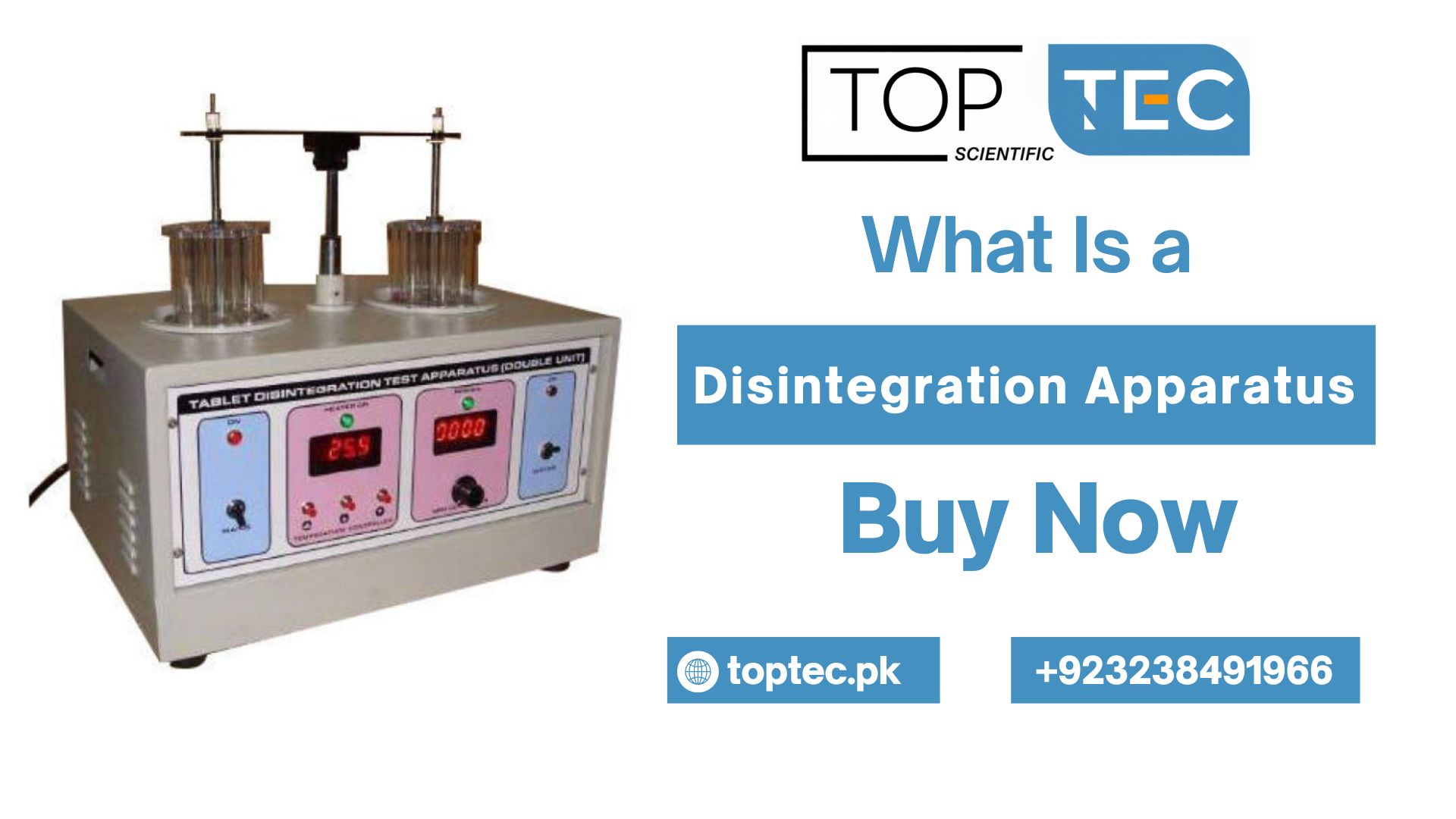
Disintegration apparatus measures the time it takes for oral dosage forms like tablets and capsules to break down. This guide covers apparatus design, pharmacopoeial standards, testing procedures, and quality control applications.
There’s a moment in every tablet’s journey through the gastrointestinal tract that determines everything that follows.
A tablet that doesn’t disintegrate properly — that stays intact too long in the stomach or small intestine, or breaks into large chunks that resist further breakdown — can’t release its active ingredient in a way that allows adequate absorption. The patient swallows the tablet. The tablet passes through. The drug effect is minimal or absent. And nobody necessarily knows why.
This is the problem that disintegration testing exists to prevent. And the Disintegration Apparatus is the instrument that makes this testing possible — a pharmacopoeia-defined device that simulates the mechanical conditions of the gastrointestinal tract to verify that tablets and capsules break down within defined time limits.
This guide covers what the Disintegration Apparatus actually is, how it works mechanically, what the pharmacopoeia requirements specify, how different dosage forms are tested, and how to build the complete laboratory environment that supports reliable disintegration testing.
Understanding Disintegration — The Pharmaceutical Concept
Before examining the instrument, the underlying pharmaceutical concept deserves clear explanation.
Disintegration is the process by which a tablet or capsule, under the influence of aqueous medium and mechanical agitation, breaks down into granules or particles of specified size — or smaller. It’s the first step in a sequence that leads from solid dosage form to dissolved drug to absorbed drug to therapeutic effect.
For immediate-release tablets, rapid disintegration is essential. If a tablet designed to release drug within an hour of administration hasn’t even disintegrated after 30 minutes, dissolution can’t proceed at the intended rate, and the expected blood level profile won’t be achieved.
For enteric-coated tablets, the situation is more nuanced. These formulations are specifically designed NOT to disintegrate in the acidic environment of the stomach — they should remain intact through gastric transit and disintegrate only in the higher-pH environment of the small intestine. Disintegration testing for enteric-coated products therefore tests both acid resistance AND subsequent disintegration in appropriate buffer conditions.
For extended-release formulations, disintegration testing may not be the primary release-characterizing test — dissolution is usually more informative. But disintegration is still part of the quality characterization picture.
The Disintegration Apparatus is designed to test all of these scenarios — immediate-release, enteric-coated, and various modified-release forms — under pharmacopoeially standardized conditions.
What Is a Disintegration Apparatus? The Basic Definition
A Disintegration Apparatus — also called a tablet disintegration tester — is a pharmacopoeia-defined instrument that subjects tablets or capsules to a standardized mechanical environment in a liquid medium at controlled temperature, assessing whether they disintegrate within the specified time limit.
The USP defines the Disintegration Apparatus in detail in USP <701> Disintegration. The BP (British Pharmacopeia) has equivalent specifications. The requirements are largely harmonized — instruments meeting USP specifications generally also meet BP and EP requirements for standard testing.
At its core, the instrument consists of:
A basket-rack assembly containing multiple tubes — typically 6 — that hold individual tablets or capsule. A vessel containing the test medium (water, simulated gastric fluid, buffer solutions). A mechanism that raises and lowers the basket assembly through the medium at a defined, controlled rate. A water bath maintaining the medium at 37.0°C ± 2.0°C — body temperature. A means of observing or detecting disintegration.
The mechanical reciprocation of the basket assembly simulates the peristaltic movement of the gastrointestinal tract, providing the agitation that, combined with the aqueous medium, breaks down the dosage form under standardized conditions.
How the Disintegration Apparatus Works — The Mechanics
Understanding the mechanical operation helps you appreciate what specifications matter when you evaluate instruments and Buy Laboratory Furniture for the supporting environment.
The Basket-Rack Assembly
The basket-rack assembly is the component that directly contacts the dosage form. It consists of:
Six transparent tubes: Open at both ends, 77.5mm long with 21.85mm internal diameter (USP specification). Each tube holds one tablet or capsule for testing.
Two perforated plates: One at the top and one at the bottom of each tube — perforated discs that hold the tablet within the tube while allowing free circulation of medium through the tube. The perforations are standardized in number and size.
Supporting rack: Holds the tubes in a defined geometric arrangement and connects to the drive mechanism.
The entire basket-rack assembly is immersed in the test medium and reciprocated vertically at 29-32 cycles per minute (USP specification) through a distance of 55 ± 2mm. Each tablet in each tube experiences the same mechanical environment — the medium flows through the perforations, wetting the tablet, and the mechanical agitation works on the tablet surface.
The Drive Mechanism
The drive mechanism provides the controlled reciprocating motion — up-and-down at 29-32 cycles per minute with the defined 55mm stroke. Modern USP disintegration tester instruments use electric motors with appropriate gear reduction and eccentric drive mechanisms to produce this motion with controlled speed and stroke.
Speed accuracy matters because deviations from the specified 29-32 CPM alter the hydrodynamic conditions experienced by the tablets. Too fast and the mechanical forces exceed those specified; too slow and disintegration is artificially prolonged beyond what the pharmacopoeia test is designed to assess.
Temperature Control
The test medium is maintained at 37.0°C ± 2.0°C — body temperature — throughout the test. Most Disintegration Apparatus designs use a circulating water bath that maintains the vessel temperature with sufficient accuracy and uniformity.
Temperature accuracy is important because disintegration rate is temperature-dependent. A tablet tested at 35°C will disintegrate more slowly than the same tablet at 37°C. Systematic temperature error introduces systematic bias into disintegration test results.
Observation and Endpoint Detection
Disintegration endpoint — when all fragments have passed through the lower plate perforations of the basket assembly, or when no residue remains on the screen — is determined either by visual observation or by automated detection.
Traditional tablet disintegration tester instruments require the analyst to observe the basket assembly through the transparent vessel and timing the point at which each tube’s contents have completely disintegrated. The test continues until all six units have disintegrated or until the time limit specified in the monograph is reached.
Modern automated disintegration testers incorporate optical or electrical sensors that automatically detect disintegration and record the time for each tube. This eliminates observer variability in endpoint determination and provides automatic data recording — significant advantages for high-throughput GMP testing.
The USP Disintegration Test — Pharmacopoeia Requirements in Detail
The USP disintegration tester must conform to the specifications in USP <701> Disintegration. Understanding these requirements helps you evaluate equipment compliance and understand what’s being tested.
USP Apparatus Specifications
Basket-rack assembly dimensions: Precisely specified — tube length 77.5mm ± 0.5mm, internal diameter 21.85mm ± 1.0mm, plate perforation dimensions and number specified.
Reciprocation rate: 29-32 cycles per minute.
Stroke length: 55 ± 2mm.
Medium temperature: 37 ± 2°C.
Tube inclination: The tubes should maintain vertical orientation throughout the reciprocating motion.
These specifications are not arbitrary. They’ve been developed and validated over decades to produce reproducible conditions that correlate with in vivo disintegration behavior. Instruments that deviate significantly from these specifications produce results that aren’t comparable to the pharmacopoeia standard.
When you evaluate options to purchase Disintegration Apparatus equipment, verifying conformance to these specifications — with factory calibration documentation confirming speed, stroke, and temperature — is the baseline quality check.
The Standard Test Procedure
For most uncoated and film-coated tablets:
One tablet is placed in each of the 6 tubes of the basket. If the individual monograph specifies, a disc is placed on top of each tablet (some formulations float without the disc). The basket assembly is lowered into the medium (purified water or other specified medium at 37°C). The reciprocating motion begins. The analyst observes all 6 tubes until all tablets have disintegrated — all material has passed through the lower plate perforations. The test is complete when all 6 tablets disintegrate within the time limit.
If 1 or 2 tablets fail to disintegrate within the specified time, the test is repeated on 12 additional tablets. The requirement is met if 16 of 18 tablets disintegrate within the time limit.
Time Limits by Dosage Form
USP specifies different disintegration time limits for different dosage form categories:
Uncoated tablets: 30 minutes in water
Film-coated tablets: 30 minutes in water
Sugar-coated tablets: 60 minutes in water
Enteric-coated tablets: Must not disintegrate within 60 minutes in 0.1N HCl (simulated gastric fluid), then must disintegrate within 60 minutes in pH 6.8 phosphate buffer (simulated intestinal fluid)
Sublingual tablets: 3 minutes in water
Buccal tablets: 4 hours in water at no agitation — specific apparatus configuration
Effervescent tablets: Specific test conditions
Hard gelatin capsules: 30 minutes in water
Soft gelatin capsules: 30 minutes in water
These time limits represent the regulatory performance standards that each dosage form must meet. The Disintegration Apparatus test verifies compliance with these standards at every batch release.
Types of Disintegration Apparatus — Understanding the Full Range
When pharmaceutical laboratories consider purchasing a tablet disintegration tester, several distinct configurations are available:
Single-Bath Standard Disintegration Apparatus
The most common configuration for routine pharmaceutical QC. A single water bath vessel with one basket-rack assembly. Tests 6 tablets simultaneously. Appropriate for laboratories with moderate testing volumes where multiple simultaneous tests of different products are not frequently required.
The Disintegration Apparatus in this configuration is the standard tool for most Pakistani pharmaceutical QC laboratories — reliable, straightforward to operate, and appropriate for standard immediate-release and film-coated tablet testing.
Dual-Bath Disintegration Apparatus
Two basket-rack assemblies operating in the same or separate baths. Allows simultaneous testing of 12 units or simultaneous running of two different tests (useful for testing replicates of enteric-coated products where acid stage and buffer stage require separate timing, or for running two different products simultaneously).
For higher-throughput QC laboratories, dual-bath configurations significantly improve testing efficiency — running two batch tests simultaneously rather than sequentially.
Multi-Station Automatic Disintegration Testers
Sophisticated instruments with multiple basket-rack stations, automated timing and endpoint detection, automatic documentation of individual tube disintegration times, and software integration for GMP batch record documentation.
These automated instruments virtually eliminate analyst involvement during the test — the instrument tracks disintegration, records times automatically, calculates pass/fail, and generates test reports. For high-volume pharmaceutical QC laboratories testing many batches daily, automated USP disintegration tester systems dramatically improve throughput and reduce analyst time.
Combined Disintegration/Dissolution Systems
Some specialized instruments combine disintegration and dissolution capability in a single platform. These are more relevant for formulation development laboratories than routine QC, but exist as an option for laboratories wanting to characterize both disintegration and early dissolution behavior with the same instrument.
The Enteric-Coated Tablet Test — A Critical Special Case
Enteric-coated tablet disintegration testing deserves specific discussion because it’s more complex than standard tablet testing and because the test requirements differ fundamentally.
Enteric-coated tablets must resist disintegration in the acidic gastric environment. The coating — typically methacrylic acid copolymers — is designed to remain intact at pH 1-2 (gastric pH) and dissolve at pH 5.5-6.8 (intestinal pH).
The disintegration test for enteric-coated tablets therefore has two sequential stages:
Stage 1 (Acid Resistance): The basket assembly is immersed in 0.1N HCl for 60 minutes. After 60 minutes, all tablets must show no signs of disintegration — no cracks, no softening of the coating, no rupture. This stage confirms the gastric acid resistance that defines the enteric coating function.
Stage 2 (Buffer Stage): Immediately after the acid stage, the medium is changed to pH 6.8 phosphate buffer and testing continues. The tablets must disintegrate within 60 minutes in the buffer medium.
This two-stage testing requires either:
Medium change capability in the same vessel — some Disintegration Apparatus designs allow medium exchange without removing the basket assembly.
Transfer of the basket assembly to a second vessel pre-loaded with buffer medium — more common in standard instrument designs.
The two-stage enteric tablet test is a routine part of pharmaceutical QC for enteric-coated products. When specifying a Disintegration Apparatus for a laboratory that tests enteric-coated tablets, ensuring the instrument accommodates this two-stage protocol without disrupting the test integrity is an important specification consideration.
GMP Requirements for Disintegration Testing
Like all pharmaceutical analytical instruments used for batch release testing, Disintegration Apparatus equipment must meet GMP requirements for qualification, calibration, and operation.
Equipment Qualification
Installation Qualification (IQ): Confirms the instrument is installed correctly — location, electrical connections, instrument identity documented, calibration certificates received, operating manuals available.
Operational Qualification (OQ): Verifies instrument performance within specification:
Reciprocation rate verification — confirming 29-32 CPM at the test position.
Stroke length verification — confirming 55 ± 2mm at operating speed.
Temperature verification at the vessel position — confirming 37.0°C ± 2.0°C is achieved and maintained throughout testing duration.
Timing system accuracy verification.
Software function verification for automated instruments.
Performance Qualification (PQ): Ongoing demonstration of acceptable instrument performance. For Disintegration Apparatus, this often includes testing USP disintegration reference standards and verifying that results meet expected specifications.
Calibration Requirements
Temperature calibration: Thermometer or temperature sensor used for medium temperature verification must have current calibration certificate from a traceable standard. Temperature verification at the vessel position — not just at the bath controller — is the appropriate measurement point.
Reciprocation rate calibration: Stroke count per minute verified with a calibrated tachometer or by direct timing with a calibrated stopwatch.
Stroke length calibration: Measured with a calibrated ruler or digital caliper.
Calibration intervals — typically annually or semi-annually depending on testing volume and criticality — generate documented records that form part of the instrument qualification file.
Analyst Training and SOPs
GMP requires that analysts performing disintegration testing are trained on the specific instrument and the applicable SOPs. For manual endpoint detection (visual observation), inter-analyst variability in endpoint determination is a real source of variability that training and clear SOP definition minimizes.
Building the Complete Disintegration Testing Environment — Where TOPTEC Scientific Comes In
Here’s something that’s easy to overlook when focusing on instrument specification: the laboratory environment surrounding the Disintegration Apparatus directly affects testing reliability and analyst efficiency.
An unstable workbench transmits building vibration to the water bath and basket assembly — potentially affecting the hydrodynamic conditions within the test vessel. A poorly organized laboratory makes sample management before and after testing inefficient and error-prone. Inadequate storage for reference materials, test media reagents, and documentation creates the kinds of laboratory disorganization that introduce errors into routine testing.
This is exactly where TOPTEC Scientific provides essential value to Pakistani pharmaceutical QC laboratories.
TOPTEC Scientific is a Pakistan-based manufacturing company producing high-specification laboratory furniture and infrastructure for pharmaceutical QC laboratories, research institutions, and industrial testing facilities throughout Pakistan. When you Buy Laboratory Furniture from TOPTEC Scientific, you’re buying locally manufactured, pharmaceutical-grade laboratory infrastructure with direct technical support and no import complications.
For disintegration testing laboratories specifically, TOPTEC Scientific manufactures:
Stable Laboratory Workbenches for Disintegration Testing
The bench supporting a Disintegration Apparatus needs to be stable — vibration from an inadequate bench affects the controlled mechanical conditions the instrument creates. TOPTEC Scientific manufactures robust laboratory workbenches with appropriate mass and construction for analytical instrument support.
Chemical-resistant surface materials — epoxy resin, phenolic resin, or stainless steel — resist degradation from disintegration medium spills and cleaning chemical exposure. Appropriate working height supports comfortable analyst operation during the observation periods that visual endpoint determination requires.
These workbenches are purpose-specified for pharmaceutical QC laboratory environments — not generic furniture adapted for laboratory use. When you Buy Laboratory Furniture from TOPTEC Scientific for your disintegration testing area, you’re getting equipment designed for the pharmaceutical application.
Media Preparation and Storage Stations
Disintegration testing requires preparation of test media — purified water, 0.1N HCl for acid stage testing, pH 6.8 phosphate buffer for enteric tablet testing, simulated gastric and intestinal fluids per specific monographs.
TOPTEC Scientific manufactures dedicated media preparation workstations with:
Chemical-resistant surfaces for buffer preparation operations. Appropriate space for pH meter, magnetic stirrer, and volumetric glassware. Organized storage for reagent chemicals and buffer preparation materials.
Organized storage for prepared test media — properly labeled, maintained at appropriate temperature, protected from contamination.
Analytical Balance Workstations
Weighing of reference materials for media preparation requires stable, vibration-damped analytical balance workstations. TOPTEC Scientific manufactures dedicated instrument stands with anti-vibration design appropriate for analytical balances in pharmaceutical QC environments.
Proper balance positioning — away from air currents, in a location with stable temperature, on a vibration-damped surface — affects weighing accuracy for the small quantities involved in media preparation. Good Buy Laboratory Furniture decisions include purpose-designed balance stations, not simply positioning balances on general workbenches.
Reagent and Reference Standard Storage
Chemicals for disintegration medium preparation — hydrochloric acid, buffer salts — require appropriate chemical storage. Reference standards require controlled temperature storage. TOPTEC Scientific manufactures chemical storage cabinets and refrigerated storage furniture appropriate for pharmaceutical QC reference material management.
Complete QC Laboratory Benching Systems
For pharmaceutical QC laboratories equipped with multiple analytical instruments — Disintegration Apparatus, dissolution tester, friability tester, hardness tester, moisture analyzer — integrated benching systems that position instruments in logical, workflow-efficient arrangements support both testing efficiency and GMP compliance.
TOPTEC Scientific designs and manufactures complete QC laboratory benching systems that integrate multiple instruments in coordinated layouts — appropriate bench heights, adequate working space for each instrument, organized storage, and electrical supply distribution designed for the instrument cluster.
Fume Hoods for Hazardous Media Preparation
Preparation of 0.1N HCl — used in enteric-coated tablet acid stage testing — requires fume hood protection. TOPTEC Scientific manufactures ducted fume hoods with appropriate airflow performance and chemical-resistant interior surfaces (polypropylene or epoxy resin) for pharmaceutical laboratory chemical handling.
Pass-Through Systems
For QC laboratories within classified pharmaceutical facilities, controlled material transfer of samples between production areas and the QC laboratory requires pass-through boxes. TOPTEC Scientific manufactures pass-through boxes appropriate for pharmaceutical facility zone boundaries.
Sample Management and Storage Systems
Disintegration testing involves samples — tablets and capsules from production batches — that require organized storage before testing, and retention samples that need organized post-test storage. TOPOTEC Scientific manufactures pharmaceutical-grade sample storage furniture that supports organized, labeled sample management.
Instrument Maintenance and Service Support Areas
Disintegration Apparatus maintenance — basket assembly cleaning, perforated disc replacement, water bath maintenance — requires organized workspace. TOPTEC Scientific manufactures maintenance workbench areas appropriate for pharmaceutical instrument servicing.
The practical advantage of choosing TOPTEC Scientific when you Buy Laboratory Furniture for your pharmaceutical QC laboratory is comprehensive: local manufacturer, direct technical communication, custom dimensions available, no import delays, local installation support, and ongoing local service for furniture modifications as laboratory needs evolve.
Common Disintegration Testing Problems and Their Causes
Understanding these common issues helps in both specifying appropriate equipment and troubleshooting existing testing problems:
Floating Tablets or Capsules
Some formulations — particularly capsules — float in the test medium, leaving the basket-rack assembly zone and receiving different mechanical treatment than specified. The solution is the use of a perforated disc or sinker device placed on top of the dosage form within the tube, keeping it submerged.
Most tablet disintegration tester equipment comes with standard discs. Some formulations may require modified disc specifications per individual monograph requirements.
Sticky Materials Blocking Perforations
Some formulations produce sticky masses during disintegration that can block the perforated lower plate, preventing disintegration products from passing through. This is both a test interference issue and potentially a product design concern.
Investigation of blocking problems typically requires examination of the formulation — excipient selection, coating formulation if applicable — alongside assessment of whether the test methodology is appropriate for the specific dosage form.
Temperature Variability Between Tests
If the water bath takes time to recover to 37°C between consecutive tests — for example, when cold medium from a previous enteric-coated tablet test is replaced with fresh buffer — the first portion of the subsequent test may be at below-specification temperature.
Good Disintegration Apparatus operating practice includes allowing temperature equilibration before initiating timing, and confirming temperature at the vessel position (not just at the bath controller) at the start and periodically during the test.
Observer Variability in Endpoint Determination
Different analysts may determine the disintegration endpoint slightly differently — one may call the endpoint when a small fragment remains, another may wait until the last fragment has clearly passed through. This inter-analyst variability is a source of result variability that standard, detailed SOPs and analyst training minimize.
Automated USP disintegration tester instruments with sensor-based endpoint detection eliminate this source of variability entirely — the instrument consistently applies the same endpoint criterion regardless of which analyst is operating it.
Documentation Gaps
Manual timing and recording of disintegration endpoints for individual tubes creates documentation that depends entirely on the analyst recording results contemporaneously and accurately. For GMP compliance, this manual record-keeping must be subject to second-person review. Automated instruments with direct data capture eliminate these manual recording vulnerabilities.
Practical Buying Guide — Questions to Ask Suppliers
Before finalizing any decision to purchase a Disintegration Apparatus for pharmaceutical QC use, get specific answers to:
Does this instrument meet USP <701> specifications for basket-rack geometry, reciprocation rate (29-32 CPM), and stroke length (55 ± 2mm)? Request factory calibration documentation confirming these parameters.
How is temperature controlled and verified? Individual vessel verification or bath temperature only?
What is the automation level? Visual endpoint determination only, or automated detection with electronic time recording?
What documentation is provided for qualification purposes? IQ/OQ protocol templates, factory calibration records, dimension certificates?
Is calibration service available locally? At what interval and cost?
What software compliance features are included? Audit trail, user access control, electronic data records?
Are spare parts available locally? Particularly perforated discs and basket assemblies, which are routine replacement items.
Can the instrument accommodate enteric-coated tablet testing? Medium change capability or second vessel provision?
Closing Thoughts
The Disintegration Apparatus is a pharmacopoeia-mandated quality control instrument whose output directly protects patients who rely on pharmaceutical products to disintegrate and release drug as intended.
A properly specified USP disintegration tester — conforming to USP <701> mechanical specifications, with accurate temperature control, appropriate automation for your testing volume, and complete GMP qualification documentation — generates reliable, regulatory-defensible disintegration data that supports batch release decisions and patient safety.
And the laboratory environment supporting your tablet disintegration tester — the workbenches, media preparation stations, chemical storage, and complete QC laboratory infrastructure from TOPTEC Scientific — determines whether that instrument performs to its potential in daily use.
When you Buy Laboratory Furniture from TOPTEC Scientific for your pharmaceutical QC laboratory, you’re investing in locally manufactured, properly specified infrastructure that supports the reliable, GMP-compliant analytical testing your pharmaceutical manufacturing operation requires.
Build the complete testing environment properly. Your analytical data quality depends on both the instrument and the environment it operates in.
