

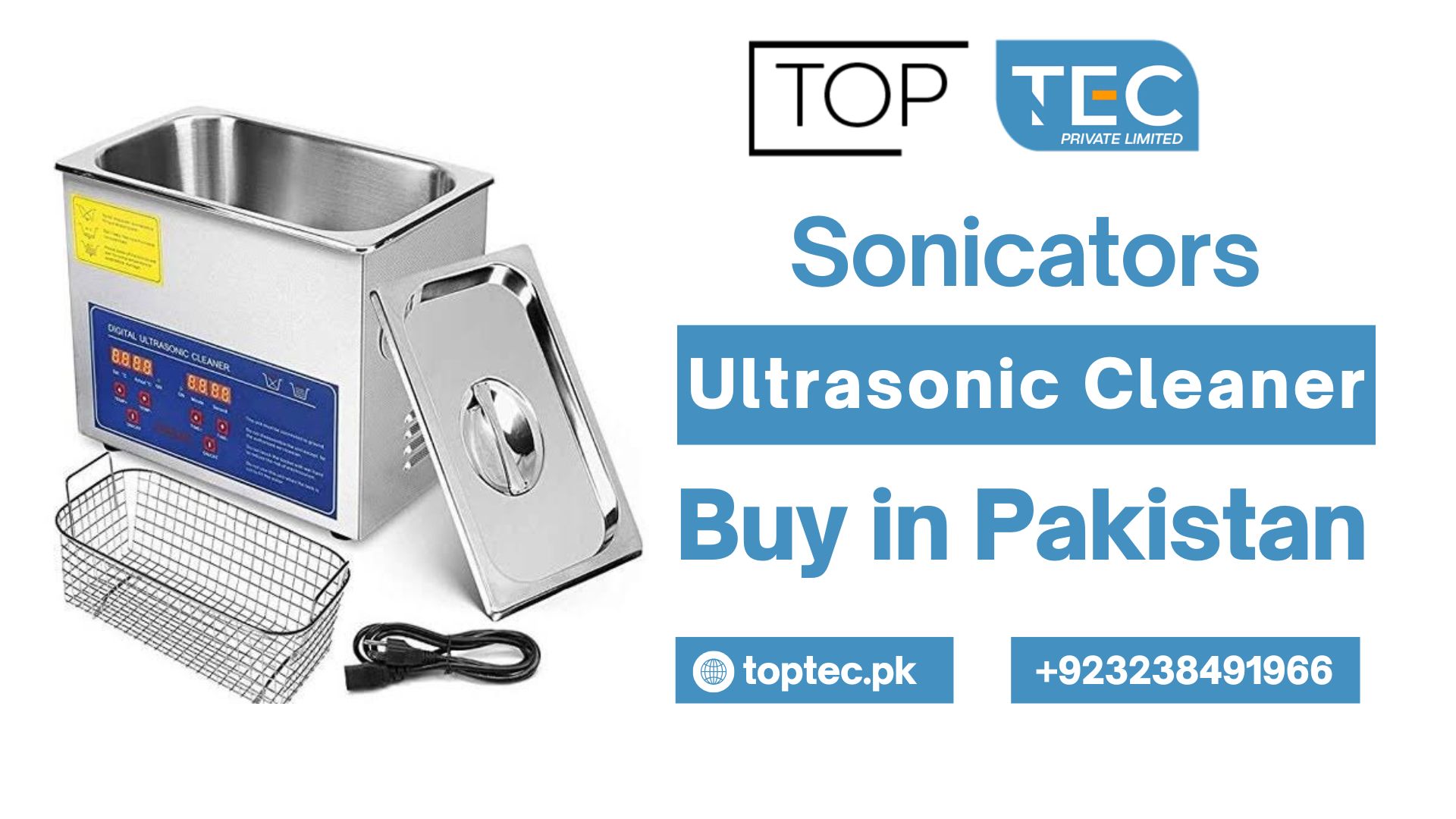
Anyone researching the Sonicator Price in Pakistan will notice a surprisingly broad range. A compact laboratory bath may cost less than PKR 100,000, while a large industrial system or high-power probe sonicator can run into several million rupees.
The difference is not simply brand markup. Tank capacity, ultrasonic output, heater power, frequency control, construction quality and included accessories all influence the final quotation. A heated 10-litre ultrasonic cleaner, for example, belongs to a different category from a 1,000-watt probe system designed for nanoparticle dispersion.
Before you buy Sonicator equipment, define the process it must perform. Cleaning glassware, degassing HPLC solvents and disrupting biological cells are very different applications, even though all three use ultrasonic energy.
What Is an Industrial Sonicator?
An industrial sonicator uses high-frequency sound waves to create cavitation in a liquid. Cavitation begins when microscopic bubbles form during low-pressure cycles and collapse during high-pressure cycles. Their collapse releases localised energy into the surrounding liquid.
An industrial ultrasonic cleaner transfers this energy from transducers fixed to a stainless-steel tank. A probe sonicator delivers concentrated energy directly into the sample through a titanium horn.
“Industrial” does not always mean an enormous floor-mounted machine. In laboratory purchasing, the term may describe a robust benchtop bath with a 10- to 30-litre tank, continuous-duty transducers and a drain valve. It may also refer to a flow-through or custom tank system used for repeated component cleaning.
Before you buy Sonicator equipment advertised as industrial grade, ask what that description means in measurable terms. Continuous-duty operation, transducer life, tank thickness and serviceable electronics matter more than the word printed on the brochure.
Bath, Probe or Flow-Through System?
1. Industrial Ultrasonic Bath
For many pharmaceutical and testing laboratories, the familiar ultrasonic cleaner is the most practical option. It contains a liquid-filled stainless-steel tank, bonded transducers, a generator and, in many models, an integrated heater.
The laboratory can use it to:
- Clean glassware and metal components
- Remove residue from dissolution baskets
- Degas HPLC solvents
- Assist sample dissolution
- Clean sieves and small machine parts
- Extract compounds from solid samples
- Disperse powders in liquid
- Remove oil and polishing compounds
If your main purpose is cleaning, degassing or gentle sample preparation, you will normally buy Sonicator bath equipment rather than a probe unit.
Bath systems are available from small 1-litre models to tanks exceeding 100 litres. For laboratory use, capacities between 3 and 30 litres are the most common.
2. Probe Sonicator
A probe sonicator consists of an electronic generator, converter and titanium horn. The horn is placed directly into the sample, delivering concentrated energy into a relatively small volume.
The Sonicator Price in Pakistan is usually much higher for a probe model because the system requires specialised electronics, amplitude control and interchangeable probes.
Probe applications include:
- Cell and tissue disruption
- Bacterial cell lysis
- DNA shearing
- Nanoparticle dispersion
- Emulsification
- Deagglomeration
- Homogenisation
- Extraction of intracellular compounds
A conventional ultrasonic cleaner cannot always provide enough concentrated energy for these applications. Bath units are gentler and less direct.
Before you buy Sonicator probe equipment, check whether the quoted package includes a stand, clamp, suitable probe, temperature sensor and sound enclosure. These accessories may add substantially to the final cost.
3. Flow-Through and Custom Tank Systems
Flow-through systems are used where liquid must be processed continuously rather than in separate batches. Large custom tanks are more common for cleaning production tools, precision components and manufacturing equipment.
These systems may require:
- Multiple transducers
- Filtration and recirculation
- Oil separation
- Automatic liquid-level control
- Lift baskets
- Rinsing and drying stages
- Stainless-steel pipework
- Programmable cleaning cycles
Their prices are normally project-specific because tank dimensions, transducer configuration and automation requirements vary.
Indicative Industrial Sonicator Prices
The current Sonicator Price in Pakistan depends heavily on exchange rates because most laboratory sonicators and their electronic components are imported. The following figures are broad market estimates rather than fixed offers.
| Equipment category | Typical specification | Indicative price range |
|---|---|---|
| Compact bath | 1–3 litres, basic timer | PKR 35,000–100,000 |
| Digital heated bath | 3–6 litres | PKR 80,000–220,000 |
| Medium laboratory bath | 10–15 litres | PKR 180,000–500,000 |
| Industrial laboratory bath | 20–30 litres | PKR 350,000–1,000,000 |
| Large custom bath | 40–80 litres | PKR 800,000–2,500,000 |
| Production cleaning tank | 100 litres and above | PKR 2,000,000–6,000,000+ |
| Entry probe system | 100–300 watts | PKR 400,000–1,200,000 |
| Mid-range probe system | 400–750 watts | PKR 1,200,000–3,000,000 |
| High-power probe system | 1,000–1,500 watts | PKR 2,500,000–6,000,000+ |
These estimates show why the Sonicator Price in Pakistan should be compared by equipment category. A 30-litre bath and a 750-watt probe instrument are built for different work, so comparing their prices directly is not useful.
When you buy Sonicator equipment, request a complete quotation showing GST, delivery, accessories, installation, training and warranty. A low advertised figure may cover only the base unit.
Specifications That Affect the Price
A quoted Sonicator Price in Pakistan normally reflects several technical features. Some are important for performance; others may add cost without helping your particular application.
Ultrasonic Power
Ultrasonic power describes the energy supplied to the transducers or probe. Unfortunately, manufacturers do not always report it consistently. A datasheet may list rated, average or peak power.
When comparing an ultrasonic cleaner, ask:
- Is the stated power average or peak?
- Can the output be adjusted?
- How many transducers are installed?
- Is the generator designed for continuous duty?
- Does power remain stable as the liquid temperature changes?
Before you buy Sonicator equipment based on wattage alone, ask for a demonstration or performance data. A well-designed 300-watt system may outperform a poorly constructed unit advertised at 600 watts.
Operating Frequency
Frequency affects the size and intensity of cavitation bubbles.
- Around 20 kHz: Aggressive cavitation, common in probe systems
- 25–28 kHz: Strong cleaning for robust industrial components
- 35–40 kHz: General laboratory and precision cleaning
- 45–80 kHz: Gentler action for delicate parts
- Above 80 kHz: Fine cleaning for sensitive components
A general laboratory ultrasonic cleaner usually operates near 40 kHz. Lower-frequency industrial units can remove heavy contamination more aggressively but may damage delicate items.
Tank Capacity and Dimensions
Tank capacity is stated in litres, but usable dimensions often matter more. A 20-litre tank may still be too short for a particular dissolution basket, metal part or laboratory instrument.
The tank should be large enough to provide liquid circulation around the item. Placing a component tightly against the tank walls reduces cleaning performance and may damage the tank.
For teams preparing to buy Sonicator bath equipment, the sensible approach is to measure the largest item first and then check the basket’s internal dimensions.
Tank Material
Most quality baths use stainless steel 304 tanks. Stainless steel 316 may be selected for greater corrosion resistance, particularly where compatible chemicals justify the additional cost.
The tank should have smooth welds, rounded internal corners and adequate wall thickness. Thin tanks may eventually develop cracks around transducer attachment points.
Heating Capacity
Heating can improve cleaning by reducing liquid viscosity and helping remove oil or grease. Typical heated baths operate from ambient temperature to around 80°C.
The heater rating, sensor position and temperature accuracy affect both performance and cost. The Sonicator Price in Pakistan tends to increase when a system includes programmable heating, over-temperature protection and an insulated tank.
Sweep Mode
Standing waves can create strong and weak cavitation zones. Sweep mode changes the frequency slightly during operation to improve energy distribution.
Sweep is particularly helpful when several parts are being cleaned at once or when the process needs more uniform results across the tank.
Degas Mode
Fresh bath liquid contains dissolved air that reduces cavitation efficiency. Degas mode helps remove this air before normal processing begins.
A degassing function is useful for HPLC solvent preparation and routine laboratory cleaning.
Industrial Bath or Probe: Which Is Better?
Neither type is universally better. The right choice depends on the sample and the result you need.
| Requirement | Bath system | Probe system |
|---|---|---|
| Glassware cleaning | Excellent | Not suitable |
| HPLC solvent degassing | Good | Possible but unnecessary |
| Cleaning metal components | Excellent | Not suitable |
| Gentle powder dispersion | Good | Excellent |
| Cell disruption | Limited | Excellent |
| Nanoparticle processing | Limited | Excellent |
| Processing several vessels | Excellent | Usually one at a time |
| Cross-contamination risk | Lower | Higher due to direct contact |
| Heat generation | Moderate | High |
| Noise level | Moderate | High |
A supplier should not recommend a high-power probe when a bath will perform the work adequately. Likewise, a small bath is not a reliable replacement for a probe system used for cell lysis.
Where to Purchase Sonicators in Pakistan
When comparing the Sonicator Price in Pakistan, laboratories typically contact scientific-equipment distributors in Karachi, Lahore, Islamabad and Rawalpindi. Regional suppliers may also serve Faisalabad, Multan, Peshawar and other cities.
Before you buy Sonicator systems, confirm that the seller can provide:
- A detailed technical datasheet
- Manufacturer and country of origin
- Warranty documentation
- Local after-sales service
- Replacement transducers or probes
- Installation and operating guidance
- Calibration or performance-verification support
- Reference customers where possible
Ask to see the ultrasonic cleaner operating under load. Listening to the noise or looking at surface movement is not a reliable performance test, but a demonstration can reveal control-panel problems, heating speed and build quality.
Supplier Types
Possible sources include:
- Authorised international brand distributors
- Established scientific-equipment importers
- Pharmaceutical machinery suppliers
- Industrial cleaning-equipment companies
- University procurement vendors
- Verified laboratory marketplaces
An unfamiliar supplier offering an unusually low price may be selling equipment with limited warranty or no local parts support. That saving can disappear after the first control-board or transducer failure.
How to Compare Quotations Properly
A fair Sonicator Price in Pakistan comparison should include the full working package, not only the instrument.
Compare these points in a single table:
- Exact model number
- Bath or probe design
- Tank dimensions
- Ultrasonic power
- Heater power
- Operating frequency
- Timer range
- Sweep and degas functions
- Basket and lid
- Drain valve
- Probe size and sample range
- Sound enclosure
- Stand and clamp
- Delivery charges
- GST
- Warranty
- Installation
- Training
- Qualification documents
When you buy Sonicator equipment from an importer, ask how long the quotation remains valid. Currency fluctuations can change the final amount before delivery.
Applications in Pharmaceutical Laboratories
An industrial ultrasonic cleaner can support several activities in a pharmaceutical QC or production facility.
HPLC Solvent Degassing
Dissolved gases may form bubbles in pumps, detector cells and tubing. Bath sonication can help remove trapped air before solvents are used.
Cleaning Dissolution Components
Baskets, paddles and small stainless-steel parts can retain deposits in fine openings. Ultrasonic cleaning reaches areas that are difficult to clean using brushes.
Sample Preparation
Sonication can help dissolve tablets, disperse powders and support extraction during analytical method preparation.
Production Tool Cleaning
Large baths may clean filling nozzles, machine parts and other removable equipment. The cleaning process must still be validated where it affects product-contact surfaces.
A pharmaceutical facility that plans to buy Sonicator equipment for critical cleaning should evaluate load arrangement, cleaning solution, temperature, sonication time and rinse requirements as part of process development.
GMP Qualification and Performance Testing
In a regulated laboratory, the Sonicator Price in Pakistan should be assessed together with qualification and maintenance costs. An inexpensive bath may become difficult to use in a GMP system if the supplier cannot provide basic documentation.
Qualification may include:
Installation Qualification
- Model and serial-number verification
- Installation location
- Electrical-supply check
- Tank and basket dimensions
- Equipment documentation
- Accessory verification
Operational Qualification
- Timer verification
- Temperature-display calibration
- Heater operation
- Control-panel functions
- Alarm checks
- Frequency or power confirmation where possible
Performance Qualification
- Cavitation-distribution test
- Cleaning effectiveness with a defined load
- Degassing performance
- Repeatability of the approved cycle
The foil test is often used as a quick visual check. Uniform pitting across aluminium foil suggests reasonably distributed cavitation. It is useful for routine comparison, but it is not a complete quantitative calibration of an ultrasonic cleaner.
Before you buy Sonicator equipment for GMP use, include documentation requirements in the User Requirement Specification rather than requesting them after delivery.
Safety and Good Operating Practice
Never place hands inside an operating ultrasonic cleaner. Cavitation and heated liquid may cause injury, even when the bath appears calm.
Follow these basic precautions:
- Never operate the tank dry
- Maintain the recommended liquid level
- Use a basket rather than placing items directly on the tank floor
- Degas fresh bath liquid before starting the process
- Keep the lid closed where practical
- Do not fill a standard bath directly with flammable solvent
- Verify chemical compatibility with the tank
- Avoid unsuitable chloride-rich solutions
- Allow hot items to cool before handling
- Drain and clean the tank regularly
- Inspect the cable and drain valve
- Keep ventilation openings unobstructed
Probe systems produce intense noise and aerosols. Anyone preparing to buy Sonicator probe equipment should include a sound enclosure in the budget. Cooling may also be necessary because direct sonication can heat small samples rapidly.
Laboratory Furniture from TOPTEC PVT. LTD
The Sonicator Price in Pakistan covers the instrument, but it does not cover the workstation needed to use it safely. A bath requires a stable, water-resistant bench with room for filling, draining and loading. A probe unit needs space for a stand, sound enclosure, samples and cooling equipment.
TOPTEC PVT. LTD manufactures laboratory furniture in Pakistan for pharmaceutical, educational, industrial and research facilities.
Suitable furniture around an ultrasonic cleaner includes:
- Chemical-resistant laboratory workbenches
- Stainless-steel worktables
- Sink benches
- Instrument tables
- Storage cabinets
- Sample-preparation workstations
- Chemical-storage cabinets
- Fume hoods
- Mobile laboratory trolleys
- Shelving systems
Before you buy Sonicator equipment, record its dimensions, loaded weight, drainage requirements and electrical clearances. TOPTEC can manufacture a bench around these requirements, including splash-resistant surfaces, cable openings and storage for baskets or probes.
The bath should not be placed on the same bench as an analytical balance or other vibration-sensitive instrument. Water drainage should also be planned so that operators are not carrying heavy tanks across the laboratory.
Local furniture manufacturing from TOPTEC offers custom sizing, shorter delivery times and accessible after-sales support without international freight and customs costs.

Buyer’s Checklist
Before approving the final Sonicator Price in Pakistan, confirm:
- The application is clearly defined
- Bath or probe technology has been selected correctly
- Usable dimensions suit the largest load
- Average and peak power are understood
- Frequency suits the cleaning or processing task
- Heating range is adequate
- Sweep and degas modes are included if required
- Necessary baskets, probes and holders are included
- Warranty terms are written clearly
- Local service and replacement parts are available
- GMP documentation has been requested where needed
- GST and delivery are included in the quotation
- A suitable TOPTEC workbench has been planned
Complete this review before you buy Sonicator equipment. It is much easier to correct a specification before issuing the purchase order than after the instrument reaches the laboratory.
Frequently Asked Questions
How much does an industrial sonicator cost in Pakistan?
A heated 10- to 15-litre bath may cost approximately PKR 180,000–500,000. Large tanks and high-power probe systems may cost several million rupees. The final amount depends on brand, specifications and accessories.
Is an ultrasonic bath suitable for cell lysis?
A bath may disrupt delicate cells, but it is generally slower and less repeatable than direct probe sonication. Probe systems are more appropriate for demanding cell-disruption work.
How often should an ultrasonic cleaner be checked?
The interval depends on use and process criticality. Routine visual or foil checks may be frequent, while formal temperature, timer and performance verification may be completed every six or twelve months.
Can flammable solvents be placed directly in the tank?
Not in a standard bath. Flammable solvents require specialised equipment and a documented risk assessment. In some laboratory applications, a small sealed vessel containing solvent is placed in a water-filled bath, but the procedure must be formally assessed and approved.
Is a higher wattage always better?
No. Excessive power can damage delicate components or heat samples unnecessarily. Power distribution, tank design and process suitability matter more than wattage alone.
Final Thoughts
The Sonicator Price in Pakistan ranges from affordable compact baths to highly specialised industrial and probe systems. A meaningful comparison starts with the task: cleaning and degassing usually call for a bath, while cell disruption and difficult dispersions need a probe.
Review true ultrasonic power, frequency, tank dimensions, accessories, warranty and service support before purchasing. The lowest quotation is not always the least expensive option over the equipment’s working life.
Once the right instrument has been selected, plan the workstation just as carefully. TOPTEC PVT. LTD manufactures chemical-resistant benches, stainless-steel tables, sink units and storage furniture in Pakistan for safe and practical sonicator installation.
