


Here’s something most people outside the pharmaceutical industry never think about. You swallow a tablet. You assume it works. But what if that tablet just… sat there? What if it passed through your entire digestive system completely intact, never releasing the active ingredient your body needed?
It happens. More often than you’d think. And the only reason it doesn’t happen with properly manufactured medicines is because pharmaceutical companies test for it. Every single batch. Every single time.
That test? It’s called a disintegration test. And the machine that performs it is called a disintegration apparatus.
It’s one of the most fundamental quality control tests in the pharmaceutical industry, and yet it’s one of the least discussed outside QC circles. Today we’re going to change that. We’ll cover what a disintegration apparatus actually is, how the basket-rack assembly works, what the pharmacopoeias require, common mistakes labs make, and where to buy Disintegration Apparatus equipment in Pakistan from a manufacturer you can actually trust.
What Exactly Is a Disintegration Apparatus?
A disintegration apparatus is a laboratory instrument used to determine whether tablets or capsules disintegrate within a prescribed time when placed in a liquid medium under specific experimental conditions.
The concept is deceptively simple. You put dosage forms in a basket assembly, lower them into a beaker of liquid maintained at body temperature (37°C ± 2°C), move the basket up and down at a specified rate, and observe whether the dosage forms completely break apart within the time limit specified by the relevant pharmacopoeia.
If they disintegrate in time — they pass. If they don’t — the batch fails. It’s binary. No partial credit.
But “simple concept” doesn’t mean “simple execution.” The mechanical precision, temperature control, timing accuracy, and compliance with pharmacopoeial specifications all need to be exactly right. That’s why the apparatus itself matters so much.
When pharmaceutical labs buy Disintegration Apparatus equipment, they’re not just buying a motor and some baskets. They’re buying compliance. They’re buying the ability to generate test results that regulatory authorities will accept.
The Basket-Rack Assembly — Heart of the Machine
The basket-rack assembly is the core functional component of any disintegration apparatus. Understanding it is essential if you’re going to select, use, or qualify this equipment properly.
What It Consists Of
The standard basket-rack assembly (as described in USP, BP, EP, and JP) includes the following components:
1. Six Glass Tubes
Open at the top, held vertically in the rack. Each tube holds one dosage unit (tablet or capsule). The tubes are approximately:
- Length: 77.5 mm ± 2.5 mm
- Internal diameter: 21.85 mm ± 1.15 mm
- Wall thickness: approximately 2 mm
These dimensions matter. If the tubes are too wide, small tablets can tumble freely and the test doesn’t represent real conditions. If too narrow, tablets can get stuck and falsely fail.
2. Wire Screen (Mesh)
A piece of woven stainless steel wire cloth is attached to the bottom of each tube (or across the bottom of the entire rack). The mesh specifications:
- Wire diameter: 0.615 mm ± 0.045 mm
- Mesh aperture: 2.0 mm ± 0.2 mm (approximately #10 mesh)
The mesh serves two purposes. It keeps the dosage form from falling out of the tube while allowing disintegrated particles and liquid to pass through freely. It also provides a physical surface against which the dosage form impacts during the up-and-down motion.
3. Disk Assembly (Optional)
For certain dosage forms (particularly capsules and some floating tablets), cylindrical disks are placed on top of each dosage unit. These transparent plastic disks have specific dimensions and weight, and they serve to keep buoyant dosage forms submerged during the test. Not all tests require disks — check your monograph.
4. Rack Frame
The frame holds the six tubes in a fixed position relative to each other. It’s typically made of stainless steel or a rigid plastic. The frame connects to the vertical shaft that provides the reciprocating motion.
5. Vertical Shaft and Motor Assembly
The shaft moves the entire basket-rack assembly up and down in the immersion fluid. The specifications for this motion are quite precise:
- Stroke length: 55 mm ± 2 mm
- Frequency: 29-32 cycles per minute (most commonly 30 ± 2)
The reciprocating motion simulates — in a very simplified way — the mechanical agitation that dosage forms experience in the gastrointestinal tract.
How They Work Together
During a test, the basket-rack assembly is lowered into a 1000 mL beaker containing the immersion medium (usually water, but sometimes simulated gastric or intestinal fluid). The beaker sits in a water bath maintained at 37°C ± 2°C.
The motor drives the assembly up and down. At the lowest point of the stroke, the bottom of the mesh screen should be at least 25 mm from the bottom of the beaker. At the highest point, the liquid should still cover the top of the tubes.
Each cycle — down and back up — takes approximately 2 seconds. This continues for the duration specified in the individual monograph for the product being tested.
At the end of the test time, the operator raises the basket-rack assembly and examines the mesh screens. If no palpable core remains on the screen (or if only fragments of coating or capsule shell remain), the dosage unit has disintegrated. All six units must disintegrate for the test to pass.
Pharmacopoeial Requirements — What the Standards Actually Say
Different pharmacopoeias have slightly different specifications, but the core principles are remarkably consistent across all of them. If you’re going to buy Disintegration Apparatus for a pharmaceutical QC lab, you need to know which pharmacopoeia governs your products and ensure your equipment complies.
United States Pharmacopeia (USP) — General Chapter <701>
USP <701> is the primary reference for disintegration testing in the US and many countries that follow USP standards.
Key requirements:
- Apparatus specifications as described above
- Water bath temperature: 37°C ± 2°C
- Immersion fluid: as specified in individual monograph (default is water)
- Standard time limits:
- Uncoated tablets: 30 minutes
- Plain coated tablets: 30 minutes (unless otherwise specified)
- Enteric-coated tablets: 1 hour in simulated gastric fluid (should NOT disintegrate), then 2 hours in simulated intestinal fluid (must disintegrate)
- Hard gelatin capsules: 30 minutes
- Soft gelatin capsules: 30 minutes (unless otherwise specified)
- Sublingual tablets: as per individual monograph
- Buccal tablets: 4 hours (should NOT disintegrate — this is a different test intent)
Passing criteria:
Test with 6 units. If 1 or 2 units fail, repeat with 12 additional units. At least 16 of the total 18 units must disintegrate for the product to pass.
British Pharmacopoeia (BP)
The BP follows the same apparatus design and general methodology as USP, with minor variations in some time limits and procedural details.
European Pharmacopoeia (EP) — Chapter 2.9.1
EP specifications are harmonized with USP in most respects. The apparatus, dimensions, operating parameters, and time limits are essentially identical.
Japanese Pharmacopoeia (JP)
Similar apparatus and methodology, though some specific monograph requirements may differ.
Pharmacopoeia Compliance When You Buy
When you buy Disintegration Apparatus, confirm that the manufacturer specifies which pharmacopoeial standard(s) the instrument complies with. The dimensions, stroke length, frequency, and temperature specifications must match. This isn’t a case where “close enough” works — auditors and inspectors will verify these parameters during facility inspections.
Types of Disintegration Apparatus
While the basic principle is the same across all models, there are different configurations available depending on your testing needs and budget.
Single Station (6-Tube)
The basic unit. One basket-rack assembly with six tubes. Tests six dosage units simultaneously. This is sufficient for labs with low to moderate testing volumes.
Dual Station (12-Tube)
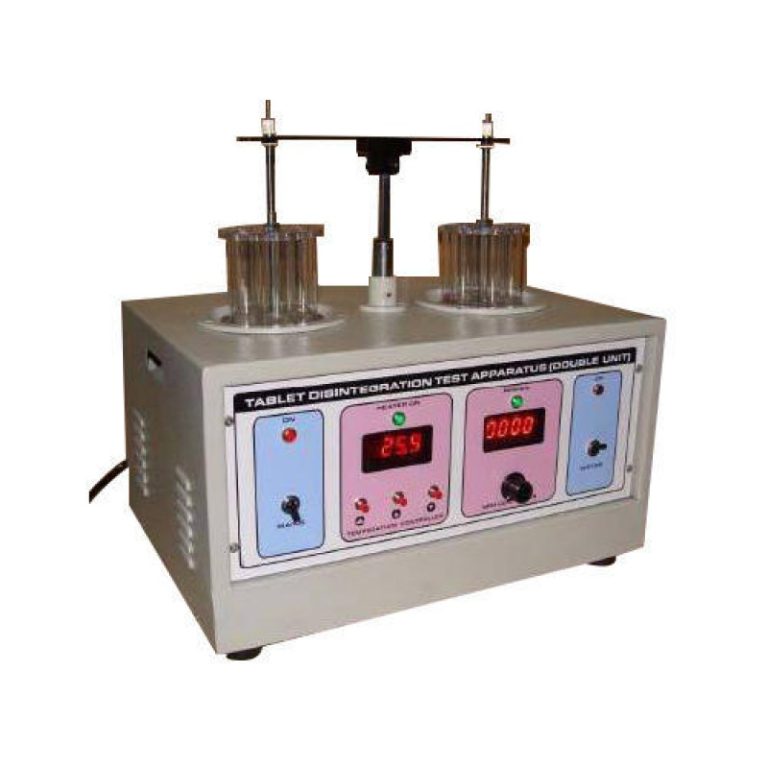
Two basket-rack assemblies operating in two separate beakers, sharing a common water bath and drive mechanism. Tests twelve dosage units simultaneously. More efficient for high-volume QC labs or when running the extended test (initial 6 plus repeat 12).
Triple Station (18-Tube)
Three basket-rack assemblies. Tests eighteen units simultaneously. Less common but useful for very high-volume operations.
Automated Models
Some modern disintegration apparatus models include:
- Automatic endpoint detection (optical sensors that detect when disintegration is complete)
- Digital timers with preset programs for different dosage forms
- Automatic basket lifting at the end of the test
- Data output to LIMS (Laboratory Information Management System)
- Printer connectivity for result documentation
If you’re going to buy Disintegration Apparatus for a GMP environment, automated features that support data integrity (21 CFR Part 11 compliance or Annex 11 compliance) are increasingly valuable.
Temperature Control — More Important Than Most People Realize
The immersion medium must be maintained at 37°C ± 2°C throughout the test. This sounds easy. It’s not always.
Why 37°C?
Because that’s human body temperature. The disintegration test is designed to simulate — at a basic level — what happens to a dosage form inside the human body. If the temperature is off, disintegration behavior changes.
- Too cold: Some dosage forms disintegrate more slowly, potentially causing false failures
- Too hot: Some dosage forms disintegrate faster, potentially masking real problems
Water Bath Design
Quality disintegration apparatus models use a thermostatically controlled water bath with:
- A heater element
- A temperature sensor (thermocouple or RTD)
- A circulation system to ensure uniform temperature
- A digital temperature display with 0.1°C resolution
When you buy Disintegration Apparatus, check the temperature uniformity specification. The temperature should be within ±2°C at all points in the bath where beakers are placed. Some cheap models have hot spots near the heater and cold spots at the periphery — this directly affects test results.
Calibration
Temperature calibration should be performed:
- During initial qualification (IQ/OQ)
- Periodically thereafter (typically every 6 months)
- Using a calibrated reference thermometer traceable to national standards
Setting Up and Running a Disintegration Test — Step by Step
For those who are new to this test or want to verify their procedure, here’s a practical walkthrough:
Preparation
- Fill the water bath and set the temperature to 37°C. Allow sufficient time for the temperature to stabilize — usually 30-60 minutes.
- Prepare the immersion medium. Fill the 1000 mL beakers with the specified medium. For most tests, this is purified water at 37°C. For enteric-coated products, you’ll need simulated gastric fluid (0.1N HCl) and simulated intestinal fluid (pH 6.8 phosphate buffer).
- Place the beakers in the water bath. Allow the medium in the beakers to equilibrate to 37°C.
- Inspect the basket-rack assembly. Check that the mesh screens are intact, clean, and properly seated. Any tears, holes, or deposits on the mesh can affect results.
Running the Test
- Place one dosage unit in each of the six tubes. If disks are required, place them on top of the dosage forms.
- Lower the basket-rack assembly into the beaker until the assembly is in its lowest position and confirm the mesh is at least 25 mm from the beaker bottom.
- Start the apparatus. The assembly should begin its reciprocating motion — 29-32 cycles per minute with a 55mm ± 2mm stroke.
- Start the timer. This seems obvious but I’ve seen people forget. Start timing from the moment the apparatus begins operating.
- Observe periodically. You don’t need to stare at it the entire time, but check at regular intervals — especially as you approach the end time.
Evaluating Results
- At the end of the specified time, stop the apparatus and lift the basket-rack assembly.
- Examine each tube. A dosage unit has disintegrated if no palpable residue remains on the screen, or if only fragments of insoluble coating or capsule shell remain. Soft masses with no palpable core also count as disintegrated.
- Record results. All six units must disintegrate for the test to pass on the first stage. If 1 or 2 fail, proceed to the second stage (12 additional units).
- Clean the apparatus thoroughly after each test. Residue from one test can affect the next.
Common Mistakes That Compromise Results
Having worked with dozens of pharmaceutical labs over the years, these are the errors I see repeatedly:
Mistake 1: Using Tap Water as Immersion Medium
Unless the monograph specifically says otherwise, use purified water — not tap water. Tap water contains dissolved minerals, chlorine, and other substances that can affect disintegration behavior. Some tablets are sensitive to the ionic strength of the medium.
Mistake 2: Not Equilibrating the Medium Temperature
Pouring room-temperature water into the beaker and starting the test immediately means the medium is at 25°C, not 37°C. It takes time for 1000 mL of water to warm from room temperature to 37°C. Pre-heat the medium or allow adequate equilibration time.
Mistake 3: Overloading Tubes
One dosage unit per tube. Not two. Not three. This seems obvious but I’ve seen it happen in labs trying to speed up testing.
Mistake 4: Worn or Damaged Mesh Screens
Mesh screens wear out. The wire becomes thinner, the apertures enlarge, and eventually fragments can fall through that shouldn’t. Inspect screens regularly and replace when they show signs of wear.
Mistake 5: Incorrect Stroke Length or Frequency
If the apparatus isn’t calibrated correctly, the stroke length or frequency might drift from specifications. This directly affects the mechanical agitation the dosage forms experience. Verify these parameters during qualification and periodic calibration.
Mistake 6: Subjective Endpoint Determination
“Is that a palpable core or just a soft residue?” This judgment call can vary between analysts. Establish clear criteria in your SOP, provide visual references if possible, and train analysts to apply consistent standards.
Qualification of Disintegration Apparatus in GMP Environments
If you buy Disintegration Apparatus for a pharmaceutical QC lab operating under GMP, the instrument must be qualified before use. Here’s what that involves:
Design Qualification (DQ)
Documenting that the selected instrument meets your User Requirement Specification (URS). This includes confirming that the apparatus complies with the relevant pharmacopoeial standard, fits your testing volume requirements, and meets any data integrity requirements.
Installation Qualification (IQ)
Verifying that the instrument:
- Was received as ordered (correct model, accessories, documentation)
- Is installed in an appropriate location (stable bench, adequate ventilation, appropriate electrical supply)
- Serial numbers and model information are recorded
- Manufacturer manuals and certificates are on file
Operational Qualification (OQ)
Testing that the instrument operates within specifications:
- Temperature accuracy: Using a calibrated reference thermometer, verify the water bath maintains 37°C ± 2°C at all beaker positions
- Temperature uniformity: Measure temperature at multiple points in the bath
- Stroke length: Verify 55 mm ± 2 mm using a calibrated ruler or digital caliper
- Frequency: Count cycles per minute using a stopwatch (should be 29-32 cpm)
- Timer accuracy: Compare instrument timer against a calibrated reference timer
- Basket-rack assembly dimensions: Verify tube dimensions, mesh specifications
Performance Qualification (PQ)
Running the instrument with actual test samples (or reference standard tablets with known disintegration behavior) to confirm that the apparatus produces expected results under normal operating conditions.
Ongoing Calibration
After initial qualification, periodic calibration should verify:
- Temperature accuracy (every 6 months typically)
- Stroke length and frequency (annually)
- Timer accuracy (annually)
All calibration activities must be documented and records retained per your facility’s retention policy.
Disintegration vs. Dissolution — Understanding the Relationship
People sometimes confuse these two tests or wonder why both are necessary. Here’s the distinction:
Disintegration Test
- Measures physical breakdown of the dosage form
- The tablet breaks into smaller pieces and fragments
- Endpoint: no palpable residue on the screen
- Does NOT measure drug release
- Simpler, faster, less expensive test
- Go/no-go result — pass or fail
Dissolution Test
- Measures the rate and extent of drug release from the dosage form into solution
- Uses a spectrophotometer or HPLC to quantify how much drug has dissolved at specific time points
- More complex, more expensive, more informative
- Provides a dissolution profile — not just pass/fail
- Required for almost all solid oral dosage forms
How They Relate
Disintegration is generally considered a prerequisite for dissolution. A tablet must first break apart before the drug can dissolve into the surrounding fluid. However, a tablet can disintegrate completely and still fail dissolution (if the drug substance itself has poor solubility, for example).
In modern pharmaceutical quality control, dissolution testing has largely taken precedence over disintegration testing for most products. However, disintegration testing remains valuable and required for:
- Products where the monograph specifies a disintegration test rather than dissolution
- In-process testing during manufacturing (faster and simpler than dissolution)
- Certain dosage forms like effervescent tablets and dispersible tablets
- Situations where disintegration is the rate-limiting step for drug release
When labs buy Disintegration Apparatus, they’re usually purchasing it alongside dissolution testing equipment — the two tests complement each other.
Troubleshooting Common Issues
Problem: Tablets Stick to the Mesh Screen
Possible causes: Excessive binding agents, high humidity during storage, mesh screen too rough or damaged
Action: Check the formulation, verify storage conditions, inspect and replace mesh screens
Problem: Results Vary Between Analysts
Possible causes: Subjective endpoint interpretation, inconsistent handling, different immersion medium preparation
Action: Standardize SOP with clear criteria, provide training with visual references, prepare media using verified procedures
Problem: Temperature Drifts During Test
Possible causes: Heater malfunction, room temperature fluctuations, water level too low in bath
Action: Service the heating element, maintain consistent room temperature, ensure adequate water level
Problem: Uneven Basket Motion
Possible causes: Worn bearings, motor issue, improper mounting
Action: Service the drive mechanism, verify mounting is secure and level
Problem: Capsule Shells Don’t Fully Dissolve
Possible causes: Some gelatin cross-linking (especially in aged capsules), medium pH or temperature issues
Action: Check USP <701> for guidance on the use of enzyme (pepsin or pancreatin) in the medium for cross-linked gelatin capsules
Where to Buy Disintegration Apparatus in Pakistan — TOPTEC PVT. LTD
If you’re in Pakistan and need to equip a pharmaceutical QC lab, you’ve probably noticed that importing laboratory equipment comes with a long list of headaches — customs delays, currency fluctuations, freight damage, warranty issues, and service gaps.
TOPTEC PVT. LTD is a Pakistani manufacturer of laboratory furniture and equipment. They produce their products locally, which translates to meaningful advantages for labs across the country.
Why Choose TOPTEC?
Local Manufacturing = Shorter Lead Times
When you buy Disintegration Apparatus from an international supplier, you’re looking at 8-16 weeks from order to delivery — sometimes longer. TOPTEC manufactures in Pakistan, which means significantly faster turnaround.
No Import Headaches
No customs clearance. No currency conversion risks. No freight charges. No worrying about whether the instrument arrived in one piece after traveling across the ocean.
After-Sales Support That Actually Works
If your apparatus needs service, calibration, or parts replacement, TOPTEC’s team is reachable. They’re in the same country, same time zone, and they understand the local regulatory context. Try getting that level of responsiveness from an overseas manufacturer.
Competitive Pricing
Without the layers of international procurement costs, TOPTEC offers pricing that makes sense for Pakistani pharmaceutical companies, universities, and research institutions — including those operating on tight budgets.
Quality Construction
TOPTEC builds equipment using stainless steel components, reliable motors, accurate temperature controllers, and durable construction. Their products are designed to meet pharmacopoeial specifications and withstand daily use in real QC environments.
Customization
Need a dual-station model? Specific voltage configuration? Custom basket dimensions for a non-standard product? TOPTEC can accommodate specific requirements that off-the-shelf imported models might not address.
TOPTEC’s Complete Laboratory Equipment Range
Beyond disintegration apparatus, TOPTEC manufactures a comprehensive range of laboratory furniture and equipment:
- Dissolution apparatus — USP Type I (basket) and Type II (paddle)
- Friability testing apparatus — for tablet mechanical strength testing
- Tablet hardness testers
- Laboratory workbenches — chemical-resistant countertops, various configurations
- Fume hoods — ducted and ductless models
- Biological safety cabinets — Class II Type A2 and B2
- Laminar flow hoods
- Pass boxes — static and dynamic
- Chemical storage cabinets
- Laboratory sinks and fixtures
- Anti-vibration tables
- Cleanroom furniture
- Shelving and storage systems
If you’re setting up a new QC lab or upgrading existing facilities, the ability to source multiple equipment items from a single local manufacturer streamlines procurement, ensures compatibility, and typically results in better overall pricing.
Maintenance Best Practices
A disintegration apparatus is a relatively simple machine, but like any precision instrument, it needs regular care to maintain accuracy and reliability.
Daily Care
- Empty and clean the water bath at the end of each working day (or at minimum, weekly)
- Clean the basket-rack assembly after each test — rinse thoroughly and dry
- Wipe down external surfaces to prevent corrosion
- Visually inspect mesh screens for damage
Weekly
- Check water bath level
- Verify temperature display against reference thermometer
- Inspect all moving parts for smooth operation
Monthly
- Deep clean the water bath — remove any scale, deposits, or microbial growth
- Inspect electrical cords and connections
- Verify stroke length and frequency
- Check timer accuracy
Semi-Annually
- Full calibration of temperature, stroke, frequency, and timer
- Replace water bath water completely
- Inspect and lubricate moving parts as per manufacturer recommendations
- Inspect mesh screens under magnification for wear
Annually
- Complete OQ re-verification
- Replace worn components (mesh screens, seals, gaskets)
- Electrical safety testing
Record Everything
In a GMP environment, all maintenance and calibration activities must be documented. Maintain a logbook or electronic record for each instrument.
Special Testing Situations
Enteric-Coated Products
These are designed to NOT disintegrate in the acidic environment of the stomach but TO disintegrate in the alkaline environment of the intestine. The test is run in two stages:
Stage 1 — Acid Stage:
Immerse in simulated gastric fluid (0.1N HCl) for 1 hour. At the end, examine. The tablets should show no evidence of disintegration, cracking, or softening (other than the coating becoming slightly discolored).
Stage 2 — Buffer Stage:
Transfer the same tablets to simulated intestinal fluid (pH 6.8 phosphate buffer) and run for 2 hours (or as specified). Now the tablets must disintegrate completely.
This dual-stage test requires careful medium preparation and is more time-consuming. When you buy Disintegration Apparatus for a lab that tests enteric-coated products, make sure the instrument can easily accommodate medium changes and temperature re-equilibration.
Dispersible Tablets
These are designed to disperse rapidly in water before administration. The test typically uses water at 15-25°C (NOT 37°C) with a disintegration time limit of 3 minutes. Different conditions entirely from standard tablets.
Effervescent Tablets
Tested in water at 15-25°C. One tablet per beaker (200 mL). No basket-rack assembly — the tablet is simply placed in the water and observed. It must dissolve or disperse within 5 minutes.
Suppositories
Some pharmacopoeias include disintegration testing for suppositories, but the apparatus and conditions are different. A different type of disintegration apparatus or specialized fixtures are used.
Data Integrity Considerations
If you’re operating in a GMP environment — and if you’re reading this article, you probably are — data integrity cannot be an afterthought.
What Auditors Look For
- Original records: Hand-written logbooks with date, time, product name, batch number, medium, temperature, start time, end time, and results for each tube
- No unexplained data: Every test must have corresponding results. Deleted or missing entries are red flags
- Consistent practices: SOPs must match what actually happens in the lab
- Calibration currency: Evidence that the instrument was calibrated and within specification at the time of the test
Electronic Records
If your apparatus has electronic data capture, ensure compliance with applicable regulations (21 CFR Part 11 for US-regulated products, EU Annex 11 for EU-regulated products). This means audit trails, electronic signatures, user access controls, and backup procedures.
Practical Advice
When you buy Disintegration Apparatus with data output capabilities, think carefully about how that data flows into your quality system. Can the instrument connect to your LIMS? Can results be printed directly? Is there an audit trail for any changes?
Even for simple instruments, a well-designed paper-based documentation system works perfectly well for GMP compliance — as long as it’s followed consistently and entries are made contemporaneously (at the time of the test, not hours later from memory).
Choosing Between Manual and Automated Models
Manual Models
Pros:
- Lower purchase price
- Simpler to operate and maintain
- Fewer things that can go wrong
- Adequate for low to moderate testing volumes
- Easier to validate
Cons:
- Requires manual timing and observation
- Endpoint determination is subjective
- No automated data recording
- More labor-intensive for high-volume testing
Automated Models
Pros:
- Automated endpoint detection (some models)
- Digital timers with programmable protocols
- Data output for LIMS integration
- Reduced analyst subjectivity
- More efficient for high-volume operations
- Better data integrity support
Cons:
- Higher purchase price
- More complex maintenance and qualification
- Software validation requirements
- May require IT support for integration
For many labs in Pakistan, particularly those with moderate testing volumes, a good-quality manual model is perfectly adequate and more cost-effective. As testing volumes increase or data integrity requirements become more stringent, automated features become increasingly valuable.
When you buy Disintegration Apparatus from TOPTEC, their team can help you evaluate which configuration makes the most sense for your specific situation — balancing functionality, compliance needs, and budget realities.
Final Thoughts
The disintegration test might not be the most sophisticated or glamorous test in a pharmaceutical QC lab. It doesn’t generate the detailed profiles that dissolution testing provides. It doesn’t require the analytical sophistication of HPLC assay methods.
But it answers a question that’s absolutely fundamental: does this tablet break apart in the body?
If the answer is no, nothing else matters. Not the assay. Not the content uniformity. Not the dissolution profile. Because a tablet that doesn’t disintegrate doesn’t deliver its drug.
That makes the disintegration apparatus one of the most important pieces of equipment in any pharmaceutical QC lab. And choosing the right one — properly specified, correctly qualified, adequately maintained — directly affects the quality of the medicines that reach patients.
If you’re in Pakistan and ready to buy Disintegration Apparatus that meets pharmacopoeial standards, is built to last, and comes with the local support you need to keep it running properly, TOPTEC PVT. LTD deserves your attention. They’re manufacturing quality laboratory equipment right here in Pakistan — and for the pharmaceutical industry, that combination of quality, accessibility, and local support is exactly what’s needed.
Get the basics right. Your patients are counting on you.
