

What are the key differences between Disintegration Tester vs. Dissolution Apparatus? Spend any time in a pharmaceutical quality control lab and you’ll hear these two terms thrown around — sometimes interchangeably, which is a mistake that makes experienced pharmacists visibly uncomfortable. Disintegration testing and dissolution testing are related concepts, they’re both pharmacopoeial requirements, and they both involve putting dosage forms into liquid media.
But they measure fundamentally different things, they use completely different equipment, and confusing one for the other during method development or QC testing can create serious compliance problems.
If you’re setting up a pharmaceutical QC laboratory in Pakistan and you’re trying to figure out which instrument you need — or whether you need both — this article is going to clear that up properly. We’ll also talk about where to buy disintegration apparatus equipment locally, because TOPTEC PVT. LTD has been quietly building a strong reputation as a reliable manufacturer of pharmaceutical testing equipment right here in Pakistan.
The Fundamental Question Both Tests Are Trying to Answer
Before separating the two instruments, it helps to understand the broader pharmaceutical question driving both tests.
When a patient swallows a tablet, a sequence of events needs to happen for the drug to actually work. The tablet needs to physically break apart in the digestive fluid. Then the drug substance needs to dissolve into solution. Then the dissolved drug needs to be absorbed through the gut wall into the bloodstream. Only at that point does it reach its site of action.
Disintegration testing focuses on step one — does the tablet break apart within an acceptable time frame?
Dissolution testing looks further down the chain — does the drug actually dissolve from the dosage form, and at what rate?
Both are critical quality parameters. Both are required by pharmacopoeias for different dosage form categories. And both require dedicated, purpose-built laboratory instruments that cannot substitute for each other.
What Is a Disintegration Tester? A Plain-Language Explanation
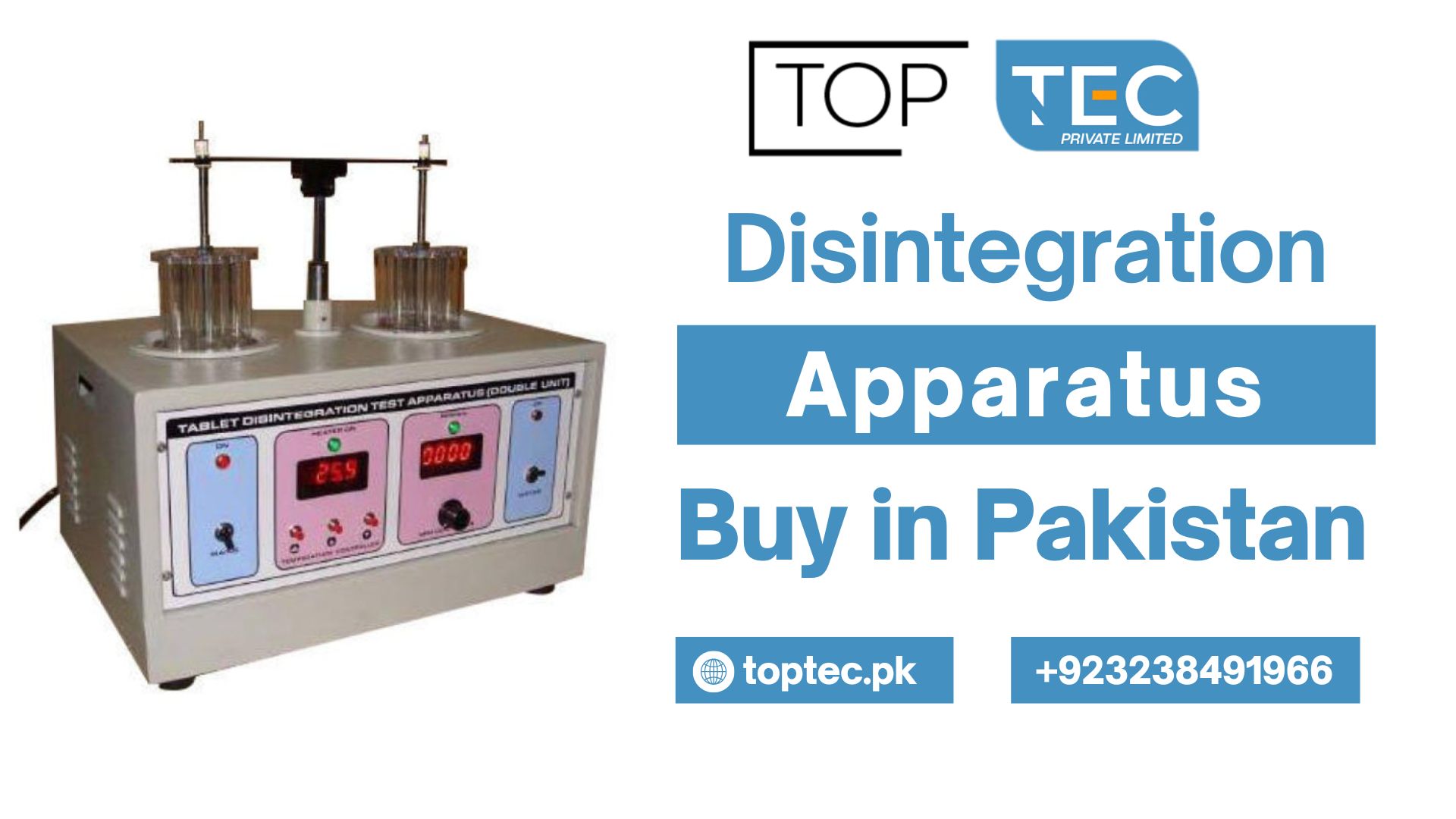
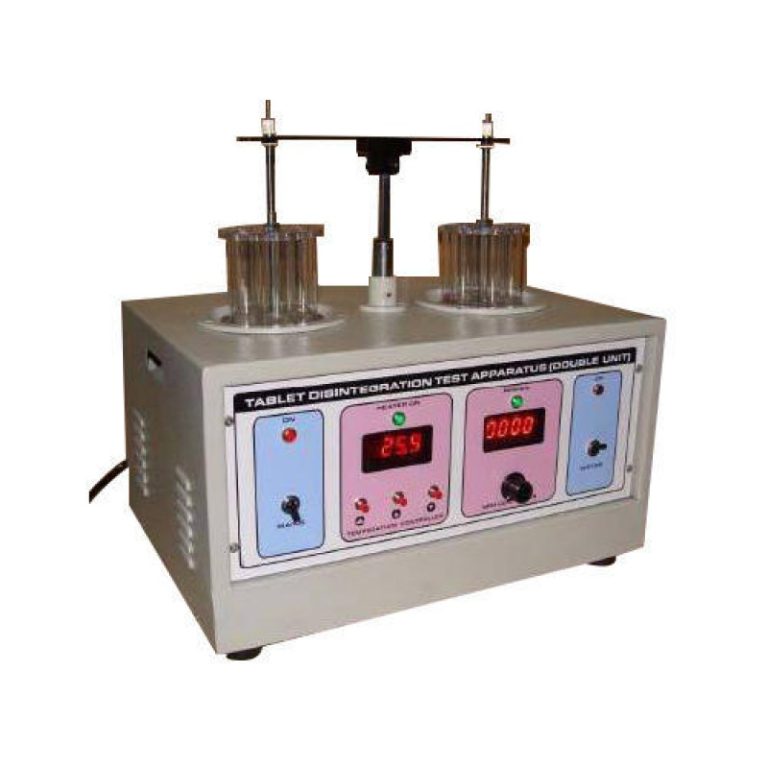
A disintegration tester is a relatively straightforward instrument. It holds tablets or capsules in individual tubes submerged in a temperature-controlled liquid bath, then moves those tubes up and down repeatedly. The test observer (or automated sensor in modern units) watches for the moment when the dosage form completely falls apart — no residue remaining on the wire mesh at the bottom of the tube.
The time from starting the test to that endpoint is the disintegration time. Compare it against the pharmacopoeial specification for your dosage form, and you have your pass or fail result.
The United States Pharmacopeia Chapter <701>, British Pharmacopeia, and Indian Pharmacopeia all specify disintegration testing requirements with defined parameters:
- Temperature of test medium: 37°C ± 2°C (simulating body temperature)
- Stroke length: 55mm ± 2mm
- Stroke frequency: 29 to 32 cycles per minute
- Basket-rack assembly: six tubes per basket, with specific internal diameter specifications
- Disks: plastic cylinders placed on top of tablets in each tube for certain test types
What disintegration testing tells you: whether your tablet physically breaks apart within the required time frame.
What it does NOT tell you: whether the drug actually dissolves from the broken fragments, or at what rate.
This distinction matters enormously, which we’ll come back to shortly.
What Is a Dissolution Apparatus? The Fuller Picture
Dissolution testing is more sophisticated than disintegration testing, and the apparatus reflects that. A dissolution tester uses precisely controlled hydrodynamics — meaning the movement of liquid in a very specific, reproducible way — to measure how much drug substance dissolves from a dosage form over time.
The USP defines several dissolution apparatus types, each creating different fluid dynamics:
Apparatus 1 (Rotating Basket): The dosage form sits in a mesh basket that rotates at a specified RPM. Used for tablets, capsules, and certain modified-release forms.
Apparatus 2 (Paddle): A paddle rotates in the dissolution vessel while the dosage form sinks to the bottom. The most widely used apparatus for immediate-release tablets. The rotating paddle creates gentle, controlled agitation.
Apparatus 3 (Reciprocating Cylinder): Cylinders containing the dosage form move up and down through a series of vessels. Good for extended-release forms.
Apparatus 4 (Flow-Through Cell): Liquid flows continuously through a cell containing the dosage form. Used for poorly soluble drugs, suspensions, and implants.
Apparatus 5, 6, 7: Specialized configurations for patches, suppositories, and other dosage forms.
During a dissolution test, samples of the dissolution medium are collected at specified time points and analyzed — usually by UV spectrophotometry or HPLC — to determine how much drug has dissolved. The result is expressed as percentage of labeled content dissolved at each time point.
What dissolution testing tells you: how much drug dissolves from your dosage form and how quickly — a direct indicator of potential bioavailability.
What it does NOT tell you: simply whether the tablet physically broke apart.
Side-By-Side Comparison: The Core Differences
Let’s put the key differences in front of you directly, because this is where clarity matters most.
What They Measure
Disintegration tester: Measures physical breakup of the dosage form. Pass/fail based on whether intact pieces remain after the specified time.
Dissolution apparatus: Measures drug release from the dosage form into solution. Results expressed as percentage dissolved at multiple time points.
Test Medium Volumes
Disintegration tester: Small volume — approximately 800 to 1000 mL per basket assembly. The exact volume isn’t critical because the test endpoint is physical, not analytical.
Dissolution apparatus: Precisely defined volumes — typically 500 mL, 900 mL, or 1000 mL depending on the method. Volume must be exactly correct because the analytical result is concentration-dependent.
Temperature Requirements
Disintegration tester: 37°C ± 2°C — relatively straightforward temperature control.
Dissolution apparatus: 37.0°C ± 0.5°C — tighter temperature tolerance because temperature affects dissolution rates and analytical results.
Test Duration
Disintegration tester: Minutes — most immediate-release tablets must disintegrate within 15 minutes. Enteric-coated tablets within 60 minutes. Results come quickly.
Dissolution apparatus: Much longer — dissolution profiles for immediate-release products are commonly run for 30 to 60 minutes. Extended-release products may run for 8, 12, or even 24 hours.
Analytical Component
Disintegration tester: No analytical chemistry involved. The test observer (or automated sensor) simply notes when physical disintegration is complete.
Dissolution apparatus: Requires analytical chemistry. Samples must be collected, filtered, and analyzed by UV spectrophotometry, HPLC, or other appropriate analytical methods.
Regulatory Application
Disintegration tester: Required for immediate-release tablets, capsules, suppositories, chewable tablets. Generally a simpler QC release test.
Dissolution apparatus: Required for all solid oral dosage forms where bioavailability is a concern. Also used in product development for bioequivalence work.
Cost Implications
Disintegration tester: Simpler instrument, lower upfront cost, minimal consumables, no analytical equipment needed.
Dissolution apparatus: More complex instrument, higher upfront cost, significant consumable costs (dissolution vessels, seals, filters), requires analytical equipment.
If you’re setting up a basic QC laboratory and need to buy disintegration apparatus equipment first, it makes sense financially and from a testing priority standpoint. Dissolution testing can be added as your laboratory grows.
Can One Replace the Other? The Direct Answer
No. Absolutely not.
A product can pass disintegration testing and fail dissolution testing. In fact, this happens more commonly than you’d expect. A tablet might physically break into fragments within the required time frame, but if those fragments don’t release drug into solution effectively — due to poor wettability, precipitation effects, or formulation issues — the dissolution test will reveal what disintegration testing missed entirely.
The reverse is also possible — though less common. A product designed for controlled release might have dissolution testing as its primary quality measure, with disintegration testing either not applicable or used only as a basic integrity check.
For most immediate-release oral solid dosage forms, regulatory requirements typically mandate both tests. Disintegration testing serves as a routine release test — quick, simple, and sensitive to major physical formulation problems. Dissolution testing provides the more thorough assessment of drug release behavior and is often required for regulatory submission and periodic product verification.
Understanding this relationship helps clarify why it’s important to buy disintegration apparatus and dissolution apparatus as complementary instruments rather than alternatives.
Specific Dosage Forms and Which Test Applies
Let’s look at this from the dosage form perspective, because that’s often how QC labs think about it.
Uncoated Tablets
Both disintegration and dissolution testing typically apply. Disintegration must occur within 15 minutes (USP <701>). Dissolution requirements depend on the specific monograph or registered specifications.
Film-Coated Tablets
Disintegration testing applies — the film coat should not prevent disintegration within the specified time. Dissolution testing also applies because the coating can affect drug release rates.
Enteric-Coated Tablets
A more complex case. Disintegration testing includes a two-stage process — the tablet must NOT disintegrate in acid medium (simulating stomach) for 60 minutes, then must disintegrate in buffer medium (simulating intestinal pH) within a further 60 minutes. Dissolution testing also uses a two-stage approach.
Hard Capsules
Disintegration testing applies — the capsule shell must rupture and release its contents within the specified time. Dissolution testing also applies for the drug substance content.
Soft Gelatin Capsules
Disintegration testing is used. Dissolution testing applies particularly for liquid-filled soft gelatin capsules where drug solubilization may be complex.
Extended-Release Tablets and Capsules
Dissolution testing is the primary pharmacopoeial test — it characterizes the release profile over extended time periods. Disintegration testing is generally not applicable for typical extended-release products because the dosage form is designed to resist rapid physical breakup.
Chewable Tablets
Disintegration testing applies with modified conditions. Dissolution testing may also be required depending on the drug substance and registered specifications.
The Decision: Do You Need Both Instruments?
Here’s the practical question that laboratory managers in Pakistan face when they’re setting up or expanding QC capabilities.
If you manufacture or test only immediate-release tablets and capsules for local distribution: Starting with disintegration testing is reasonable. The pharmacopoeial requirement is clear, the test is simpler to perform, and the instrument is more affordable. When you buy disintegration apparatus as your first pharmacopoeial testing instrument, you’re covering an immediate compliance need efficiently.
If you’re involved in pharmaceutical development, bioequivalence studies, or regulatory submissions for new products: Dissolution testing is non-negotiable. You’ll need dissolution apparatus alongside disintegration testing capability.
If you’re a contract testing laboratory offering services to pharmaceutical companies: You almost certainly need both. Clients will require both test capabilities.
If you’re preparing for WHO prequalification or international market registration: Full dissolution testing capability is required. International regulatory bodies expect dissolution profile data as part of dossier submissions.
If you’re a teaching institution with a pharmacy program: Both instruments belong in a properly equipped pharmaceutical science teaching laboratory. Students need practical exposure to both tests.
The most honest answer is that most QC laboratories serving the pharmaceutical sector need both instruments eventually. The sequencing of acquisition depends on immediate regulatory obligations, budget availability, and the types of products being tested.
What to Look for When You Buy Disintegration Apparatus Equipment
Since we’re focused partly on helping you make good procurement decisions, let’s talk specifically about what matters when you buy disintegration apparatus for your laboratory.
Pharmacopoeial Compliance — Verify the Specifics
Any disintegration tester you purchase should comply with USP <701>, BP, and IP requirements. But don’t just accept compliance claims — verify the specific parameters:
- Stroke length: 55mm ± 2mm
- Stroke frequency: 29 to 32 cycles per minute
- Temperature control range: 37°C ± 2°C at minimum
- Basket-rack tube dimensions meeting pharmacopoeial specifications
Ask the manufacturer for test data demonstrating these parameters at the time of delivery. Instruments that cannot provide this documentation should not be trusted for pharmacopoeial testing.
Single Drive vs. Dual Drive
This is a practical capacity question. A single-drive disintegration tester has one basket assembly — it tests six tablets simultaneously (one per tube). A dual-drive tester has two independent basket assemblies — twelve tablets or two different formulations simultaneously.
For any laboratory with moderate testing volume, a dual-drive unit is almost always the more economical choice over time — more testing throughput without doubling floor space or acquisition costs.
When you buy disintegration apparatus for a production QC laboratory rather than a teaching lab, consider whether a dual-drive configuration makes sense for your throughput requirements.
Temperature Stability and Control Method
Better instruments use PID (Proportional-Integral-Derivative) temperature control rather than simple on/off thermostat systems. PID control maintains tighter temperature consistency by anticipating thermal drift and correcting proactively. For pharmacopoeial compliance, consistent temperature matters.
Construction Materials
The water bath vessel and all wetted surfaces should be constructed from materials that won’t interact with common disintegration media — typically water or simulated gastric and intestinal fluids. Stainless steel construction for wetted parts is the appropriate standard.
Timer Accuracy and Display
The test timer needs to be accurate — you’re measuring minutes and seconds to demonstrate pharmacopoeial compliance. Digital displays with clearly readable elapsed time are important for operator ease and accurate record-keeping.
Alarm and Monitoring Features
Modern disintegration testers include temperature alarms that alert operators if the water bath temperature drifts outside acceptable limits during a test run. This is important for test validity — a test run where temperature dropped below specification needs to be repeated.
Ease of Cleaning and Maintenance
Labs run multiple tests daily. The basket assemblies, tubes, and disks need to be removed, cleaned, and reassembled regularly. Equipment that makes this process awkward or time-consuming creates practical problems that accumulate over months and years of daily operation.
Validation Documentation
For pharmaceutical QC labs, every critical instrument needs to go through installation qualification, operational qualification, and performance qualification. The manufacturer needs to provide specifications and calibration data that support this process. When you buy disintegration apparatus from a reputable manufacturer, this documentation should be part of what you receive.
What to Look for When Buying Dissolution Apparatus
Since we’re covering both instruments, here’s what matters in dissolution apparatus selection.
Apparatus Type Capability
Confirm the instrument supports the apparatus type specified in your methods. Most modern dissolution testers support Apparatus 1 (basket) and Apparatus 2 (paddle) as standard. If your methods require Apparatus 3, 4, or others, confirm capability specifically.
Number of Vessels
Standard dissolution testers accommodate 6 vessels (one per dosage unit, as specified by pharmacopoeias). Some instruments offer configurations for more vessels for higher throughput.
Paddle/Basket Speed Accuracy
Rotation speed must be maintained consistently within ± 4% of the specified RPM. Verify that the instrument maintains this tolerance across its speed range under load conditions.
Temperature Control
37.0°C ± 0.5°C is the standard requirement — tighter than disintegration testing. The water bath and vessel temperature control must meet this specification, and this should be verified with independent temperature measurement at the vessel level, not just the bath.
Vessel Wobble Specification
USP specifies that the paddle shaft must not wobble more than 1mm at any point. Excessive wobble disrupts the hydrodynamic conditions inside the vessel and can affect dissolution results. This is something to verify during installation qualification.
Sample Collection System
Manual sampling requires a syringe and filter for each time point per vessel. Automated sampling systems (autosamplers) significantly reduce operator burden and improve reproducibility for long dissolution profiles with multiple time points. For labs running high volumes of dissolution testing, an autosampler is worth the additional investment.
TOPTEC PVT. LTD — Making It Easier to Buy in Pakistan
Here’s where I want to be practical and direct about something that affects every pharmaceutical laboratory and research institution in Pakistan.
Historically, acquiring pharmacopoeial testing instruments in Pakistan meant either paying premium prices for imported equipment with extended delivery times, or compromising on quality with instruments that didn’t genuinely meet pharmacopoeial specifications. Neither option is good.
TOPTEC PVT. LTD has been addressing this by manufacturing pharmaceutical testing equipment locally in Pakistan. Their product range includes disintegration testers and related laboratory instruments, manufactured to meet USP, IP, and BP specifications.
When you buy disintegration apparatus from TOPTEC, here’s what changes compared to the import route:
Pricing: No import duties. No international freight charges. No distributor margins stacked on overseas manufacturer prices. Local manufacturing reflects local cost structures, and the savings are real and significant.
Delivery: Weeks rather than months. When your laboratory has a testing backlog or a regulatory deadline, waiting 3 to 4 months for an imported instrument isn’t an option. Local manufacturing means delivery timelines you can actually plan around.
Customization: Standard imported instruments come in fixed configurations. TOPTEC can work with you on specifications that match your specific testing requirements and laboratory layout.
Technical support: When something needs attention — calibration, a technical question, a spare part — you’re working with people who are in the same time zone, speak the same languages, and understand the regulatory context of pharmaceutical manufacturing in Pakistan. That’s practically valuable in ways that are easy to underestimate until you actually need support.
Documentation: TOPTEC provides the technical documentation — specifications, calibration data, material certifications — that your QC department needs for validation activities and regulatory audit files.
Beyond disintegration testers, TOPTEC manufactures a comprehensive range of laboratory furniture including workbenches, fume hoods, biological safety cabinets, laminar flow hoods, storage cabinets, and clean room furniture. For laboratories equipping complete facilities, single-source procurement from a local manufacturer simplifies everything from ordering to documentation to ongoing support.
Common Misconceptions Worth Clearing Up
Since this article is about explaining the differences between these two instruments, let me address some misconceptions that come up regularly.
“If my product passes disintegration, dissolution will be fine too.”
Not necessarily. As explained earlier, physical disintegration and drug dissolution are related but separate phenomena. Formulation factors — particle size of the drug substance, type of diluents and binders, coating composition — can create situations where tablets disintegrate promptly but drug release is incomplete or delayed. Dissolution testing catches these problems. Disintegration testing does not.
“We only need dissolution apparatus because it’s the more sophisticated test.”
Disintegration testing remains a specific pharmacopoeial requirement for many dosage forms. It’s a routine batch release test that’s faster and simpler than dissolution testing. Skipping it because dissolution testing exists is a compliance gap, not an efficiency improvement.
“All disintegration testers are basically the same.”
They’re not. Temperature stability, stroke length accuracy, stroke frequency consistency, and build quality vary meaningfully between manufacturers. Instruments that can’t maintain pharmacopoeial parameters consistently produce unreliable results. When you buy disintegration apparatus, these specifications matter — they’re not marketing details.
“We can use our disintegration tester results to predict dissolution behavior.”
Only in very limited, qualitative ways. Disintegration time has some correlation with dissolution behavior for simple, immediate-release formulations, but it’s not a substitute for actual dissolution testing. Regulatory agencies don’t accept disintegration data as a surrogate for dissolution data where dissolution testing is required.
Setting Up Testing Procedures — Brief Practical Notes
For laboratories that have purchased or are planning to purchase these instruments, here are some operational considerations.
Disintegration Testing Procedure Basics
- Prepare the test medium (typically water or simulated gastric/intestinal fluid) and bring the bath to 37°C ± 2°C
- Place one tablet or capsule in each tube of the basket assembly
- Place disks on tablets if required by the method
- Lower the basket assembly into the test medium
- Start the timer and drive mechanism simultaneously
- Observe for disintegration endpoint — no residue remaining on the wire mesh that isn’t a soft mass with no palpable firm core
- Record time to disintegration for each tablet
- Compare against pharmacopoeial specification
If any tablet fails to disintegrate within the specified time, the test may be repeated with additional tablets as specified in the pharmacopoeia, with specific pass criteria for the combined results.
Dissolution Testing Procedure Basics
- Prepare dissolution medium — degas thoroughly to remove dissolved air that can affect results
- Fill each vessel with the specified volume of medium and equilibrate to 37.0°C ± 0.5°C
- Introduce dosage form into each vessel (drop for Apparatus 2, place in basket for Apparatus 1)
- Start drive at specified RPM
- Collect samples at each specified time point using appropriate filter and syringe
- Analyze samples by UV spectrophotometry or HPLC
- Calculate percentage dissolved at each time point
- Compare against specifications — single-point acceptance criteria or dissolution profile specifications
Regulatory Implications — Getting This Right for Compliance
For pharmaceutical manufacturers in Pakistan, regulatory compliance is increasingly rigorous. DRAP (Drug Regulatory Authority of Pakistan) requirements are evolving toward alignment with international standards. When auditors inspect QC laboratories, they look at:
- Whether the correct pharmacopoeial tests are being performed for each dosage form
- Whether the instruments meet the required specifications
- Whether instruments are calibrated and records maintained
- Whether test methods are validated
- Whether out-of-specification results are handled correctly
Having the right instruments, properly qualified, with current calibration records, is fundamental to passing these inspections. When you buy disintegration apparatus and dissolution equipment from a manufacturer that provides proper documentation, you’re building compliance infrastructure rather than just buying hardware.
Making the Purchase Decision — Practical Steps
If you’ve read through this article and you’re now ready to move forward with equipment acquisition, here’s a straightforward approach:
Step 1: Audit your current product portfolio and testing requirements. List every dosage form you manufacture or test, and identify which pharmacopoeial tests are required for each.
Step 2: Identify your testing volume. How many tests per day, per week? This drives the decision between single and dual-drive configurations, and between manual and automated systems.
Step 3: Determine your regulatory framework. Are you testing only for local DRAP compliance? Are you working toward WHO prequalification or international market registration? This affects the sophistication of equipment and documentation you need.
Step 4: Contact TOPTEC PVT. LTD. When you’re ready to buy disintegration apparatus or dissolution equipment, their team can consult on appropriate specifications for your requirements. Get detailed technical specifications and pricing before committing.
Step 5: Plan your validation activities. Before any instrument goes into service for regulated testing, IQ/OQ/PQ must be completed. Plan this timeline into your acquisition schedule.
Step 6: Train your team. Pharmacopoeial testing requires trained analysts. Instrument acquisition should be paired with appropriate training programs.
Final Thoughts
The confusion between disintegration testing and dissolution testing is understandable — they’re related concepts addressing connected aspects of dosage form quality. But the instruments are different, the information they provide is different, and using one in place of the other creates compliance gaps that regulatory agencies will find.
Disintegration testing tells you whether your tablet breaks apart. Dissolution testing tells you whether your drug dissolves. Both questions matter. Both deserve proper answers from properly specified, correctly operated instruments.
For pharmaceutical laboratories in Pakistan looking to build genuine pharmacopoeial testing capability, TOPTEC PVT. LTD offers a practical path to that capability at pricing and delivery timelines that imported equipment simply cannot match. When you buy disintegration apparatus from a manufacturer who understands the regulatory requirements and builds to meet them, you’re making a decision that serves your laboratory’s compliance position and your team’s daily work environment well.
Start with clarity about what each test is actually measuring. Choose instruments that genuinely meet pharmacopoeial specifications. Document everything. And work with suppliers who understand the regulatory stakes involved.
That’s the path to a pharmaceutical QC laboratory that holds up under scrutiny — and more importantly, that actually protects the quality of medicines reaching patients.
