

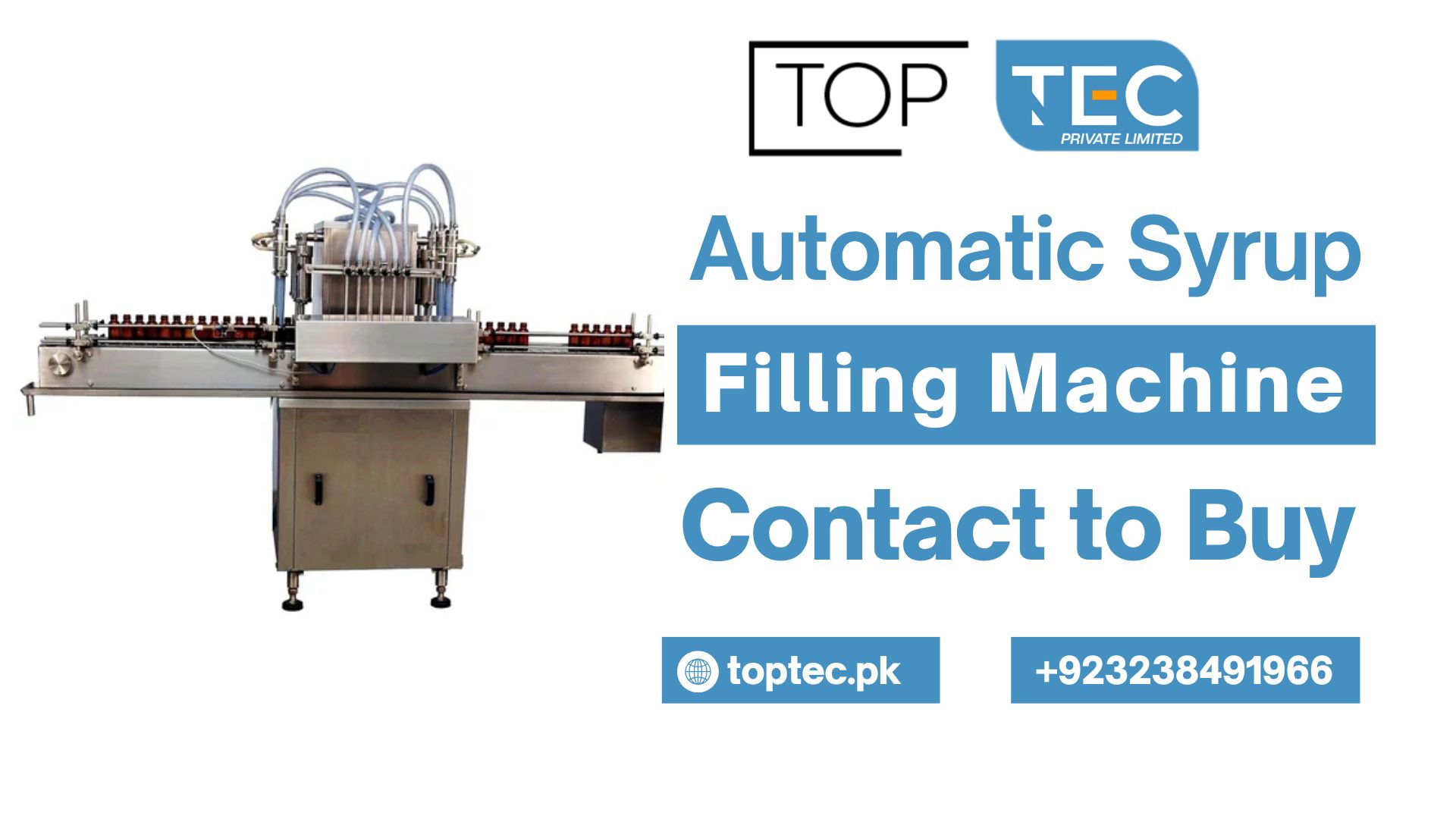
Buy Automatic Syrup Filling MachineI remember walking through a small pharmaceutical facility about six years ago. They were filling syrup bottles by hand. Literally — a worker would hold a bottle under a manually operated valve, estimate the fill volume by eye, cap it by hand, and move to the next one.
Their rejection rate was somewhere around 8%. Fill volumes were inconsistent. Label adhesion was poor because bottles had liquid on the outside from spillage. The line supervisor told me they could do maybe 800 bottles on a good day with three people working flat out.
Three months later, they installed an automatic syrup filling line. Same team, same facility, same product. They were doing 4,500 bottles a day. Rejection rate dropped to under 0.5%. Fill accuracy was within ±1%. The three people who used to hand-fill bottles were now doing QC checks, labeling verification, and batch documentation.
That’s what automation does. And honestly, that’s exactly why the decision to buy syrup filling machine equipment is one of the most impactful capital investments any pharmaceutical or food processing company will ever make.
This article walks through the complete picture — how these machines work from rinsing all the way through capping, what actually matters when you’re comparing options, mistakes to avoid, and where to find quality filling line equipment right here in Pakistan.
Stop Thinking About Just the Filling Machine
Here’s the honest truth. One of the most common mistakes companies make when they decide to buy syrup filling machine equipment is narrowing their focus to the filling function alone. They find something that fills bottles accurately, buy it, get it installed, and then realize that everything else around it is still creating bottlenecks.
A syrup filling line isn’t a single machine. It’s a chain of processes, and every link in that chain affects your output. The slowest stage controls your entire throughput — full stop.
The complete production sequence for liquid syrup looks something like this:
Bottle Feeding → Rinsing → Filling → Capping → Sealing → Labeling → Batch Coding → Inspection → Packaging
Let’s go through each stage the way it actually matters on a real production floor.
Bottle Feeding and Orientation — Where It All Starts
Before any bottle gets rinsed, filled, or capped, it needs to arrive at the line in the right position and at a consistent pace. Sounds simple. It’s not always.
Bottle Unscramblers
Bottles come from storage in bulk — a pile of containers tumbled together in random orientations. An unscrambler takes that chaos and outputs a steady single-file stream of upright bottles onto your conveyor. It does this through rotating discs, guide channels, and sometimes air jets that flip and sort bottles until they’re moving correctly.
The output speed needs to match — or slightly exceed — your filling speed. If bottles can’t reach the filler fast enough, your expensive filling machine sits idle waiting. That’s wasted capacity you’ve already paid for.
The Conveyor System
People underestimate conveyors. A poorly designed conveyor causes jams, tipping, and stoppages that eat into your efficiency numbers fast. For pharmaceutical syrup lines, conveyors should be stainless steel construction, variable speed, with adjustable side guides for different bottle widths. Smooth surfaces that you can actually clean properly — not the kind with dozens of crevices where product residue hides.
When you buy syrup filling machine systems, evaluate the conveyor as seriously as any other component. It connects everything.
Bottle Rinsing — Don’t Skip This Stage
A lot of companies treat rinsing as an optional extra. They assume new bottles are clean enough. They’re not — not for pharmaceutical standards.
Bottles travel from manufacturers to warehouses to your facility. They pick up dust, particulate matter, mold spores, and various forms of contamination along the way. For a product that patients are going to swallow, “probably clean enough” isn’t good enough.
How Automatic Rinsers Work
An automatic bottle rinser grabs each bottle, inverts it completely or partially, injects a cleaning medium into the interior, drains it, and returns the bottle upright to the conveyor. This happens continuously, synchronized with the rest of the line.
What’s Used for Rinsing
Sterile filtered air is the most common choice. Compressed air filtered through HEPA or 0.2-micron filtration gets blasted into the inverted bottle, removing loose particles and debris. The bottle comes back upright and moves forward dry — no moisture to dilute your product.
Purified water gives more thorough cleaning but requires the bottle to drain completely before filling. Any residual water in a syrup bottle changes concentration, creates conditions for microbial growth, and causes a whole cascade of quality problems. If you rinse with water, you need sufficient drain time built into the process.
Combination approach — water rinse followed by air purge — is what some facilities prefer for the cleanest result.
The rinser needs to handle bottles at the speed of your entire line. If it can’t keep up, it becomes the bottleneck regardless of how fast your filler runs.
The Filling System — Where the Real Decision Gets Made
This is the stage that gets the most attention, and honestly it deserves it. Fill accuracy, throughput speed, and the ability to handle different viscosities and bottle sizes — these are the characteristics that define whether your investment performs or frustrates.
When people buy syrup filling machine equipment, most of their technical evaluation happens here.
Volumetric Piston Filling
This is the workhorse technology for pharmaceutical syrups, and for good reason.
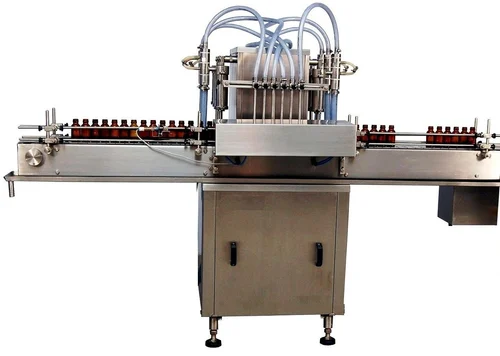
A piston moves back and forth inside a precision cylinder. The backward stroke pulls product from the supply tank. The forward stroke pushes exactly that volume through the nozzle into the bottle. Change the stroke length, and you change the fill volume. Simple, reliable, and accurate.
Typical accuracy is ±0.5% or better — that’s the kind of consistency that keeps your QC team happy and your regulatory audits clean.
It handles a wide viscosity range, cleans up well with CIP procedures, and the fill volume is easy to adjust for different products. The downside is that piston seals wear out and need periodic replacement, and product changeovers require thorough cleaning.
For pharmaceutical syrups — especially anything with significant viscosity or where fill accuracy is tightly regulated — volumetric piston filling is usually the right call.
Gravity and Time-Pressure Filling
Here, product flows from an elevated supply tank through a timed valve. Open the valve for a set period, get a set volume. Simple, gentle on fragile products, fewer moving parts.
The problem is accuracy. Fill volume depends on consistent product temperature, viscosity, and head pressure. Any of those variables change — and in real production conditions they do — your fill accuracy drifts. For thin, consistent liquids in non-pharmaceutical applications this works fine. For pharmaceutical syrups, it’s rarely the best choice.
Peristaltic Pump Filling
Rotating rollers squeeze product through flexible tubing. The product only ever contacts the inside of the tubing — not any metal pump components. This makes it attractive for sterile applications or products sensitive to metal contact.
The weakness is that tubing wears out, and as it wears, accuracy degrades. You need to track tube usage carefully and replace on schedule. Works well in the right application, but it’s not a universal solution.
Net Weight Filling
Instead of measuring volume, you fill by weight. Load cells under each filling position detect when the target weight has been reached and stop the fill. The accuracy is exceptional — ±0.1% or better — and it automatically compensates for density variations in your product.
The trade-off is speed and cost. Net weight filling is slower than volumetric filling and the equipment costs more. For high-value products where that accuracy justifies the investment, it makes sense. For standard syrup production at high volume, volumetric piston filling is usually the more practical answer.
How Many Filling Heads Do You Actually Need?
The number of simultaneous filling heads is what determines your throughput:
- 2-head fillers — roughly 1,000 to 3,000 bottles per hour
- 4-head fillers — roughly 3,000 to 8,000 bottles per hour
- 6-head fillers — roughly 6,000 to 15,000 bottles per hour
- 8-head fillers — roughly 10,000 to 25,000 bottles per hour
Do the math on your actual production needs before you talk to any supplier. A machine running at 40% capacity costs you more to operate than a smaller machine running efficiently. More heads isn’t automatically better — right-sized is better.
Nozzle Design Matters More Than People Think
Diving nozzles enter the bottle and rise as it fills, keeping the tip below the liquid surface the entire time. This prevents splashing, reduces foaming, and keeps the outside of the bottle clean. For foamy syrups, this isn’t optional — it’s necessary.
Fixed nozzles stay in position above the bottle. Simpler and faster, but splashing is a real issue with certain products.
Anti-drip nozzles use spring-loaded valves or suck-back mechanisms to stop liquid dripping between fills. If you’ve ever seen a filling machine that looks like someone spilled syrup all over it after an hour of production, you’re looking at a drip problem. Anti-drip nozzles are worth specifying.
Capping — More Technical Than It Looks
A perfectly filled bottle with a loose cap, cross-threaded cap, or cap that falls off in shipping is a product failure. Capping sounds straightforward. Getting it consistently right across thousands of bottles per hour is not.
Screw Cap Systems
Most pharmaceutical syrup bottles use screw caps. The capper places a cap on the bottle neck and rotates it to a specified torque. Too little — the cap backs off in handling. Too much — the cap cracks or becomes impossible for patients to open. Getting torque right, and keeping it right, matters.
Rotary cappers use multiple capping heads on a rotating turret. High speed, smooth operation, consistent torque. These are common on higher-volume lines.
Inline cappers apply and tighten caps as bottles travel in a straight line through spindles. Good for moderate speeds and simpler to maintain.
Torque settings must be validated. The acceptable range needs to be documented, and torque needs to be verified regularly with a calibrated torque meter — not guessed at.
Child-Resistant Closures
Many pharmaceutical syrups require child-resistant caps under regulatory requirements. These caps are notoriously difficult to feed and apply consistently because of their design. The cap feeder and capping head must be specifically set up for CRC caps, and you should expect more maintenance attention to this part of the line.
Cap Feeding
Caps arrive in bulk and need to be sorted, oriented, and fed to the capping heads at line speed. Vibratory bowl feeders and centrifugal feeders handle this. Cap feeder jams are among the most common causes of line downtime. Quality feeders, properly configured for your specific cap geometry, make a measurable difference in how often you’re stopping the line to clear jams.
Induction Heat Sealing — The Tamper Evidence Layer
For products that require a foil seal under the cap — and most pharmaceutical syrups do — an induction sealer sits in the line between filling and capping, or between capping and labeling.
The induction sealer uses electromagnetic energy to heat a foil layer in the cap liner. The foil bonds to the bottle neck, creating an airtight, tamper-evident seal that patients can see has been intact.
Three things affect seal quality: power level, conveyor speed, and the gap between the liquid surface and the bottle neck. Product touching the foil prevents proper sealing. Power too low means an incomplete seal. Power too high means the foil burns or bubbles.
When you buy syrup filling machine production lines for pharmaceutical products, specify induction sealing as part of the package if your product requires tamper-evident packaging — which it almost certainly does.
Labeling — Consistency That Machines Do Better Than Humans
After filling, sealing, and capping, bottles need labels. Automatic labeling machines apply them consistently and quickly, in ways that manual application simply cannot match over an entire production run.
Types of Labeling Systems
Single-side labeling applies one label to the front or back of the bottle.
Double-side labeling applies different labels to front and back — common for pharmaceutical products that need product information on one side and dosage instructions on the other.
Wrap-around labeling applies a single label that wraps around the circumference of cylindrical bottles.
Modern labeling machines use sensors and servo motors to achieve placement accuracy within ±1mm. The labeler needs to run at line speed — if it can’t keep up with the filler, bottles back up and you’re defeating the purpose of automation.
Batch Coding — Non-Negotiable for Pharmaceutical Products
Every pharmaceutical syrup must carry the batch/lot number, manufacturing date, and expiry date. This isn’t optional — it’s a fundamental regulatory requirement everywhere.
Inkjet coding prints directly on the bottle or label surface without contact. Fast, flexible, handles curved surfaces.
Laser coding marks directly on the packaging surface without ink or consumables. The marking is permanent and the running costs are lower than inkjet, though the initial equipment cost is higher.
Thermal transfer overprinting prints variable data on labels during the labeling process itself.
For GMP pharmaceutical production, coding must be legible, durable, and verifiable. Vision inspection systems can automatically check that a readable code is present on every single bottle — far more reliable than periodic manual checks.
Automated Inspection — Catching What Human Eyes Miss
Automated vision systems inspect every bottle coming off the line:
- Fill level verification — confirming liquid is within specification
- Cap presence and correct seating
- Label placement and presence
- Code legibility verification
- Seal integrity detection
Bottles that fail any check are automatically diverted to a reject collection area. Automatic rejection isn’t just about efficiency — it’s a data integrity requirement in GMP environments. You can’t rely on operator attention to catch every defect across an 8-hour shift.
GMP Requirements Your Filling Line Must Meet
If you’re filling pharmaceutical products in Pakistan or exporting to any regulated market, GMP compliance shapes every equipment decision.
Material Requirements
All product-contact parts must be:
- Stainless steel 316L for critical surfaces (304 acceptable in some lower-contact areas)
- Pharmaceutical-grade silicone or PTFE for tubing and seals
- Smooth, non-porous, non-reactive surfaces (Ra ≤ 0.8 μm for critical contact surfaces)
- Free from crevices, dead legs, and areas that trap contamination
Cleanability
The machine must be cleanable to validated standards. CIP (Clean-in-Place) capability — where cleaning solution circulates through the system without full disassembly — is strongly preferred for pharmaceutical applications. Manual cleaning must be possible for areas CIP cannot reach, with documented procedures.
Qualification Documentation
When you buy syrup filling machine equipment for a GMP facility, qualification documentation needs to be part of what you receive:
- IQ (Installation Qualification): Equipment installed per specification
- OQ (Operational Qualification): Equipment operates within defined parameters
- PQ (Performance Qualification): Equipment consistently produces acceptable product under actual production conditions
- Cleaning Validation: Evidence that cleaning procedures reliably remove product residue and microbial contamination to acceptable levels
TOPTEC PVT. LTD — Quality Equipment, Made in Pakistan
Here’s something worth being direct about. When pharmaceutical companies in Pakistan decide to buy syrup filling machine equipment, the default assumption is often to look overseas. European filling lines have a strong reputation. But that reputation comes attached to a very significant cost — and it’s not just the price of the machine itself.
Import freight adds 10-15% to the base price. Customs duties and taxes add more. Agent margins add more. Currency fluctuation between order and delivery adds uncertainty. And then once it’s installed, if something needs service or a part fails, you’re looking at international logistics, time zone differences, and weeks of waiting.
TOPTEC PVT. LTD manufactures laboratory furniture and pharmaceutical production equipment right here in Pakistan. For companies ready to buy syrup filling machine systems, that local manufacturing base changes the economics and the risk profile significantly.
What Local Manufacturing Actually Means for You
Faster delivery. No ocean freight, no customs queues, no waiting 14-16 weeks for your equipment to arrive. TOPTEC manufactures and delivers locally on realistic timelines.
Support you can actually reach. If a filling head develops an issue six months after installation, TOPTEC can send someone. Not after a 3-week international service ticket. Not after shipping a part from Europe. They can come to your facility, assess the problem, and fix it.
Understanding of your regulatory context. Pakistani pharmaceutical companies operate under DRAP requirements, local electrical standards (220V/50Hz), and specific market conditions. A supplier based in Pakistan understands these realities in practical terms.
Sensible pricing. Without the layers of international procurement cost, TOPTEC’s pricing reflects what the equipment actually costs to build — not what it costs after freight, duties, agents, and currency conversion.
Customization that’s actually possible. Different companies need different configurations. Some need specific bottle size ranges, some need particular voltage setups, some have unusual product characteristics. TOPTEC can accommodate these requirements in ways that catalog-order international suppliers simply cannot.
TOPTEC’s Complete Range
Beyond filling equipment, TOPTEC manufactures across the full range of pharmaceutical facility needs:
- Laboratory workbenches — various configurations and countertop material options
- Fume hoods — ducted and ductless
- Biological safety cabinets — Class II Type A2 and B2
- Laminar flow hoods — horizontal and vertical airflow
- Pass boxes — static and dynamic models
- Chemical storage cabinets
- Cleanroom furniture — stainless steel tables, trolleys, and seating
- Laboratory sinks and fixtures
- Anti-vibration tables and instrument benches
- Tablet testing equipment — disintegration apparatus, dissolution testers, friability apparatus
- Shelving and storage systems
Being able to source multiple items from a single local supplier simplifies procurement, clarifies accountability, and typically results in better overall pricing than sourcing each item separately.
Calculating Your Actual Production Capacity Requirements
Before you buy syrup filling machine equipment, do this math. Seriously. I’ve watched companies buy machines that were completely wrong for their actual production volumes — either over-specified and expensive to run, or undersized and back to being a bottleneck within months.
Work Through the Numbers
Start with what you genuinely need to produce per day — not what you’d like to be doing in five years, but what you actually need now with realistic growth built in.
Let’s use a real example. Say you need 5,000 bottles of 100mL syrup per day on a single 8-hour shift.
A realistic line efficiency for a well-run pharmaceutical operation is about 80% — accounting for minor stoppages, changeovers, cleaning, and breaks.
Effective operating time: 8 hours × 0.80 = 6.4 hours = 384 minutes
Bottles needed per minute: 5,000 ÷ 384 = approximately 13 bottles per minute = roughly 780 bottles per hour
So you need a filler capable of around 800-1,000 bottles per hour with a reasonable buffer. A 2-head or 4-head piston filler handles this volume comfortably. You don’t need a 6-head machine.
Run these numbers before you talk to any supplier. It gives you a foundation for every conversation that follows.
