


USP <701> describes the disintegration apparatus in specific detail. Understanding these specifications is important because variations in apparatus design directly affect test results. Disintegration testing is one of the oldest, most routine tests in pharmaceutical quality control. Labs have been running it for decades. The equipment looks simple — a water bath, some baskets, a motor driving them up and down. Analysts can set it up and run it almost on autopilot after a while.
And that familiarity is exactly what creates problems.
Because when something is routine, people stop thinking carefully about it. They stop checking whether the equipment is actually performing correctly. They stop questioning whether their technique matches what the pharmacopeia actually specifies. They run the test the way they were shown by whoever trained them, which may or may not have been correct to begin with.
I’ve seen disintegration test results that were completely meaningless — not because the tablets failed, but because the test was being run incorrectly. Wrong temperature. Stroke rate out of specification. Basket assembly not properly positioned. And nobody knew, because nobody was checking carefully enough.
This guide is about making sure that doesn’t happen in your lab. We’re going to work through USP <701> properly, cover the equipment specifications that actually matter, talk about what to look for when you decide to buy Disintegration Apparatus for your facility, and — for Pakistani labs specifically — discuss sourcing options and the laboratory infrastructure that needs to surround this equipment.
What Disintegration Testing Actually Tells You
Before getting into apparatus specifications and pharmacopeial requirements, let’s be clear about what this test is and isn’t telling you.
Disintegration testing measures the time required for a solid dosage form — tablet, capsule, or similar — to break down into particles under specified conditions. The test uses a defined medium (usually water, simulated gastric fluid, or simulated intestinal fluid), a defined temperature (37°C ± 2°C, mimicking body temperature), and a defined mechanical action (the basket assembly moving up and down at a specified rate).
What it tells you: whether the dosage form breaks down within the specified time limit under controlled conditions. It’s a measure of the physical integrity and formulation characteristics of the product.
What it doesn’t tell you: whether the drug actually dissolves after disintegration, whether it’s bioavailable, or whether it will produce the intended therapeutic effect. Disintegration is a necessary condition for dissolution and absorption, but it’s not sufficient by itself.
This distinction matters because it affects how you interpret results and what conclusions you can reasonably draw from them. A tablet that disintegrates in two minutes under USP conditions may still have dissolution problems. A tablet that takes 28 minutes when the specification says 30 might actually be fine — or might be on the edge of a formulation problem. Context matters.
But as a quality control test, disintegration has real value. It’s sensitive to changes in manufacturing process, raw material quality, and storage conditions. A batch showing significantly different disintegration times compared to historical data is worth investigating even if it still passes the specification limit.
USP <701>: What the Pharmacopeia Actually Specifies
Let’s go through USP <701> properly, because the details matter when you’re running this test and when you’re evaluating whether to buy Disintegration Apparatus that meets the standard.
The Apparatus Description
USP <701> describes the disintegration apparatus in specific detail. Understanding these specifications is important because variations in apparatus design directly affect test results.
The basket-rack assembly:
The standard apparatus consists of a basket-rack assembly holding six cylindrical tubes, open at both ends. Each tube is:
- 77.5 mm ± 2.5 mm in length
- 21.85 mm ± 1.15 mm in internal diameter
- Made from transparent plastic or borosilicate glass
The tubes are held vertically in two perforated plastic plates. The lower plate has a woven stainless steel wire mesh with a nominal opening of 2.0 mm (USP No. 10 mesh). This mesh is what catches disintegrated tablet fragments and determines the endpoint — when no solid mass remains on the screen or if any residue remaining is soft, without a palpable firm core.
The drive mechanism:
The basket-rack assembly moves vertically in a specified medium at a specified rate. The key specifications:
- Stroke rate: 29 to 32 cycles per minute (some sources express this as 30 ± 2 CPM)
- Stroke length: 53 to 57 mm
These are precise requirements, not approximate guidelines. A machine running at 27 CPM or 34 CPM is out of specification. A stroke length of 48mm is out of specification. Both would potentially give you different results from a correctly configured machine, and neither would be compliant with the pharmacopeia.
The water bath:
The apparatus is designed to maintain the medium at 37°C ± 2°C. The basket assembly is positioned so that it travels within the medium at the upper and lower limits of its stroke, with the wire mesh never rising above the medium surface and the top of the basket not submerging below the medium surface at the lower limit of travel.
The Disks
For certain tablets (unless otherwise specified in the monograph), a disk is placed on top of each tablet in the tube. These disks are cylindrical, approximately 9.5 mm thick, made of transparent plastic, with five holes — one central hole 2 mm in diameter and four symmetrically positioned holes 2 mm in diameter. The disk has a specific density (approximately 1.18-1.20 g/cm³) designed to keep the tablet positioned properly within the tube during testing.
The use of disks is specified in the monograph or in the general chapter instructions. Not all tablets require disks — uncoated tablets, film-coated tablets, and buccal tablets are tested without disks under most monograph conditions. Plain-coated tablets and enteric-coated tablets have separate procedures.
Temperature Specification and Its Implications
The medium temperature of 37°C ± 2°C might seem like a generous tolerance, but it’s actually quite specific in terms of its effect on results. Here’s why this matters more than people sometimes realize:
Temperature affects medium viscosity. At higher temperatures within the permitted range, water is slightly less viscous, which can slightly accelerate disintegration. The 2°C tolerance is there to accommodate practical measurement variability, not to permit careless temperature control.
More practically: the temperature must be maintained at the basket position, not just in the bulk of the water bath. If your water bath has poor temperature uniformity — hot spots near the heater, cold zones away from it — your results will be variable in ways that have nothing to do with the tablets.
This is one of the reasons temperature uniformity verification is part of apparatus qualification. We’ll come back to this.
The Endpoint
USP <701> defines the endpoint as the time when no residue remains on the screen of the apparatus, or if any residue remains, it consists of soft mass having no palpably firm core.
That phrasing — “palpably firm core” — is important and subjective. It requires the analyst to touch or probe the residue to determine whether any firm mass remains. This is a tactile judgment call, which is why training and consistency between analysts matters for this test.
Some tablets disintegrate cleanly with no visible residue at the endpoint. Others leave soft, amorphous masses on the screen that clearly have no firm core. The borderline cases — small amounts of residue that might or might not have a firm core — are where analyst judgment and training make a real difference.
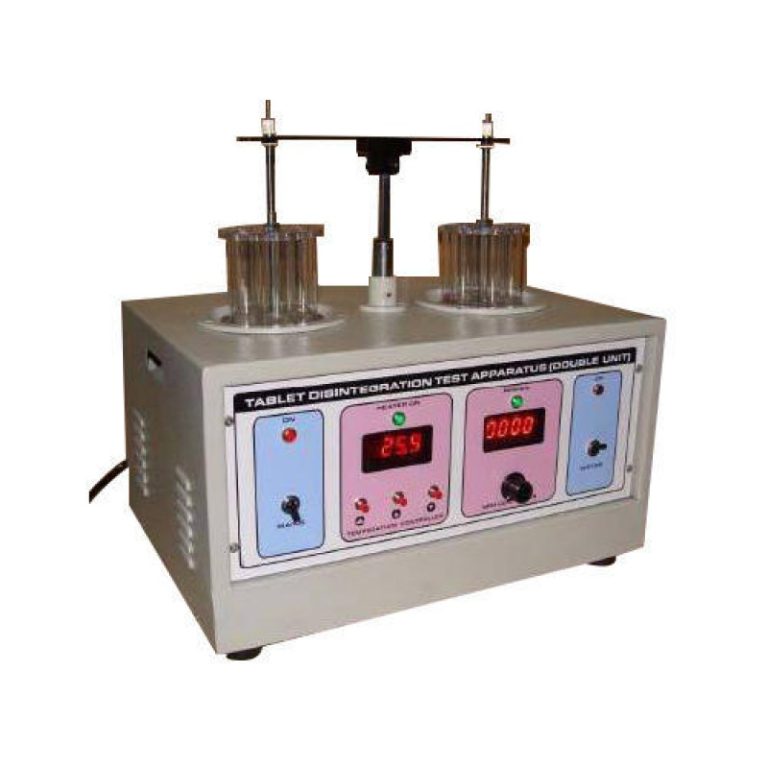
Types of Disintegration Apparatus
When you’re in the process of evaluating where to buy Disintegration Apparatus for your laboratory, understanding the equipment variations helps you specify correctly.
Single Station Apparatus
One basket-rack assembly with six tubes, one water bath, one drive mechanism. Tests one batch of six tablets simultaneously.
When it makes sense:
- Low testing volume — a few tests per day or less
- Teaching and training labs
- Research labs running occasional disintegration tests
- Budget-constrained operations with minimal throughput requirements
The limitation: If you’re running multiple products or large batches through QC, a single station becomes a bottleneck. Six tablets at a time, one run at a time, with equilibration and preparation time between runs — your throughput is limited.
Dual Station Apparatus
Two basket-rack assemblies sharing a water bath, or two completely independent station systems. Runs two sets of six tablets simultaneously, effectively doubling throughput.
This is the configuration most pharmaceutical QC labs in Pakistan should be looking at when they buy Disintegration Apparatus. The incremental cost over a single station is modest compared to the throughput benefit, and in any lab running more than a handful of products, the dual station pays for itself quickly.
Important clarification: Some dual-station units share a single water bath (both basket assemblies in the same bath). Others have independent temperature control for each station. The shared bath design is fine for most applications — but verify that temperature uniformity across both stations meets specification, particularly if stations are testing different products with different specifications simultaneously.
Automated Disintegration Apparatus
More advanced systems with automatic endpoint detection — either through video monitoring of the basket contents, optical sensors detecting when tablets have fully disintegrated, or weight-based detection. These systems can also log results automatically, produce electronic records, and in some configurations, print or export results without manual data entry.
When automated makes sense:
- High-volume testing operations
- Facilities with 21 CFR Part 11 electronic records requirements
- Labs trying to eliminate manual data transcription as an error source
- Operations where operator presence throughout the full test duration is a resource constraint
The trade-off: Automated endpoint detection is generally reliable but not infallible. The palpably firm core judgment that USP specifies is genuinely difficult to automate perfectly. Some systems address this better than others. Ask specifically about endpoint detection mechanism and false pass/fail rates.
Apparatus for Suppositories and Pessaries
A completely different apparatus for testing suppositories. Not basket-rack assemblies but a different mechanism designed for waxy dosage forms that melt or soften rather than disintegrate mechanically. USP <701> describes this apparatus separately. If your lab handles suppositories, you need either a separate dedicated apparatus or one with interchangeable components for both tablet and suppository testing.
The Disintegration Media: What Goes in the Bath
This is something that monographs specify and that analysts sometimes follow less carefully than they should.
Purified water: The simplest medium. Used for many uncoated tablet tests when the monograph doesn’t specify otherwise.
Simulated gastric fluid (SGF) without enzymes: pH 1.2 medium (hydrochloric acid with sodium chloride). Used for tablets intended to dissolve under gastric conditions, and for testing enteric-coated tablets to verify they don’t disintegrate in the stomach (the tablet should remain intact in SGF before being transferred to SIF).
Simulated intestinal fluid (SIF) without enzymes: pH 6.8 phosphate buffer. Used for enteric-coated tablet testing in the second stage (after SGF exposure) and for various other applications.
0.1 N Hydrochloric acid: Sometimes specified directly in monographs as an alternative to SGF.
Medium with surfactant: Some hydrophobic formulations may be tested with polysorbate 80 or similar surfactant added to improve wetting.
When you’re preparing media, preparation quality matters. pH should be verified after preparation. Buffer concentrations should be accurate. Temperature should be equilibrated before the test starts, not adjusted during it. These aren’t just good practice recommendations — they affect whether your results are comparable to the pharmacopeia’s expectations.
What to Look For When You Buy Disintegration Apparatus
Let me be practical about this, because the feature lists on product specifications can obscure what actually matters.
Temperature Performance
This is the most important performance parameter after stroke rate and stroke length. Specifically:
Temperature accuracy: How closely does the displayed temperature match the actual medium temperature? Verify this with a calibrated external thermometer during qualification — not just by reading the instrument’s display.
Temperature stability: How much does the temperature fluctuate during operation? A bath that cycles between 35°C and 39°C is technically within the ±2°C specification at some points but may not maintain consistent test conditions.
Temperature uniformity: What is the temperature at the basket position compared to the bulk bath temperature? At different positions across the two stations in a dual-station unit? This requires actual mapping with a calibrated thermometer during OQ.
Heating rate: How long does the unit take to reach 37°C from room temperature? In a busy QC lab, a unit that takes 45 minutes to equilibrate is a productivity constraint.
Stroke Rate and Length Accuracy
The pharmacopeia is specific: 29-32 CPM, 53-57mm stroke length. Your qualification should verify both of these with appropriate measuring tools.
Stroke rate: Measured with a calibrated tachometer or by timing a defined number of strokes with a stopwatch. Simple and unambiguous.
Stroke length: More awkward to measure but important. A ruler or calibrated gauge held against the basket assembly during operation can give you an approximation. More precise measurements may require the service engineer’s tooling during installation.
When you buy Disintegration Apparatus and run OQ, both of these must be documented at multiple points — beginning, middle, and end of a typical test run, to verify they don’t drift.
Build Quality of Basket Assemblies
The basket-rack assembly takes a lot of mechanical stress over its operating life — constant up-and-down movement, exposure to aqueous media and occasionally acidic or alkaline conditions, regular cleaning. Cheap basket assemblies can:
- Distort over time, affecting tube positioning
- Corrode if the stainless steel quality is inadequate
- Develop mesh damage that changes the effective mesh opening
- Have loose-fitting disks that don’t maintain proper positioning in the tube
Inspect basket assemblies carefully before purchase and at regular intervals during use. The mesh specification is critical — a mesh that’s been damaged or stretched no longer meets the pharmacopeial requirement.
Software and Data Management
For GMP pharmaceutical operations, the data management capability of the apparatus matters beyond basic functionality.
Minimum requirements for a regulated QC environment:
- Accurate timer with resolution appropriate to the test (seconds, not just minutes)
- Result recording that minimizes transcription opportunities
- Audit trail for any result changes
- User login and access control (for 21 CFR Part 11 compliance)
Better systems offer:
- Direct data export to LIMS
- Barcode integration for sample identification
- Automatic result flagging when results approach specification limits
- Report generation without manual formatting
When evaluating instruments to buy Disintegration Apparatus for a regulated operation, specifically ask whether the software meets 21 CFR Part 11 requirements if you need electronic records compliance. Not all instruments do, and retrofitting compliance capability after purchase is usually difficult or impossible.
Ease of Maintenance
Things that affect real-world maintenance burden:
Water bath drain: Is there a proper drain valve, or do you tip the bath? A proper drain makes the routine cleaning that prevents scale and biological growth much more practical.
Basket assembly disassembly: How easy is it to remove and clean the mesh screens? Mesh that’s difficult to clean properly will accumulate tablet debris and give you gradually deteriorating results.
Motor access: When the drive mechanism needs service, how accessible is it? Hoods that require complete disassembly to access the motor are a service engineering problem.
Replacement parts availability: Specifically ask about basket assembly availability, mesh screen availability, and drive belt or motor availability for the specific model you’re considering. For equipment you’ll operate for 10+ years, local spare parts availability matters.
Qualification Requirements for Disintegration Apparatus
Once you’ve decided to buy Disintegration Apparatus for a GMP pharmaceutical lab, qualification is not optional. Here’s what it needs to cover.
Installation Qualification (IQ)
IQ verifies that the equipment arrived as specified, was installed correctly, and meets basic documentation requirements.
What IQ should document:
- Equipment model, serial number, and manufacturer
- Verification that received equipment matches purchase order specifications
- Confirmation that all components are present and undamaged
- Review and filing of manufacturer documentation (manual, certificates)
- Electrical installation verification
- Environmental conditions at installation site
- Software installation and license documentation (if applicable)
Operational Qualification (OQ)
OQ verifies that the equipment operates within specified parameters. For disintegration apparatus, this includes:
Temperature qualification:
- Accuracy: Measure actual medium temperature using a calibrated external thermometer; compare to display reading. Acceptable difference typically ≤0.5°C from calibrated reference.
- Stability: Monitor temperature over at least a full test duration (typically 30-60 minutes). Document maximum temperature excursion.
- Uniformity: Measure temperature at multiple positions across the bath, including at both station positions in a dual-station unit.
Stroke rate qualification:
- Measure CPM using calibrated tachometer or timed count
- Document result; must fall within 29-32 CPM
- Perform at beginning and end of a test cycle to verify no drift
Stroke length qualification:
- Measure using appropriate calibrated gauge
- Document; must fall within 53-57 mm
Timer accuracy:
- Compare instrument timer against calibrated reference (stopwatch or laboratory timer with calibration certificate)
- Document deviation; typically acceptable within ±5 seconds per 30 minutes
Alarm function test:
- If temperature alarm present, verify activation at specified deviation
- Document test results
Performance Qualification (PQ)
PQ verifies that the equipment performs correctly for its intended use. For disintegration apparatus, this typically involves testing with a reference standard tablet of known disintegration characteristics.
Some labs use commercially available reference tablets specifically designed for disintegration apparatus calibration. Others use a well-characterized in-house reference standard with established historical disintegration data.
PQ acceptance criteria:
- All six tablet positions must show disintegration within the expected time range
- Results should be consistent across multiple runs (reproducibility)
- Results from both stations in a dual-station unit should be comparable
Ongoing Calibration
After initial qualification, ongoing calibration should cover:
Temperature: Before each use (check displayed temperature against calibrated reference) and formal calibration quarterly or per your validated SOPs.
Stroke rate and length: Quarterly or per SOP frequency.
Full OQ-level requalification: Annually, or after any significant maintenance, repair, or relocation.
Keep all qualification and calibration records in the equipment’s history file. In Pakistan’s pharmaceutical environment, DRAP inspectors will ask for these records during GMP audits. Having them incomplete or absent is a straightforward finding that’s completely preventable.
Running the Test: Step by Step
For analysts who are learning this test properly, or experienced analysts who want to verify their current technique against the pharmacopeial specification:
Preparation
Water bath and medium:
- Fill the water bath with purified water (or specified medium) to the appropriate level — the basket assembly must be fully immersed in medium throughout its stroke travel
- Set the temperature to 37°C and allow to equilibrate — don’t start timing until the temperature is stable at 37°C ± 2°C
- Verify the temperature with a calibrated external thermometer before starting (not just reading the instrument display)
Basket assembly:
- Inspect basket-rack assembly — all tubes present and undamaged, mesh intact and clean
- Verify disks are present and undamaged if required by the monograph
- Ensure assembly is properly seated in the drive mechanism
Samples:
- Select representative tablets from the sample
- Weigh if required (some monographs specify that tablets meeting certain weight criteria require disks)
- Note any visual defects that might affect the test (chips, fractures, unusual appearance)
Running the Test
- Place one tablet in each of the six tubes
- If disks are required, place a disk on top of each tablet
- Lower the basket-rack assembly into the medium
- Start the drive mechanism and timer simultaneously
- Monitor the test — you should observe tablet breakup progressing through the test
- At the specified time limit, or when disintegration appears complete, examine the basket contents
Evaluating the Endpoint
This is where technique matters most.
At the specified time limit, examine each tube:
- Is there any solid residue remaining?
- If residue is present, is it soft with no firm core?
If you need to assess whether remaining residue has a palpable firm core: use a spatula or glass rod to probe the residue gently. Soft, slimy, or easily displaced residue with no firm center = passes. Any firm, resistant mass = fails.
Record the time at which each tablet was observed to have disintegrated — or record “not disintegrated at [specified time]” for any failures.
Document everything contemporaneously. In a GMP environment, results should be recorded at the time of observation, not reconstructed later from memory.
Post-Test
- Remove basket assembly from the medium
- Rinse basket assembly and tubes with purified water
- Allow to drain and dry (or dry with clean, lint-free cloth)
- Drain and clean the water bath periodically to prevent scale buildup and biological contamination
- Record equipment condition and any observations in the equipment log
Troubleshooting: When Results Don’t Look Right
Even experienced analysts encounter unexpected disintegration results. Here’s how to think through the most common situations.
All Tablets Failing When They Shouldn’t
Before concluding you have a batch failure, check your equipment and technique:
- Is the temperature actually 37°C at the basket position? Not just on the display — check with an external thermometer.
- Is the medium correct? Wrong pH, wrong buffer, wrong concentration?
- Are you using disks when you shouldn’t be, or vice versa?
- Is the stroke rate within specification?
- Are the tubes correctly positioned in the basket?
One or two failures out of six tablets might be a genuine product quality issue. All six failing simultaneously is much more likely to indicate an equipment or technique problem. Investigate before concluding on the product.
Variable Results Between Runs
High variability in disintegration times for the same product — when you’d expect consistent results — suggests:
- Temperature instability in the water bath (poor heater control, inadequate medium volume)
- Stroke rate variability (worn drive mechanism components)
- Inconsistent sample selection (tablets from different positions in the batch may have real variation)
- Analyst technique variation (inconsistent endpoint judgment)
- Medium preparation inconsistency (pH, concentration variation between preparations)
Systematic troubleshooting — isolating one variable at a time — is the right approach here.
One Position Consistently Different
If tablets in a specific tube position consistently disintegrate faster or slower than the others, the problem is usually with that specific tube position:
- Tube positioning affecting medium exchange
- Disk not fitting correctly in that tube
- Mesh damage at that position
- Temperature gradient in the bath affecting that position
Swap the tube to a different position and see if the anomalous behavior follows the tube or stays with the position.
Tablets Disintegrating But Leaving Undissolved Residue
Some tablets will disintegrate — the tablet structure breaks down — but leave residue of undissolved material (coating fragments, filler particles) on the mesh. This is generally acceptable for the disintegration test as long as no firm core remains. The undissolved residue is excipient material that doesn’t need to dissolve for the dosage form to have disintegrated. The drug-containing granules or particles should be passing through or being released.
If you’re seeing more residue than expected compared to historical runs, check for changes in formulation, coating composition, or raw material sources.
Enteric-Coated Tablets: The Two-Stage Test
USP <701> includes specific procedures for enteric-coated tablets that are worth understanding separately because the two-stage test design is sometimes misunderstood.
Stage 1 — Acid stage:
Enteric-coated tablets are tested in simulated gastric fluid (0.1 N HCl or SGF without enzymes) for 1 hour. After 1 hour, no tablet should show signs of disintegration — the enteric coating should be fully intact. The pass criterion here is actually the absence of disintegration.
Stage 2 — Buffer stage:
After passing the acid stage, the same tablets (or fresh tablets per monograph instructions) are transferred to simulated intestinal fluid (pH 6.8 phosphate buffer) for a specified additional time. Now the tablets should disintegrate within the monograph-specified time limit.
The two-stage test mimics the physiological passage from stomach (acidic) to small intestine (near-neutral) that enteric-coated dosage forms are designed to survive and then release drug in.
Practical note: the transition between Stage 1 and Stage 2 requires either changing the medium (if your apparatus allows this) or transferring the basket assembly to a second apparatus pre-equilibrated with the intestinal fluid medium. The transition should be done without drying the tablets between stages.
Setting Up the Right Lab Environment
When labs decide to buy Disintegration Apparatus, the equipment needs a properly designed space to perform well and to allow analysts to work safely and efficiently.
This is where TOPTEC PVT. LTD becomes directly relevant to your disintegration testing setup.
The water bath of a disintegration apparatus is heavy when filled. Depending on model and configuration, a dual-station unit with full water bath can weigh 30-50 kg or more. It also vibrates during operation — the drive mechanism is constantly cycling. These factors matter for bench design.
A disintegration tester placed on inadequate furniture — a lightweight table, a bench not designed for laboratory equipment — will experience more vibration transfer than it should, and there’s a real risk of the bench surface being damaged by heat from the water bath base.
TOPTEC PVT. LTD: Laboratory Furniture Manufactured in Pakistan
TOPTEC PVT. LTD is a Pakistani manufacturer of laboratory furniture and lab infrastructure — genuinely manufactured here, not imported and labeled locally. For pharmaceutical QC labs that are purchasing or upgrading disintegration testing equipment, TOPTEC provides the complete surrounding infrastructure.
What TOPTEC Makes for QC Labs:
Laboratory Workbenches
The bench your disintegration apparatus sits on needs to handle the weight of the unit plus water bath, provide a stable vibration-resistant surface, and be constructed of materials that handle water splashes and occasional chemical exposure without deteriorating.
TOPTEC’s laboratory workbenches are steel-frame construction with chemical-resistant surface options — phenolic resin, epoxy resin, or chemical-resistant laminate depending on your application requirements. Custom dimensions are standard practice, not a special order.
QC Instrument Benches
Specifically configured for pharmaceutical QC equipment — disintegration testers, dissolution apparatus, hardness testers, friability testers. Proper structural support for heavy equipment, cable management, and surface finish appropriate for a GMP environment.
Under-Bench and Adjacent Storage
Organized storage for basket assemblies, reference standards, media preparation equipment, and documentation. An organized QC workspace is not just tidier — it’s a GMP requirement and an audit finding waiting to happen if it’s not addressed properly.
Media Preparation Benches
Adjacent to the testing area, you need a properly configured preparation bench for buffer preparation, pH measurement, and medium filtering. TOPTEC can design this as an integrated bench system with the testing area — consistent surface materials, compatible dimensions, unified design.
Sink Units
Essential for disintegration labs — you need water access for bath filling and basket cleaning, and appropriate drainage for used media. TOPTEC manufactures sink units designed for laboratory use with appropriate materials and configurations.
Reagent Storage
For the various media components — HCl, phosphate buffers, sodium chloride — appropriate chemical storage that’s organized, labeled, and accessible without creating clutter in the testing area.
The Practical Advantages of Buying from TOPTEC
Here’s what I think is genuinely underappreciated about buying laboratory furniture from a local Pakistani manufacturer:
The lead time reality is significant. Imported laboratory furniture — from European or other international manufacturers — typically arrives in Pakistan 12-16 weeks after ordering, when you account for all the steps from manufacturer to your lab. If you’re setting up a new QC lab with a target opening date, this timeline can become your critical path problem.
TOPTEC delivers standard items in 3-5 weeks. Custom fabrications in 5-8 weeks depending on complexity. For most Pakistani laboratory projects, this difference between 4 weeks and 16 weeks determines whether your lab opens on schedule.
The custom dimension question is also more significant than it sounds at first. Imported furniture comes in standard European or American module widths. Your specific lab room probably has dimensions that don’t perfectly accommodate standard modules. Rather than arranging furniture in a layout that’s slightly awkward because the bench runs aren’t quite the right length, TOPTEC fabricates to your exact dimensions.
And PKR pricing. No currency exposure between quotation and delivery. No import duty calculation. The price you’re quoted is what you pay.
Price Expectations for Pakistan’s Market
When labs in Pakistan are ready to buy Disintegration Apparatus, here’s what to realistically budget:
Single Station, Basic Digital:
- Budget tier (basic Indian manufacture): PKR 150,000 – 280,000
- Mid-tier (LABINDIA, Electrolab equivalent): PKR 280,000 – 450,000
Dual Station (most common QC lab choice):
- Mid-tier Indian manufacture: PKR 400,000 – 700,000
- Upper mid-tier with better software: PKR 700,000 – 1,100,000
- Imported European brands: PKR 1,500,000 – 3,000,000+
Automated with Endpoint Detection:
- Mid-tier: PKR 900,000 – 1,800,000
- Premium European: PKR 2,500,000 – 5,000,000+
Ongoing costs to factor in:
- Annual calibration/OQ: PKR 15,000 – 40,000
- Basket assembly replacement (when needed): PKR 8,000 – 25,000 per set
- Drive mechanism service: Variable
These are approximate market ranges. Always get current formal quotations before making purchasing decisions.
Regulatory Context: DRAP and International Requirements
For pharmaceutical manufacturers in Pakistan, the regulatory environment around disintegration testing has specific implications for equipment selection and qualification.
DRAP GMP requirements align with WHO GMP guidelines and increasingly reflect EU GMP expectations. During DRAP inspections, inspectors routinely review:
- Equipment qualification documentation (IQ/OQ/PQ)
- Calibration records and calibration intervals
- SOPs for disintegration test operation
- Analyst training records for the test procedure
- Out-of-specification (OOS) investigation records
- Data integrity compliance (raw data, audit trails, contemporaneous recording)
If you’re an export-oriented manufacturer — supplying to markets in the Middle East, Africa, or elsewhere that reference WHO or ICH standards — your disintegration testing operation needs to meet the same standards as your other analytical procedures.
When you buy Disintegration Apparatus for a regulated pharmaceutical environment in Pakistan, make sure you’re getting:
- Manufacturer specifications sufficient to write your IQ protocol
- Calibration certificates for critical parameters
- Software validation documentation (if applicable)
- User manual and maintenance manual in accessible language
- Reference to applicable pharmacopeial specifications in manufacturer documentation
Common Audit Findings Related to Disintegration Testing
Based on what regularly comes up during pharmaceutical inspections — these are the findings worth anticipating and preventing:
Temperature calibration with only the instrument’s own sensor:
Using the instrument’s built-in temperature display as both the control and the calibration reference. You need an independent, externally calibrated thermometer to verify accuracy. Document this properly.
Stroke rate not documented in qualification:
Some qualification packages focus entirely on temperature and neglect stroke rate and stroke length verification. USP <701> specifies all three parameters — all three need to be in your OQ.
Basket assembly inspection not included in maintenance schedule:
Mesh damage, tube distortion, disk wear — these are real degradation mechanisms that need to be on a documented inspection schedule, not just checked when something looks wrong.
Medium preparation records incomplete:
pH of simulated fluids not documented. Preparation date not recorded. Buffer concentration not verified. These are data integrity findings that have nothing to do with the instrument itself but affect the validity of every result the instrument generates.
Contemporaneous recording not practiced:
Results filled in retrospectively from memory or rough notes. In a GMP environment, this is a serious data integrity concern. Results should be recorded at the time of observation.
OOS investigations not linked to equipment records:
When a disintegration failure occurs and an OOS investigation is opened, the investigation should include a review of equipment calibration status and recent performance. If this linkage isn’t systematically happening, it’s both a quality and compliance gap.
Building a Complete Disintegration Testing Area
For labs setting up or upgrading a disintegration testing space, here’s an integrated infrastructure checklist:
Testing Zone:
- ☐ Heavy-duty instrument bench at appropriate height for comfortable operation (TOPTEC)
- ☐ Adequate bench depth for the instrument plus operator working space (minimum 75cm depth)
- ☐ Dedicated electrical outlets — not shared with high-draw equipment
- ☐ Water supply access nearby for bath filling
- ☐ Drainage access for bath emptying
- ☐ Good lighting — you need to clearly observe basket contents
Media Preparation Zone (TOPTEC):
- ☐ Preparation bench with chemical-resistant surface
- ☐ Sink unit for glassware rinsing and water access
- ☐ Analytical balance table (vibration-isolated from testing equipment)
- ☐ pH meter station with appropriate reagent storage
Storage (TOPTEC):
- ☐ Organized storage for basket assemblies (clean, dry, protected from damage)
- ☐ Reference standards storage (secure, appropriate temperature)
- ☐ Reagent storage for buffer components
- ☐ Consumables (purified water containers, filter paper, cleaning supplies)
Documentation:
- ☐ Logbook and raw data recording area adjacent to testing bench
- ☐ SOP display within sight of testing equipment
- ☐ Calibration records filing accessible in the lab
Summary: Getting This Right
The disintegration test is routine. That’s exactly why it needs careful attention.
When you buy Disintegration Apparatus for your pharmaceutical QC lab, the core considerations are: temperature performance and uniformity, stroke rate and length accuracy, build quality of the basket assemblies, software and data management capability, local service support, and the qualification documentation package.
For Pakistani pharmaceutical labs, the choice between imported premium equipment and well-specified mid-tier Indian-manufactured alternatives involves real cost-benefit trade-offs that depend on your specific regulatory environment, testing volume, and budget. Know your actual requirements before you start evaluating products.
And when you buy Disintegration Apparatus — don’t forget the infrastructure it needs to operate in. A properly specified instrument on a poorly designed bench, in a disorganized lab with inadequate media preparation facilities, is going to give you more problems than a moderate instrument in a well-designed, properly equipped space.
TOPTEC PVT. LTD manufactures the complete laboratory infrastructure your disintegration testing operation needs — workbenches, preparation areas, storage solutions, sink units — all made in Pakistan, on realistic timelines, at PKR pricing, with the flexibility to match your specific lab dimensions and configuration.
Get both pieces right — the instrument and the environment it operates in — and your disintegration testing program will run reliably, generate defensible data, and hold up under regulatory scrutiny.
Contact TOPTEC PVT. LTD
TOPTEC PVT. LTD manufactures laboratory workbenches, QC instrument benches, media preparation stations, storage cabinets, sink units, and complete laboratory furniture solutions — all manufactured locally in Pakistan for pharmaceutical, research, and industrial laboratory environments.
Contact TOPTEC to discuss your QC lab infrastructure requirements and receive a customized quotation based on your specific layout and application.
