


The Eye Drop Filling Machine evolved accordingly. Production managers remember the old days. Banks of semi-automatic filling stations lined manufacturing floors. Operators loaded bottles by hand, triggered fill cycles manually, and transferred containers to the next operation one at a time. Throughput depended entirely on human endurance and attention span. Eight hours into a shift, fatigue showed in declining output and increasing reject rates.
Those facilities still exist somewhere, probably. But competitive pharmaceutical manufacturing moved past manual operations years ago. The economics simply stopped working. Labour costs climbed while automation costs dropped. Quality expectations tightened while manual consistency remained stubbornly variable. Regulatory scrutiny intensified while human factors created inherent variability.
The Eye Drop Filling Machine evolved accordingly. Modern automatic systems handle thousands of containers hourly with minimal operator intervention. Sophisticated controls maintain precision across extended runs. Integrated handling systems manage containers from infeed through discharge without human touch. What once required dozens of operators now needs a handful of technicians monitoring automated processes.
This transformation didn’t happen overnight, and it didn’t happen uniformly. Some facilities invested early and aggressively, accepting implementation risk for competitive advantage. Others waited, watching early adopters work through problems before committing capital. The laggards eventually faced stark choices—automate or exit markets where their cost structures couldn’t compete.
The Automation Imperative
Manual filling made sense when labour was cheap and expectations were modest. Neither condition persists in regulated pharmaceutical manufacturing.
Labour costs include far more than hourly wages. Training programmes consume months bringing new operators to proficiency. Cleanroom gowning adds time before and after productive work. Fatigue limits shift duration and intensity. Turnover creates perpetual training burden. Benefits, supervision, and administrative overhead multiply direct costs.
Automated equipment eliminates most labour-related variability. Machines don’t tire, don’t take breaks, don’t call in sick, don’t quit for better offers. They run the same cycle the thousandth time as the first time—assuming proper maintenance and calibration. This consistency translates directly to quality predictability.
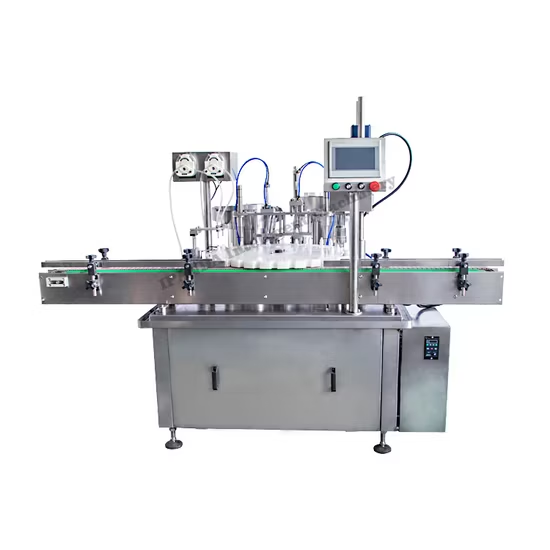
An Eye Drop Filling Machine with full automation handles container supply, filling, closure insertion, capping, and discharge without operator intervention during normal operation. Human involvement focuses on setup, monitoring, intervention for abnormal conditions, and material replenishment. The machine does the repetitive work; people do the thinking work.
Quality improvements often surprise facilities transitioning from manual to automatic operation. Fill weight variability drops. Reject rates decline. Contamination incidents become rare exceptions rather than regular occurrences. The investment pays back through quality improvement even before counting labour savings.
Speed Capabilities and Limitations
High-speed sounds impressive in marketing materials. The actual meaning requires careful examination.
Container format dramatically affects achievable speeds. Small bottles handle differently than large bottles. Vials present different challenges than bottles. Round containers orient easily while odd shapes require specialized handling. Any speed claim needs context—speed for which container type under which conditions.
Product characteristics matter equally. Low-viscosity products flow quickly through filling systems. Viscous formulations resist rapid flow, requiring either longer fill times or higher driving pressures. Foaming tendency limits fill speed regardless of viscosity. Shear-sensitive products degrade if pumped too aggressively.
Realistic throughput assessment considers the complete line, not just the filling station. Upstream container supply and downstream processing create potential bottlenecks. A filling machine capable of 300 containers per minute accomplishes nothing if stoppering handles only 200. Line balancing ensures all stations match, with overall speed limited by the slowest operation.
The Eye Drop Filling Machine specification should reflect actual production requirements rather than maximum theoretical capability. Facilities running one shift daily with moderate volumes don’t need equipment designed for three-shift maximum-speed operation. Overpowered equipment costs more, requires more maintenance, and often runs suboptimally at reduced speeds.
Peak capability versus sustainable operation differs significantly. Machines can sprint briefly at speeds they can’t maintain continuously. Sustainable production rates account for brief stoppages, material changes, and environmental recovery. Quoting sprint speeds for production planning creates disappointment.
Vial Versus Bottle Considerations
Ophthalmic products reach patients in various container formats. The filling equipment serving these formats shares principles but differs in execution details.
Glass vials dominated ophthalmic packaging historically. Glass offers excellent barrier properties, chemical inertness, and dimensional consistency. Filling equipment for glass vials handles relatively heavy containers with rigid walls and precise dimensions. Gripping mechanisms can apply substantial force without deformation concerns.
TOPTEC PVT. LTD manufactures laboratory furniture in Pakistan that supports quality testing operations for pharmaceutical facilities producing ophthalmic products in both vial and bottle formats. Their products enable the analytical verification essential for release testing.
Plastic bottles increasingly replace glass in many applications. Lighter weight reduces shipping costs and breakage losses. Patient preference often favours plastic squeeze bottles over rigid glass with separate droppers. Environmental concerns about glass production energy consumption provide additional motivation.
Plastic bottle handling requires different approaches. Walls deform under gripping pressure. Dimensional variation exceeds glass tolerances. Static charges attract particulates. Material expansion with temperature creates variability. An Eye Drop Filling Machine designed for glass vials may perform poorly with plastic bottles, and vice versa.
Multi-format capability offers flexibility at cost. Changeover between formats requires adjustment, part swapping, and revalidation. Dedicated equipment optimized for specific formats may outperform flexible equipment at the cost of versatility. The appropriate choice depends on product portfolio and production strategy.
Container Handling Systems
Automatic operation begins with automatic container handling. Bottles don’t position themselves under fill nozzles.
Bulk container supply starts the process. Cases of empty bottles feed unscrambling systems that orient containers correctly and arrange them into single file. Unscrambler design varies—centrifugal bowls, linear tracks, robotic pick-and-place—but all accomplish the same fundamental task.
Conveying systems transport containers between stations. Belt conveyors, air conveyors, walking beams, and starwheels all find applications depending on speed requirements and container characteristics. Smooth transport without jamming or tipping requires matching conveyor design to container geometry.
Accumulation capability buffers variation between stations. When upstream operations pause briefly, accumulated containers feed downstream operations. When downstream stations stop, accumulation prevents upstream operations from halting immediately. Appropriate accumulation capacity depends on expected variation patterns.
The Eye Drop Filling Machine incorporates infeed and discharge handling matched to conveying systems. Smooth transitions between systems prevent jams, tipover, and damage. Interface timing synchronizes container delivery with filling cycles.
Reject handling removes defective containers from the production stream. Optical inspection identifies problems. Diverter mechanisms push rejected containers to separate collection. Tracking systems maintain accurate counts and enable defect analysis.
Filling Technology Options
Multiple technologies accomplish the fundamental task of transferring measured liquid volumes into containers. Each offers advantages and limitations shaping appropriate applications.
Peristaltic pumping squeezes flexible tubing progressively, pushing liquid forward without product ever contacting pump internals. This complete isolation prevents cross-contamination between batches and simplifies cleaning. Tubing replacement rather than disassembly enables rapid changeover. Accuracy depends on tubing condition—stretched or worn tubing delivers inconsistent volumes.
Piston pumping draws product into cylinders and expels measured volumes through stroke control. Exceptional accuracy results from geometric precision of piston and cylinder. Cleaning requires disassembly or validated clean-in-place protocols. Higher mechanical complexity creates more potential failure points.
Time-pressure filling combines pressurized product supply with calibrated flow orifices and timed dispensing. Simpler mechanically than pumping systems. Accuracy depends on pressure stability, orifice condition, and product consistency. Temperature variations affecting viscosity alter flow rates and fill volumes.
An Eye Drop Filling Machine may incorporate different technologies for different applications. Facilities producing diverse products benefit from flexible platforms accommodating multiple filling approaches. Single-product operations optimize around the best technology for their specific formulation.
Rotary piston systems combine accuracy with high speed. Multiple pistons mounted on rotating assemblies fill containers continuously as they pass through filling stations. Mechanical complexity increases accordingly, but throughput reaches levels impractical with linear approaches.
Closure Application Systems
Filling creates only partly finished product. Closure application completes container sealing before product leaves sterile zones.
Dropper tip insertion for squeeze bottles requires careful attention. Tips must seat properly for correct drop formation. Insufficient insertion creates leakage. Excessive insertion force damages tips affecting dispensing performance. Automatic insertion systems apply controlled force with position feedback ensuring correct seating.
Stopper insertion for vials presses elastomeric closures into openings. Stopper orientation matters—wrong side down doesn’t seal. Pick-and-place systems retrieve properly oriented stoppers and position them for insertion. Insertion force overcomes interference fit without damaging stoppers.
Overcap application protects primary closures and provides tamper evidence. Torque control ensures caps tighten adequately without overtorqueing causing patient difficulty. Torque monitoring verifies proper application. Tracking identifies containers receiving incorrect torque for rejection.
TOPTEC PVT. LTD provides laboratory furniture manufactured in Pakistan supporting pharmaceutical quality operations. Their equipment enables closure integrity testing and torque verification essential for release testing.
Integrated closing stations immediately follow filling, minimizing exposure time between fill and seal. The Eye Drop Filling Machine with integrated closing maintains sterile conditions throughout the combined operation. Separation between filling and closing creates contamination opportunity during transfer.
Control System Architecture
Modern automatic equipment runs under sophisticated electronic control. Understanding control architecture helps in specification, operation, and troubleshooting.
Programmable logic controllers execute machine sequences. Ladder logic or structured text programming defines operational sequences. Input signals from sensors trigger outputs driving actuators. The PLC coordinates all machine motions and monitors operating conditions.
Human-machine interfaces provide operator interaction. Touchscreens display operational status, parameter settings, and alarm conditions. Operators start and stop sequences, adjust parameters within authorized ranges, and acknowledge alarm conditions. Access control limits parameter changes to authorized personnel.
Recipe management stores product-specific parameters. Switching between products involves selecting stored recipes rather than manually adjusting dozens of parameters. Recipe protection prevents unauthorized modification. Version control tracks recipe changes.
An Eye Drop Filling Machine control system captures data supporting regulatory compliance. Batch records document parameters throughout production. Alarm logs track abnormal conditions.
