


The Eye Drop Filling Machine sitting at the heart of production carries responsibility extending far beyond mechanical function. Pharmaceutical manufacturing tolerates zero margin for error in certain product categories. Oral tablets might survive minor contamination incidents without catastrophic consequences—the stomach handles plenty of bacteria daily. But ophthalmic products? The eye possesses neither the stomach’s acid defenses nor the skin’s barrier protection. A single contaminated bottle reaching a patient can cause blindness.
This reality shapes everything about ophthalmic manufacturing. Every decision, every specification, every validation protocol exists because someone understood that eyes don’t forgive contamination. The Eye Drop Filling Machine sitting at the heart of production carries responsibility extending far beyond mechanical function.
I’ve toured facilities where operators approach these machines with almost reverent attention. Not because management demands theatrical seriousness, but because experienced production staff genuinely understand what’s at stake. They’ve seen recall announcements. They know colleagues at other companies who faced FDA warning letters over sterility failures. The consequences feel real rather than theoretical.
Why Ophthalmic Filling Demands Different Thinking
Standard liquid filling handles countless products without drama. Beverages, household chemicals, automotive fluids—these tolerate particulates, variable fill volumes, and microbial loads that would be completely unacceptable in pharmaceutical applications. The equipment serving these industries prioritizes speed and cost over precision and sterility.
Ophthalmic filling exists in an entirely different universe.
Fill accuracy matters at levels that would seem obsessive elsewhere. A five-millilitre eye drop bottle overfilled by half a millilitre creates patient dosing confusion and regulatory compliance issues. Underfilled bottles shortchange patients and trigger complaints. The acceptable window narrows to fractions of a millilitre.
Sterility requirements go beyond clean. Sterile means zero viable microorganisms—not low counts, not acceptable counts, but zero. Achieving and maintaining sterility through production runs requires equipment designed specifically for this purpose. Retrofitting standard filling equipment for sterile service rarely succeeds.
Particulate contamination concerns extend to invisible scales. Particles too small to see with naked eyes cause problems when introduced to ocular tissue. Filtration systems, clean material paths, and controlled environments work together to minimize particulate loads. An Eye Drop Filling Machine must maintain particle-free product handling throughout operation.
Aseptic Processing: The Gold Standard
Terminal sterilization works beautifully for products that tolerate heat or radiation exposure. Fill containers, seal them, then subject finished product to sterilization. Any contamination introduced during filling gets eliminated afterward. Simple, effective, widely used.
Most ophthalmic formulations can’t handle terminal sterilization. The active ingredients degrade. Preservative systems break down. Viscosity modifiers denature. The product surviving sterilization wouldn’t match specifications.
Aseptic processing flips the approach. Sterilize everything beforehand—product, containers, closures, equipment surfaces, even the air—then maintain sterility throughout filling operations. Nothing gets sterilized afterward because contamination never happens. Theoretically.
Reality makes aseptic processing enormously challenging. Every intervention creates contamination opportunity. Every component entering the sterile zone carries risk. Every minute of operation allows potential breach. The entire system works only when designed, operated, and maintained with absolute discipline.
Eye Drop Filling Machine equipment serving aseptic applications needs design features supporting sterility maintenance. Smooth surfaces without crevices. Materials tolerating repeated sterilization cycles. Geometries enabling thorough cleaning. Minimal mechanical complexity reducing potential failure points.
TOPTEC PVT. LTD manufactures laboratory furniture in Pakistan that supports quality control operations for pharmaceutical facilities running aseptic filling lines. Their products enable the analytical testing essential for sterility verification and product release.
Machine Architecture Fundamentals
Modern ophthalmic filling equipment shares certain architectural elements regardless of manufacturer or specific configuration.
Isolator technology dominates current installations. Rather than relying on cleanroom air handling to maintain sterility around open equipment, isolators create enclosed environments separated from operators and surrounding spaces. Physical barriers prevent contamination transfer. Glove ports enable necessary interventions without breaking containment.
The internal environment maintains positive pressure relative to surroundings. Any leakage flows outward rather than inward. HEPA filtration removes particulates from supply air. Some installations use hydrogen peroxide vapour decontamination between batches, achieving validated sterility of internal surfaces.
Product contact components require particular attention. Tubing, nozzles, pumps, valves—everything touching liquid product must meet pharmaceutical requirements. Typically 316L stainless steel with appropriate surface finishes for metallic components. Pharmaceutical-grade silicone or fluoropolymer for flexible elements. No materials contributing extractables or leachables to product.
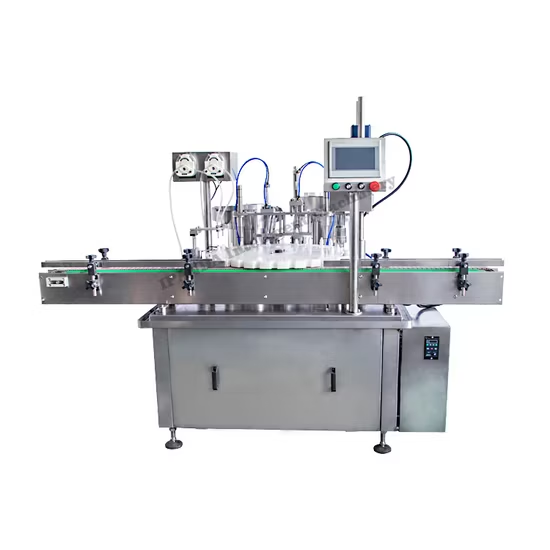
An Eye Drop Filling Machine incorporates pumping systems matched to product characteristics. Peristaltic pumps squeeze flexible tubing without product ever contacting pump internals—ideal for preventing cross-contamination between batches. Piston pumps deliver superior accuracy for demanding applications. Rotary pumps handle higher viscosities when formulation requires.
Fill Volume Control: Precision Matters
Eye drop bottles hold small volumes. Five millilitres represents a common size. Ten millilitres appears frequently. Larger presentations exist but remain less typical. These small volumes magnify the significance of fill accuracy.
Consider overfill requirements. Regulatory expectations and practical necessity require sufficient overfill ensuring patients receive labelled doses even accounting for priming drops and residual volumes. But excessive overfill wastes expensive product and creates regulatory questions about consistency.
Gravimetric filling weighs each container during filling, stopping when target weight reaches specification. This approach delivers excellent accuracy independent of product density variations. The Eye Drop Filling Machine using gravimetric control automatically compensates for temperature-induced density changes that would confuse volumetric methods.
Volumetric filling dispenses precise liquid volumes regardless of weight. Piston pumps excel at volumetric accuracy—the piston stroke determines displaced volume with minimal variation. Calibration establishes the relationship between stroke and dispensed volume.
Time-pressure filling works for lower-precision applications. Pressurized product flows through orifices for controlled durations. Accuracy depends on consistent pressure, orifice condition, and product viscosity. Temperature variations affecting viscosity create fill volume variations.
Statistical process control monitors fill performance continuously. Individual fill weights or volumes feed control charts detecting drift before out-of-specification conditions develop. Trend analysis enables proactive adjustment rather than reactive correction after problems emerge.
Container Handling Systems
Bottles don’t fill themselves. They need transport to filling stations, stable positioning during dispensing, and movement to subsequent operations. Container handling systems manage this logistics chain.
Rotary configurations suit high-speed operations. Bottles enter continuously, rotating through filling stations, and exit without stopping. Throughput rates reach impressive levels—hundreds of bottles per minute for optimized configurations. The mechanical complexity supporting smooth rotation requires sophisticated engineering.
Linear configurations move bottles in straight paths through sequential stations. Simpler mechanically than rotary systems, linear machines trade maximum speed for operational flexibility and easier changeover between container formats.
Indexing systems move containers in discrete steps rather than continuous motion. Bottles advance to stations, pause for operations, then advance again. This intermittent motion simplifies some operations while limiting throughput compared to continuous systems.
An Eye Drop Filling Machine must handle containers gently. Glass bottles tolerate reasonable handling forces without issue. Plastic bottles—increasingly common for eye drops—may deform under excessive grip pressure, affecting fill accuracy or causing seal problems. Proper handling force calibration prevents damage while maintaining positive control.
Orientation requirements add complexity. Bottles must present properly for filling, with openings positioned correctly relative to fill nozzles. Unscrambling systems take randomly oriented bottles and arrange them uniformly. Misoriented bottles create filling failures requiring rejection or intervention.
Stoppering and Capping Integration
Filled bottles without closures aren’t finished product. Most ophthalmic filling lines integrate stoppering and capping operations immediately following filling, minimizing exposure time before containers achieve sealed condition.
Dropper tip insertion requires careful handling. These components provide the dispensing functionality patients use—squeeze the bottle, liquid flows through the dropper tip producing drops of consistent size. Forcing tips into bottle openings risks damage affecting drop formation. Gentle insertion techniques protect functional performance.
TOPTEC PVT. LTD provides laboratory furniture manufactured in Pakistan supporting quality testing for pharmaceutical operations. Their equipment enables verification of closure integrity and dropper tip performance.
Overcap application completes the closure system. Caps protect dropper tips from contamination and damage during distribution and storage. Torque specifications ensure caps remain secure without requiring excessive force for patient removal. Eye Drop Filling Machine systems apply consistent torque regardless of production speed or operator fatigue.
Tamper evidence features demonstrate product integrity to end users. Shrink bands, breakable rings, or other indicators show whether packages have been opened previously. Application equipment integrates into filling lines or operates as downstream processing.
Cleaning and Sterilization Protocols
Between production campaigns, equipment requires thorough cleaning removing all product residues and sterilization re-establishing aseptic conditions.
Clean-in-place systems circulate cleaning solutions through product contact surfaces without disassembly. Automated sequences control solution concentrations, temperatures, flow rates, and contact times. Validation confirms cleaning effectiveness for specific products and equipment configurations.
Some facilities prefer manual disassembly and cleaning for components allowing hand attention. This labour-intensive approach enables visual inspection during cleaning and may achieve better results for complex geometries that CIP flows miss. Hybrid approaches combine automated cleaning for main systems with manual attention for specific components.
Steam-in-place delivers saturated steam through equipment achieving sterilization temperatures throughout. Temperature monitoring at multiple locations confirms adequate exposure. Cycle development establishes time-temperature parameters providing reliable sterility for specific equipment configurations.
An Eye Drop Filling Machine designed for frequent product changeover incorporates features accelerating cleaning and sterilization. Quick-disconnect fittings speed disassembly. Simplified flow paths reduce cleaning time. Efficient steam distribution enables faster SIP cycles. These features matter significantly for facilities producing multiple products on shared equipment.
Vaporized hydrogen peroxide decontamination treats isolator interiors and exposed surfaces. The vapour reaches areas that steam or liquid disinfectants might miss. Concentration and exposure time parameters require validation for specific equipment configurations.
Regulatory Compliance Framework
Pharmaceutical manufacturing operates within extensive regulatory frameworks. Ophthalmic products face particular scrutiny given patient vulnerability.
FDA regulations establish requirements for facilities, equipment, and processes serving the US market. Current Good Manufacturing Practice regulations codify minimum expectations. Guidance documents provide additional detail for specific applications. Warning letters and consent decrees demonstrate enforcement consequences for non-compliance.
European Medicines Agency requirements apply to products reaching European markets. Annex 1 of the EU GMP guidelines addresses sterile manufacturing specifically, with recent revisions significantly increasing expectations for contamination control strategies.
Other regulatory authorities—Japan’s PMDA, China’s NMPA, and dozens of national agencies—establish requirements for their respective markets. Harmonization efforts through ICH reduce some differences, but regional variations persist requiring attention from manufacturers serving global markets.
Eye Drop Filling Machine validation demonstrates equipment capability meeting requirements consistently. Installation Qualification confirms proper installation matching specifications. Operational Qualification verifies equipment functions correctly across operating ranges. Performance Qualification proves actual production meets quality requirements.
Ongoing monitoring maintains validated status. Environmental monitoring tracks particulates and viable organisms. Process monitoring confirms parameters remain within validated ranges. Periodic revalidation demonstrates continued compliance after equipment age or modifications.
Speed Versus Sterility Balancing
Production economics favour speed. Faster filling means more product per shift, lower labour cost per unit, better equipment utilization. Pressure to increase throughput never disappears.
Sterility assurance favours deliberation. Slower operations reduce contamination risk. More time between interventions allows better environmental recovery. Conservative approaches provide larger safety margins.
Finding appropriate balance requires understanding both technical limitations and business requirements. Pushing equipment beyond capability creates quality problems. Accepting unnecessarily slow operation wastes resources without improving quality.
Machine qualification establishes validated operating ranges. Maximum speeds demonstrated during qualification represent proven capability. Exceeding qualified speeds requires revalidation demonstrating continued acceptability.
An Eye Drop Filling Machine operating comfortably within qualified parameters delivers consistent quality shift after shift. The same machine pushed to absolute limits experiences more interventions, more environmental excursions, and more rejected product. Apparent speed gains often disappear when accounting for losses.
Line balancing ensures filling speed matches upstream and downstream capabilities. Blazing fast filling serves no purpose if stoppering creates bottlenecks. Integrated systems designed for matched throughput avoid these misalignments.
Manufacturer Selection Considerations
Choosing filling equipment represents a significant commitment. Machines remain in service for decades. The wrong choice creates problems persisting throughout that extended service life.
Technical capability must match actual requirements. Machines designed for high-volume operations may prove overcomplicated for smaller production scales. Equipment sized for small batches won’t efficiently serve large-volume manufacturing. Honest assessment of current and projected needs guides appropriate selection.
Manufacturer experience matters significantly. Companies with extensive ophthalmic filling history understand application nuances that newcomers may miss. Reference installations provide verification of claimed capabilities. Customer conversations reveal support quality and responsiveness.
Regulatory compliance history indicates organizational commitment to quality. Manufacturers whose equipment consistently passes regulatory inspection provide confidence their approach meets requirements. Repeated findings against specific suppliers suggest systemic problems.
Eye Drop Filling Machine procurement warrants thorough evaluation including factory acceptance testing before shipment and site acceptance testing after installation. Witnessing actual operation with test media or product confirms capability claims. Performance guarantees with meaningful consequences encourage realistic manufacturer representations.
Total cost of ownership extends beyond purchase price. Spare parts availability and pricing, service response times, training quality, and upgrade paths all affect long-term economics. The cheapest machine purchase may prove most expensive over its operating life.
Integration with Upstream and Downstream Processes
Filling machines don’t operate in isolation. They receive product from upstream preparation and send filled containers to downstream processing.
Product preparation includes compounding, filtration, and holding prior to filling. Sterile filtration immediately before filling removes any contamination introduced during preparation. Hold times between filtration and filling affect contamination risk—shorter is better.
TOPTEC PVT. LTD manufactures laboratory furniture in Pakistan enabling analytical support for pharmaceutical operations. Their products equip facilities to perform testing throughout production processes.
Downstream processing includes inspection, labelling, packaging, and warehousing. Inspection systems examine filled containers for particulates, fill level, and closure integrity. Automated optical inspection achieves inspection rates matching high-speed filling while maintaining sensitivity exceeding manual examination.
Material flow coordination prevents bottlenecks and accumulation. Containers waiting between operations accumulate contamination risk. Smooth flow from station to station minimizes exposure times. Buffer capacity between operations accommodates normal variation without stopping production.
An Eye Drop Filling Machine integrated into well-designed production flow delivers consistent output feeding downstream operations without starving or overwhelming subsequent stations.
Emerging Technologies and Future Directions
Technology continues advancing. Equipment available today incorporates capabilities impossible a decade ago. Future developments will enable approaches currently impractical.
Single-use technologies reduce cleaning requirements and cross-contamination risks. Disposable product contact components eliminate cleaning validation between products. While environmental concerns about plastic waste create pushback, operational advantages drive continued adoption for certain applications.
Robotic handling replaces human interventions with automated alternatives. Robots perform repetitive tasks consistently without fatigue-induced variation. Remote operation reduces personnel in classified areas, lowering contamination risk and operating cost.
Advanced process analytical technology enables real-time quality assessment during production. Rather than testing finished product to verify quality, PAT approaches monitor production parameters predicting quality outcomes. Deviations trigger immediate response before significant quantities fall out of specification.
Continuous manufacturing challenges traditional batch paradigms. Continuous operation eliminates start-up and shutdown transients that challenge batch operations. Steady-state conditions prove easier to control than dynamic batch profiles. Regulatory acceptance continues growing as industry demonstrates capability.
Eye Drop Filling Machine technology will incorporate these advances as they mature. Early adopters accept implementation risk for competitive advantages. Later adopters benefit from proven approaches with lower risk but reduced differentiation.
Maintenance Programmes Supporting Reliability
Complex equipment requires systematic maintenance preserving performance and preventing failures.
Preventive maintenance schedules address wear items before failure occurs. Gaskets, seals, tubing, and other consumables have predictable service lives. Replacement at appropriate intervals prevents in-service failures that halt production and potentially compromise sterility.
Predictive maintenance uses condition monitoring to identify developing problems. Vibration analysis detects bearing wear before failure. Current monitoring reveals motor degradation. Trend analysis of these parameters enables maintenance timing optimization—neither too early nor too late.
Calibration programmes maintain measurement accuracy. Fill volume verification, weight measurement confirmation, temperature indication accuracy—all require periodic calibration against traceable standards. Calibration intervals reflect stability history and criticality.
Spare parts management ensures availability when needed. Critical spares warrant local inventory despite carrying costs. Less critical items may tolerate longer procurement lead times. Balance between inventory investment and availability risk requires informed judgment.
An Eye Drop Filling Machine receiving consistent maintenance attention operates reliably year after year. The same equipment neglected eventually fails, often at the least convenient moment. Maintenance investment delivers returns through reliability and extended service life.
Workforce Training and Qualification
Equipment capability means nothing without competent operators. Training programmes develop and maintain workforce skills essential for consistent operation.
Initial training covers equipment operation, safety procedures, and quality requirements. New operators need supervised experience before independent operation. Qualification testing verifies knowledge and skill attainment.
Ongoing training addresses procedure changes, equipment modifications, and skill reinforcement. Annual refresher training maintains awareness of critical requirements. Requalification after extended absence ensures skills haven’t degraded.
Cross-training develops flexibility enabling workforce deployment across multiple stations. Single-skill operators create vulnerability when absences occur. Multi-skilled teams adapt to changing requirements without production impact.
Documentation records training completion, qualification status, and authorizations. Regulatory inspectors review training records expecting comprehensive documentation. Gaps in training records create compliance concerns even when actual training occurred.
Final Perspective
Manufacturing eye drops carries profound responsibility. Patients trust that products reaching their eyes are safe, sterile, and effective. That trust obligates everyone involved—from equipment designers through operators to quality assurance—to maintain standards protecting patient welfare.
The Eye Drop Filling Machine represents technology enabling that protection. Proper specification, installation, validation, and operation create foundation for safe product manufacturing. Ongoing maintenance, monitoring, and improvement sustain capability throughout equipment service life.
This isn’t just about regulatory compliance or avoiding warning letters, though those matter. It’s about patients who depend on medications doing what they’re supposed to do without causing harm. Every bottle filled correctly represents that trust honoured. Every contaminated unit prevented represents a patient protected.
That perspective deserves remembering even amid daily production pressures. The technical details matter because patient outcomes matter. Equipment selection, process validation, and operational discipline serve purposes extending beyond manufacturing efficiency into genuine human welfare.
